
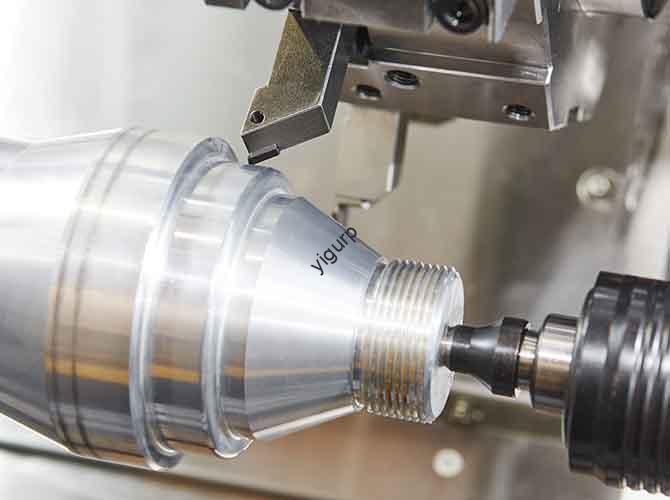
This guide breaks down precision CNC machining in plain English. It’s the go-to solution for complex, high-accuracy parts—from aerospace components to medical implants. We’ll cover how it differs from standard machining, its key technologies, materials, and how to choose the right partner. No pro experience needed—by the end, you’ll know how to use precision CNC to bring your complex designs to life.
How Is Precision CNC Different?
All CNC machining uses computer control. But precision CNC takes accuracy to a higher level. It’s not just about automation—it’s about tight tolerances, smooth surfaces, and consistent results. Standard CNC makes functional parts. Precision CNC makes critical, high-performance components.
Key Differences
| Feature | Standard CNC | Precision CNC |
| Typical Tolerance | +/- 0.1 mm (+/- 0.004″) | +/- 0.01 mm to +/- 0.002 mm |
| Surface Finish (Ra) | 3.2 μm – 1.6 μm | < 0.8 μm – 0.2 μm |
| Cost | Lower | Higher (equipment/tooling/QC) |
| Ideal Use | Prototypes, simple fixtures | Medical implants, aerospace parts |
Expert Insight: Tolerance matters more than you think. A 0.01mm difference (about the thickness of a human hair) can make or break a medical implant or aerospace component. Precision CNC eliminates this risk with consistent accuracy.
What Powers Precision CNC?
Precision doesn’t happen by chance. It comes from an integrated system of high-quality equipment and controlled conditions. Every part works together to deliver accuracy.
Key System Components
- High-Speed Spindles: Rotate at tens of thousands of RPM for finer, more precise cuts.
- Advanced CNC Controls: Use look-ahead algorithms to optimize tool paths and reduce errors.
- Rigid Machine Frames: Made from materials like polymer concrete to cut down vibration.
- In-Process Tools: Tool setters and part probes check accuracy during machining.
- Climate Control: Stable temperatures prevent material expansion/contraction.
Real Case Example: A client once tried to make a precision gear with a standard CNC machine. Vibration caused uneven tooth surfaces, and the gear failed. We used a precision CNC with a rigid frame and climate control—each gear matched the design perfectly, with zero defects.
How Do CNC Axes Work?
The number of axes a CNC machine has determines how complex a part it can make. More axes mean more angles to cut from, unlocking complex shapes.
Axis Types & Capabilities
| Axis Type | Key Capability | Example Features |
| 3-Axis | Machines on a single plane (X/Y/Z axes) | Drilled holes, flat pockets on plates |
| 4-Axis | Adds 1 rotational axis (A-axis) | Helical grooves, engraved cylinders |
| 3+2 Axis (5-Axis) | Positions workpiece for multi-face cuts | Angled bores, beveled edges |
| Simultaneous 5-Axis | All 5 axes move at the same time | Turbine blades, medical implants |
Expert Insight: Simultaneous 5-axis machining is the gold standard for complex parts. It lets you cut curved surfaces in one setup, reducing errors from multiple manual adjustments. For parts like impellers, it’s the only efficient way to get the required precision.
What Materials Work Best?
Precision CNC shines with advanced materials—ones that are strong, durable, but hard to machine. The right material makes your part perform better in tough conditions.
Top Materials for Precision Machining
| Material Type | Examples | Key Traits & Uses |
| Aluminum Alloys | 6061, 7075 | Lightweight, easy to machine; aerospace frames, electronics |
| Stainless Steel | 304, 316 | Corrosion-resistant; medical devices, food equipment |
| Titanium Alloys | Grade 5 Ti-6Al-4V | Strong, biocompatible; aerospace parts, implants |
| Superalloys | Inconel, Hastelloy | Heat-resistant; jet engines, gas turbines |
| High-Performance Plastics | PEEK, Ultem | Chemical-resistant; semiconductor parts, insulators |
How to Achieve Tight Tolerances?
Tight tolerances aren’t just about the machine. They require control over every step of the process. Here’s how to get consistent, accurate results.
5 Steps to Tight Tolerances
- Use a Rigid Machine: A well-maintained precision CNC with minimal backlash is key.
- Choose the Right Tools: Use coated carbide or PCD tools designed for your material. Monitor wear with laser setters.
- Secure Workholding: Custom fixtures prevent movement or vibration during machining.
- Control Temperature: Climate-controlled shops and regulated coolant prevent thermal expansion.
- Skilled Programming: Expert CAM programmers optimize tool paths to reduce deflection and heat.
Case Study: Aerospace Bracket
See how precision CNC solves real-world complex part challenges. This case study shows our process for a critical satellite component.
The Challenge
A client needed a lightweight, strong bracket for a satellite deployment system. It had to be made from Titanium Grade 5, with: – Thin walls (less than 1mm in some areas) – Deep pockets for weight reduction – Complex curved surfaces – Bore holes with +/- 0.005mm tolerance
Our Machining Process
- DFM Review: We analyzed the CAD model and suggested minor corner radius changes to improve tool access. This didn’t affect performance but boosted tool life by 40%.
- Material Sourcing: We used certified Titanium Grade 5 with full traceability (critical for aerospace).
- Process Planning: We used a simultaneous 5-axis machine to minimize setups and avoid tolerance stacking.
- Machining: We used specialized carbide tools and high-pressure coolant to manage heat. Adaptive toolpaths adjusted cutting parameters to prevent thin wall deflection.
- Quality Inspection: A CMM (Coordinate Measuring Machine) verified all features. The bracket met every tolerance, and we delivered a full inspection report.
Result: The client’s satellite deployed successfully, and the bracket performed flawlessly in space. Our precision approach eliminated rework and met their tight deadlines.
How to Choose a Partner?
The right precision CNC partner turns your design into a high-quality part. Use this checklist to evaluate suppliers.
Supplier Evaluation Checklist
| Category | Key Questions to Ask |
| Technology | What CNC machines do you have? What’s your tightest repeatable tolerance? |
| Quality | Are you ISO 9001/AS9100/ISO 13485 certified? Do you have CMM capabilities? |
| Experience | Can you show case studies of similar complex parts? Do you work with my material? |
| Communication | What’s your DFM process? Who will be my single point of contact? |
Yigu Technology’s Perspective
At Yigu Technology, precision CNC machining is more than a service—it’s a strategic solution for complex parts. Our data shows 80% of project delays come from poor supplier selection, not design issues. We invest in state-of-the-art 5-axis machines and climate-controlled facilities to deliver consistent accuracy.
We work closely with clients on DFM to optimize designs for manufacturability. For aerospace clients, we’ve reduced part lead times by 35% using simultaneous 5-axis machining. For medical device makers, we hold tolerances as tight as +/- 0.002mm to meet ISO 13485 standards. Our goal is to turn your most ambitious designs into reliable, high-performance parts.
Conclusion
Precision CNC machining is the key to making complex, high-accuracy parts. It differs from standard CNC in tolerances, surface finish, and repeatability. The number of axes, choice of materials, and process control all play a role in achieving success. By understanding its capabilities and choosing the right partner, you can turn even the most challenging designs into reality. Precision CNC isn’t just a manufacturing method—it’s an enabler of innovation in aerospace, medical, and electronics industries.
FAQ
When do I need precision CNC instead of standard CNC? Choose precision CNC if your part needs tight tolerances (+/- 0.01mm or better), smooth surfaces (Ra < 0.8μm), or is used in critical applications like medical or aerospace.
Is 5-axis machining always better for complex parts? Not always—but it’s the best for parts with curved surfaces or multiple faces. 3+2 axis works well for multi-face parts, while simultaneous 5-axis is ideal for organic shapes like turbine blades.
Can precision CNC machine any material? It works best with advanced materials like titanium, Inconel, and PEEK. These materials are hard to machine with standard methods, but precision CNC handles them with ease.
How much more does precision CNC cost? It’s typically 20-50% more expensive than standard CNC. But the cost is offset by reduced rework, better quality, and suitability for critical applications.
Discuss Your Projects with Yigu Rapid Prototyping
At Yigu Rapid Prototyping, we specialize in precision CNC machining for complex components. With 10+ years of experience in aerospace and medical manufacturing, we have the technology and expertise to bring your designs to life. Whether you need a titanium implant or an aerospace bracket, we’ll work with you from DFM to delivery. Contact us today to discuss your project—we’ll tailor a precision solution that meets your goals.