
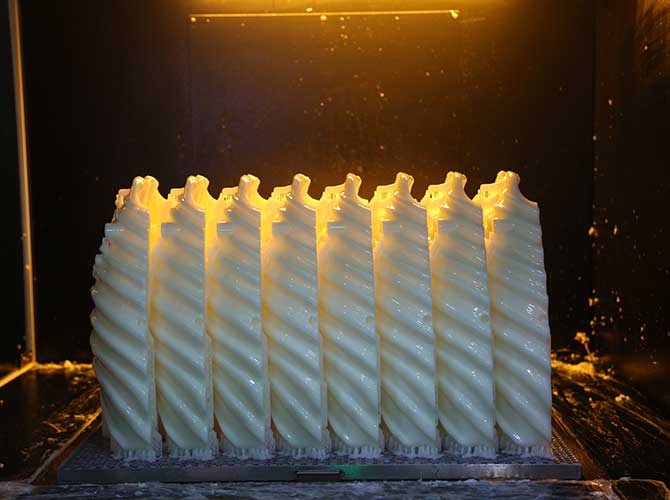
The lighting industry is in the midst of a bright revolution. It’s no longer just about illumination; it’s about smart technology, sustainable design, and unique aesthetics that become the centerpiece of a room. For designers and manufacturers, this creates immense pressure: How do you rapidly innovate, personalize designs, and reduce environmental impact without blowing your budget? The answer is increasingly shining from within a 3D printer.
3D printed prototypes have become the secret weapon for leading lighting brands. They transform abstract concepts into tangible, testable models in days, not weeks. This guide cuts through the hype to show you exactly how this technology solves real-world problems—saving time, cutting costs, unlocking radical designs, and paving the way for a more sustainable future. We’ll walk through the key applications with concrete data and case studies, so you can see precisely how to integrate it into your own workflow.
Why is Speed and Precision the #1 Game-Changer?
In lighting, a millimeter can be the difference between a flawless fixture and a faulty one. A shade that doesn’t align perfectly with its housing, or a bracket that’s a hair too loose, can ruin a design. Traditional prototyping—hand-carving, machining, or basic molding—is often too slow and imprecise to catch these issues early.
How Does 3D Printing Achieve Unmatched Accuracy?
Technologies like SLA (Stereolithography) and DLP (Digital Light Processing) use lasers or projectors to cure liquid resin layer by layer with incredible precision. This allows for tolerances as tight as ±0.1 mm, a level that manual methods simply can’t match consistently. This precision is critical for:
- Optical component testing: Prototyping lenses and diffusers to precisely control light distribution and beam angles.
- Electronics integration: Ensuring perfect fits for LED boards, drivers, and wiring channels within complex housings.
- Snap-fit assemblies: Creating interlocking parts that work perfectly on the first try, eliminating post-assembly adjustments.
Let’s look at the tangible impact on your bottom line and timeline:
| Aspect | Traditional Prototyping (e.g., CNC/Machining) | 3D Printing (SLA/DLP) | Improvement |
|---|---|---|---|
| Typical Lead Time | 7-14 business days | 1-3 business days | ~80% faster |
| Cost per Prototype | $300 – $800+ | $80 – $200 | 65-75% savings |
| Achievable Precision | ±0.5 mm | ±0.1 mm | 5x more accurate |
| Design Flexibility | Limited by tool paths | Virtually unlimited | Complex geometries are easy |
Real-World Case: A US-based designer of high-end architectural sconces used to outsource machined aluminum prototypes, costing $650 each with a 2-week wait. By bringing SLA 3D printing in-house, they now produce functional resin prototypes for $95 in 48 hours. This allowed them to test five subtle design variations of a mounting bracket in the time it used to take for one, leading to a final product with a more secure and elegant installation.
How Can You Slash Your Time-to-Market?
Lighting trends evolve at the speed of social media. What’s hot in minimalist, warm lighting one season shifts to bold, color-changing smart fixtures the next. If your prototyping cycle is slow, you’ll miss the market window.
What Does a “Rapid Iteration” Workflow Look Like?
3D printing enables a true agile design process. Imagine this:
- Monday: Your team finalizes a CAD model for a new pendant light.
- Tuesday: The file is sent to the 3D printer overnight.
- Wednesday: You have a physical prototype in hand for an internal review. You discover the cord opening is slightly too narrow.
- Wednesday afternoon: You modify the CAD file in 30 minutes and start a new print.
- Thursday: Version 2 is ready. You can now present a refined model to a key retail buyer or use it for a focus group.
This compressed feedback loop is invaluable. A 2023 industry report found that companies using 3D printing for prototyping reduced their overall product development cycles by an average of 40-60%. For a lighting startup, this could mean launching a trend-aligned product in 3 months instead of 6, capturing crucial early market share.
Is Mass Customization Finally Feasible for Lighting?
Consumers no longer want a cookie-cutter lamp from a big-box store. They want a personalized piece that fits their exact space and style. Traditional manufacturing, with its expensive molds and setup, makes single-unit or small-batch production financially impossible. 3D printing flips this model on its head.
What Are the Real Applications for Custom Lighting?
- Direct Consumer Customization: Online platforms can allow customers to adjust parameters—like the height of a floor lamp, the pattern on a shade, or the text on a base—and receive a prototype-proof visualization that is immediately manufacturable. No new tooling required.
- Bespoke Architectural Projects: Contract lighting for hotels, restaurants, or luxury homes often requires unique sizes and forms. Instead of costly one-off fabrication, designers can 3D print a prototype to confirm scale and aesthetics, then print the final series using the same digital file.
- Functional Personalization: Creating prototypes for assistive lighting, like a desk lamp with a bespoke clamp designed for a specific wheelchair or table thickness.
Example from the Field: A European lighting studio landed a contract to design signature wall lights for a boutique hotel chain. Each of the 12 locations wanted a variation of the core design to reflect local art. Using 3D printing, they produced 12 unique prototype sets for approval at a fraction of the cost of traditional methods, securing a lucrative contract that would have been unprofitable otherwise.
What Design Frontiers Does 3D Printing Unlock?
Forget the limitations of milling bits and injection molds. Additive manufacturing builds objects layer by layer, meaning complexity is free. This liberates designers to explore forms that were previously too expensive or impossible to prototype.
Which “Impossible” Designs Are Now Possible?
- Organic, Nature-Inspired Structures: Think of lamp bodies that mimic twisting vines, coral, or honeycombs. These shapes are incredibly strong, lightweight, and create captivating light and shadow play. A famous example is the continued success of designers like Lindsey Adelman, whose branching forms are ideally suited to 3D printing processes.
- Integrated Components: Prototype a single assembly that combines the light housing, heat sink fins, and cable management channel as one unified part. This reduces assembly time and can improve thermal performance.
- Advanced Light Guides and Diffusers: Print prototypes with internal lattice structures or graded transparency to engineer light in entirely new ways, achieving softer shadows or specific illumination patterns without additional components.
Technical Deep Dive: The key here is Generative Design and Topology Optimization. Software can now create a design based on specific goals (e.g., “use the least material to support this weight” or “maximize heat dissipation”). The resulting organic, optimized shapes are often only producible via 3D printing. Prototyping these algorithmically-generated forms is essential to validate their real-world performance.
Can Prototyping Really Be Sustainable?
The modern consumer is eco-conscious. A 2024 study showed over 60% of buyers are influenced by a company’s environmental stance. Traditional subtractive prototyping (carving from a block) can waste over 50% of the raw material as chips and shavings. 3D printing, as an additive process, uses only the material that ends up in the final part, with typical waste below 10%.
How Do You Build a Greener Prototyping Process?
- Material Choice: Use bio-based resins (like certain PLA blends) or recyclable powder materials. Some companies now offer resin recycling programs.
- Waste Reduction: The inherent efficiency of additive manufacturing slashes material waste from the start. Support structures, often necessary, can be designed to be minimal and are sometimes recyclable.
- Supply Chain Simplification: Printing prototypes in-house or locally reduces the carbon footprint associated with shipping heavy machined parts across the globe.
Sustainability in Action: A Scandinavian lighting brand made sustainability its core identity. By adopting 3D printing for all prototyping and using plant-based resins, they reduced their prototype-related waste by 85%. This fact became a powerful marketing point, featured prominently in their product storytelling and helping them secure placements in eco-focused design stores.
Conclusion
The application of 3D printed prototypes in lighting is far more than a technical novelty; it’s a fundamental shift in how products are born. It empowers designers with unprecedented speed and freedom, enables manufacturers to respond to trends and personalize at scale, and aligns the industry with crucial sustainability goals. The barriers—cost, capability, and complexity—have fallen. The question for lighting professionals is no longer if they should adopt this technology, but how quickly they can integrate it to illuminate their path to innovation and market success.
FAQ: 3D Printed Lighting Prototypes
Are 3D printed prototypes strong enough for functional testing of a hanging light fixture?
Yes, with the right material. For functional testing of load-bearing components (like a pendant cord housing), engineers use engineering-grade resins (e.g., ABS-like or PC-like resins) or even sintered nylon (SLS). These materials can be specified to simulate the strength and heat resistance of final production plastics, allowing for robust mechanical and thermal testing.
What file format do I need to provide for a 3D printed lighting prototype?
The standard and most reliable format is .STL or .OBJ. For models requiring color texture (like a patterned shade), a .VRML or .OBJ with an accompanying texture map (MTL file) is used. Always ensure your CAD model is “watertight” (manifold) with no gaps or errors in the mesh before exporting.
Can the surface finish of a 3D printed prototype mimic final production materials like glass or brushed metal?
Absolutely. While the base print may have a characteristic finish (matte for resin, slightly granular for powder), post-processing techniques can achieve stunning results. Prototypes can be sanded, polished, vapor-smoothed, and painted. For metallic finishes, electroplating or high-quality metallic spray paints are used. A 3D printed resin prototype can be finished to look like polished brass, anodized aluminum, or frosted glass for photorealistic marketing samples.
Is it cost-effective for very large lighting prototypes, like a large chandelier?
It depends. Printing a single, massive piece can be expensive and prone to warping. The standard industry approach is to design for assembly. Prototype the chandelier as multiple modular components (arms, center hub, shades) that are printed separately and assembled. This is more cost-effective, allows for testing of individual parts, and accurately reflects the final manufacturing plan.
Illuminate Your Next Design with Yigu Rapid Prototyping
Navigating the intersection of stunning design and feasible manufacturing is the core challenge in modern lighting. At Yigu, we partner with lighting innovators to bridge that gap. Our expertise isn’t just in operating printers; it’s in understanding lighting-specific requirements—from optical clarity and heat management to aesthetic finishes and regulatory compliance.
We provide a full spectrum of 3D printing technologies (SLA, DLP, SLS) to match your prototype’s need: speed, detail, strength, or transparency. Let us help you turn your bright idea into a tangible, testable reality faster than you thought possible.
Ready to prototype smarter? Contact Yigu today for a confidential consultation and a quote on your next lighting project.