
Introduction
In the realm of precision manufacturing, milling and turning stand as two foundational machining processes. Each plays an irreplaceable role in shaping raw materials into functional components. Whether you are a seasoned manufacturing engineer, a production manager deciding on process selection, or a technical enthusiast exploring machining technologies, understanding the nuances of these two processes is critical. This knowledge helps you optimize production efficiency, ensure part quality, and control costs. This guide delves deep into the core of milling and turning, covering their basic principles, CNC-driven advancements, similarities, key distinctions, and real-world applications. By the end, you will have a comprehensive grasp of how to leverage these processes effectively in your specific manufacturing scenarios.
1. What Are the Basics of Milling and Turning?
Before diving into complex comparisons, it is essential to establish a solid foundational understanding of what milling and turning are and how they work.
What is Turning?
Turning is a machining process that involves rotating the workpiece while a stationary cutting tool removes material from the workpiece’s surface. The primary goal of turning is to create cylindrical or conical shapes, though it can also produce features like threads, grooves, and chamfers.
- Core Principles & Equipment: The key equipment for turning is a lathe, which can be manual or CNC. The workpiece is clamped in a chuck or collet on the lathe, which rotates it at a controlled speed. The cutting tool, mounted on a tool post, moves linearly to feed into the workpiece and remove material.
- Real-World Case: A leading automotive parts manufacturer uses turning to produce crankshafts. This critical rotating component requires precise cylindrical surfaces to ensure smooth engine operation. By using a high-speed lathe, the manufacturer achieves a consistent diameter tolerance of ±0.005 mm across thousands of units per batch.
- Key Facts & Data: Typical turning speeds range from 50 to 5000 RPM, depending on the material. For example, aluminum is turned at 1000–5000 RPM, while steel is turned at 50–500 RPM. The surface finish achievable with turning is typically Ra 0.8–3.2 μm.
What is Milling?
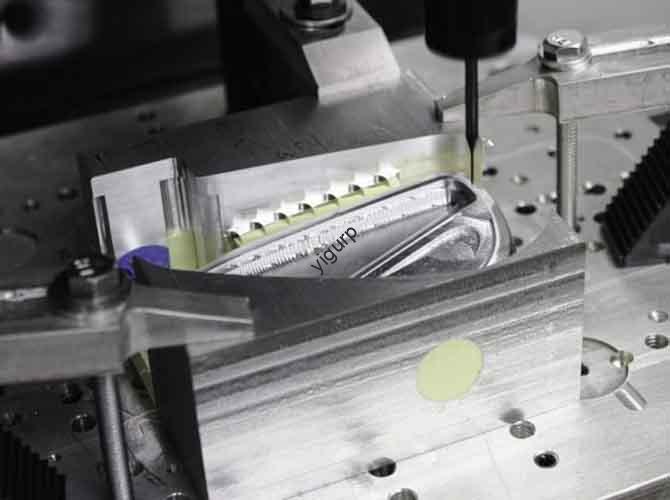
Milling is a versatile machining process where a rotating cutting tool with multiple cutting edges removes material from the workpiece. Unlike turning, the workpiece is typically stationary or moves in a controlled manner relative to the rotating tool. Milling excels at creating flat surfaces, grooves, slots, complex contours, and 3D shapes.
- Core Principles & Equipment: The primary equipment is a milling machine, which can be vertical, horizontal, or CNC. The cutting tool, such as an end mill or face mill, is mounted on a spindle that rotates at high speed. The workpiece is secured on a worktable that moves along the X, Y, and Z axes to position the material relative to the tool.
- Real-World Case: An aerospace component supplier uses milling to produce wing rib components for commercial jets. These ribs have complex curved contours and multiple slots. By employing a 5-axis CNC milling machine, they machine the ribs from a single block of aluminum alloy, achieving a contour tolerance of ±0.01 mm and eliminating the need for assembly of multiple parts.
- Key Facts & Data: Milling spindle speeds typically range from 100 to 10,000 RPM, with high-speed milling reaching up to 50,000 RPM. The surface finish achievable with milling is generally Ra 1.6–6.3 μm.
2. What Are the Key Similarities Between Milling and Turning?
While milling and turning have distinct characteristics, they share several core similarities that make them foundational to manufacturing.
- Material Removal Principle: Both processes use cutting tools to remove excess material from a workpiece to achieve the desired shape and dimensions. This classifies them as subtractive manufacturing, the most widely used method for metal components.
- Dependence on Cutting Tools: Both require high-quality cutting tools tailored to the workpiece material. Tool geometry, coating, and sharpness directly impact part quality and process efficiency. This drives the development of advanced cutting tool technologies like diamond-coated tools and ceramic tools.
- Role in Manufacturing Workflows: Both are often used in sequential workflows to produce complete parts. For example, a part may undergo turning to create a cylindrical base, followed by milling to add flat surfaces or slots.
- CNC Integration Capability: Both can be fully automated with CNC technology, enabling precision control, repeatability, and integration with other manufacturing systems like CAD/CAM software and robotics.
3. What Are the Key Distinctions Between Milling and Turning?
The primary differences between milling and turning lie in their cutting action, workpiece and tool movement, capabilities, and ideal applications.
| Comparison Aspect | Turning | Milling |
|---|---|---|
| Cutting Action | Workpiece rotates; cutting tool is stationary (linear movement only). | Cutting tool rotates; workpiece moves (or is stationary with tool moving in multiple axes). |
| Primary Shapes Produced | Cylindrical, conical, threads, grooves (rotational symmetry). | Flat surfaces, slots, contours, 3D shapes (non-rotational symmetry). |
| Tool Type | Single-point cutting tools. | Multi-point cutting tools. |
| Cutting Continuity | Continuous cutting. | Intermittent cutting. |
| Precision Range | Higher precision (IT7–IT8) and better surface finish for rotational parts. | Good precision (IT8–IT9) with variable surface finish. |
| Ideal Batch Size | High-volume production for repeatable rotational parts. | Both low-volume and high-volume for non-rotational parts. |
| Cost | Lower setup cost; faster cycle times for rotational parts. | Higher setup cost, especially for 5-axis; more versatile. |
CNC Turning Distinctions
In CNC turning, the workpiece’s rotation is the primary motion, with the cutting tool moving along the length and radius. This creates rotational symmetry, which is critical for parts like shafts and bushings. Single-point tools generate less vibration than multi-point tools, leading to smoother surface finishes. CNC turning can also perform internal turning (boring) to create holes and internal threads.
CNC Milling Distinctions
In CNC milling, multi-axis movement enables machining of parts with complex geometries that cannot be produced with turning. For example, a turbine blade’s curved airfoil requires 5-axis milling. While intermittent cutting can cause tool wear, it also allows for better chip evacuation. Milling can produce flat, curved, and contoured surfaces in a single setup.
4. Application Guidelines: When to Choose Turning vs. Milling?
Selecting between milling and turning depends on several key factors: part geometry, material, precision requirements, batch size, and cost.
When to Choose Turning
Turning is the optimal choice when your part has rotational symmetry or requires high precision for cylindrical features. Key scenarios include:
- Rotational Parts: Shafts, pins, bushings, nuts, bolts, crankshafts, and camshafts.
- High-Volume Production: Turning has faster cycle times for rotational parts, making it cost-effective for large batches of 1000 or more units.
- Internal Machining Needs: Parts requiring precise holes, internal threads, or internal grooves, such as hydraulic cylinders and pipe fittings.
- High Surface Finish for Rotational Features: Parts like motor shafts that require smooth surfaces to reduce friction and wear.
Example Scenario: A fastener manufacturer producing M10 bolts in batches of 100,000 uses CNC turning. The process ensures consistent thread pitch and diameter tolerance with a cycle time of just 10 seconds per bolt.
When to Choose Milling
Milling is preferred for non-rotational parts, complex geometries, or parts requiring multiple surface features. Key scenarios include:
- Non-Rotational Parts: Enclosures, brackets, gears, turbine blades, and mold cavities.
- Complex 3D Shapes: Parts with undercuts, curved surfaces, or multiple features like holes, slots, and contours that cannot be produced with turning.
- Low-Volume, Custom Parts: Milling’s versatility makes it cost-effective for prototypes or small batches of 1 to 100 units.
- Flat Surface Machining: Parts requiring precise flat surfaces, such as engine blocks and machine bases, benefit from milling’s ability to produce large, flat areas.
Example Scenario: An aerospace prototype shop needs to produce five custom turbine blade prototypes. The blades have complex curved airfoils and multiple holes. 5-axis CNC milling is used to machine each blade from a single block of Inconel, achieving precise shaping that would be impossible with turning.
Conclusion
Milling and turning are the two foundational processes of precision machining. While turning excels at creating cylindrical parts with high precision and efficiency, milling offers unparalleled versatility for complex, non-rotational geometries. Understanding their key differences—from cutting action and tool type to ideal applications and batch sizes—is essential for selecting the right process for any manufacturing project. By leveraging the strengths of each, and even combining them in modern mill-turn centers, manufacturers can produce a vast range of high-quality components efficiently and cost-effectively.
FAQ
What is the main difference between milling and turning?
The main difference lies in the cutting action. In turning, the workpiece rotates while the tool moves linearly, making it ideal for cylindrical parts. In milling, the cutting tool rotates while the workpiece moves, making it suitable for flat surfaces, slots, and complex 3D shapes.
Can a part be processed using both milling and turning?
Yes, many complex parts require both processes. For example, a gear shaft may undergo turning to create the cylindrical shaft and then milling to cut the gear teeth. Modern mill-turn centers can perform both operations in a single setup, improving accuracy and reducing cycle time.
Which process is more precise: milling or turning?
Turning typically offers higher precision (IT7–IT8) and a better surface finish for rotational parts. Milling provides good precision (IT8–IT9) for non-rotational parts, and high-speed milling can narrow this gap for certain applications.
How do I choose between milling and turning for my part?
Start by evaluating your part’s geometry. If it has rotational symmetry, like a shaft or bushing, choose turning. If it is non-rotational or has complex features, like a bracket or turbine blade, choose milling. Also, consider your batch size, with turning being more cost-effective for high-volume, rotational parts.
Discuss Your Projects with Yigu Rapid Prototyping
Are you trying to decide between milling and turning for your next project? At Yigu Rapid Prototyping, our team of experienced engineers can help you select the optimal process based on your part’s geometry, material, and production requirements. We have extensive expertise in both CNC milling and CNC turning, and we can provide solutions ranging from single prototypes to high-volume production runs.
Contact Yigu Rapid Prototyping today to discuss your project. Let’s build something great together.