
Introduction
If you have ever wondered how metal parts, plastic components, or even intricate aerospace parts are made, you are likely curious about machining. Machining is the backbone of manufacturing, but with so many machining types available, it is easy to feel overwhelmed. Whether you are a hobbyist looking to start a small workshop, a manufacturing student studying for exams, or a professional needing to choose the right process for a project, this guide will break down every key machining category. We will include real-world examples, practical tips, and clear comparisons to help you make informed decisions.
1. Conventional Machining Processes: The Foundation of Manufacturing
Conventional machining is the oldest and most widely used set of techniques. These processes rely on physical contact between a cutting tool and the workpiece to remove material, which is a process called chip formation. These methods are ideal for simple to moderately complex parts and are often the most cost-effective for low-to-medium volume production.
Key Conventional Machining Techniques
- Turning: Done on a lathe, turning spins the workpiece while a single-point cutting tool shapes it. It is perfect for creating cylindrical parts like bolts, shafts, or pipes. A local automotive shop, for example, uses a lathe to repair worn-out crankshafts. By spinning the crankshaft and removing a thin layer of metal, they can restore its original diameter and smoothness.
- Milling: Using a mill, this process rotates a multi-point cutting tool, like an end mill, against a stationary workpiece. It is used for creating flat surfaces, slots, or complex 3D shapes. According to the Manufacturing Technology Association (MTA), over 60% of small-scale machine shops rely on vertical mills for prototyping parts.
- Drilling: The simplest conventional process, drilling creates holes using a rotating drill bit. It is used in everything from woodworking to metal fabrication. For deep holes, more than three times the hole’s diameter, a useful technique is “peck drilling.” This involves pausing and retracting the bit periodically to clear chips and prevent overheating.
- Grinding: Often used as a finishing step, grinding uses an abrasive wheel to smooth surfaces or achieve very tight tolerances. It is critical for parts like bearing races, where the surface finish directly impacts performance.
When to Choose Conventional Machining
Conventional processes are the best choice when you are working with common materials like aluminum, steel, or brass. They are also ideal when production volumes are low to medium, ranging from 1 to 1,000 parts, and when cost is a primary concern, as conventional machines are often cheaper to purchase and maintain than advanced alternatives.
2. Non-Traditional Machining (NTM): Beyond Cutting Tools
Non-Traditional Machining (NTM) processes do not rely on physical cutting tools. Instead, they use other forms of energy—such as electricity, lasers, water, or chemicals—to remove material. These methods are essential for hard-to-machine materials like titanium or ceramics, or for creating intricate parts where conventional tools would cause damage.
| Machining Type | How It Works | Ideal Applications | Key Advantage |
|---|---|---|---|
| EDM (Electrical Discharge Machining) | Uses electrical sparks to melt and erode material. | Intricate molds, dies, or parts with tiny holes. | No physical contact, which avoids distorting fragile parts. |
| ECM (Electrochemical Machining) | Uses a chemical reaction to dissolve material. | Large, complex parts like turbine blades. | No heat and no tool wear, making it ideal for high-tolerance parts. |
| Laser Cutting | Uses a high-powered laser to vaporize material. | Thin metal sheets, signage, or precision components. | Extremely fast for thin materials and produces minimal waste. |
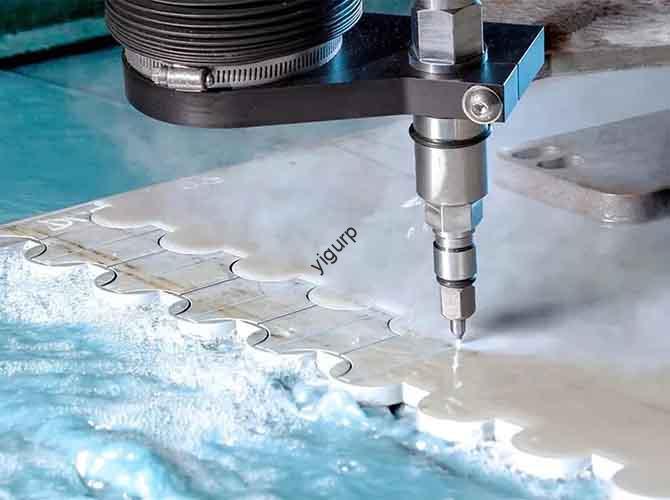
| Waterjet Cutting | Uses high-pressure water, often with abrasives. | Thick materials like wood, stone, or metal, and heat-sensitive parts like plastics. | Creates no heat-affected zone (HAZ). |
| Ultrasonic Machining | Uses high-frequency vibrations combined with an abrasive slurry. | Hard, brittle materials like glass and ceramics. | A gentle process that prevents cracking. |
Real-World Case Study: A medical device manufacturer uses ECM to produce titanium hip implants. Titanium is very strong but difficult to machine with conventional tools. ECM creates smooth, precise surfaces that reduce friction in the body, which is critical for the implant’s long-term success.
3. Abrasive Machining Processes: Precision Finishing for Quality Surfaces
Abrasive machining focuses on improving surface finish and dimensional accuracy. It is often the final step in manufacturing to ensure parts meet strict standards. Unlike conventional machining, which removes large amounts of material, abrasive processes remove tiny amounts, sometimes just a few microns, to refine the surface.
- Honing: This uses a rotating abrasive stone to smooth the inside of holes, like engine cylinders. Automotive manufacturers use honing to create crosshatched patterns in cylinder walls. These patterns hold oil, which reduces friction between the piston and the cylinder.
- Lapping: This is a slow, precise process that uses a flat lap plate and an abrasive paste to create ultra-flat surfaces. It is used for optical lenses, semiconductor wafers, and precision bearings. Lapping can achieve surface finishes as smooth as 0.025 microns, which is thinner than a human hair.
- Polishing and Buffing: Polishing uses fine abrasives to remove scratches, while buffing uses soft cloth wheels to create a shiny, reflective finish. These are common on consumer goods like stainless steel appliances.
- Superfinishing: Even more precise than honing, superfinishing uses a small abrasive stone to remove microscopic irregularities. It is critical for parts like gears or camshafts, where extreme smoothness reduces wear and noise.
4. CNC and Automated Machining: The Future of Precision
CNC (Computer Numerical Control) machining uses computers to control machine tools, replacing manual operation. It has revolutionized manufacturing by increasing speed, precision, and consistency, especially for high-volume or complex parts.
- CNC Milling: A computer-controlled mill can create complex 3D shapes, slots, and holes. A drone manufacturer, for example, uses a 5-axis CNC mill to produce lightweight aluminum frames. The 5-axis machine can move the workpiece in five directions, allowing for complex shapes that a standard 3-axis mill cannot achieve.
- CNC Turning: Similar to manual turning but computer-controlled, this is used for high-volume cylindrical parts like bolts and fasteners. CNC turning centers can produce parts 2 to 3 times faster than manual lathes, with error rates below 0.1%.
- Machining Centers: These are all-in-one machines that combine milling, drilling, and tapping. They often include features like pallet changers to swap workpieces automatically and robotic loading arms to load and unload parts without human help.
- CAD/CAM Integration: CAD (Computer-Aided Design) software creates 3D models, while CAM (Computer-Aided Manufacturing) software converts these models into machine-readable code. This seamless workflow eliminates manual programming errors and saves time.
Conclusion
The world of machining types is vast and varied, but understanding the core categories is the first step to choosing the right process for any project. Conventional machining remains the workhorse for simple parts and low volumes. Non-traditional machining opens up possibilities for hard materials and intricate designs. Abrasive processes provide the final touch of precision and surface quality. And CNC automation delivers the speed, consistency, and complexity required for modern high-volume manufacturing. By understanding the strengths of each, you can make informed decisions that balance cost, quality, and efficiency.
FAQ
What is the difference between conventional and non-traditional machining?
Conventional machining uses physical cutting tools to remove material, like in turning or milling. Non-traditional machining uses other forms of energy, such as lasers, electricity, or chemicals, with no direct contact between the tool and the workpiece. Conventional is generally cheaper for simple parts, while NTM is better for hard materials or very intricate designs.
When should I use CNC machining instead of manual machining?
You should use CNC machining if you need very high precision with tolerances less than ±0.001 inches, if you have a high production volume of 100 parts or more, or if your parts have complex 3D shapes. Use manual machining for very small batches of 1 to 10 parts or for simple tasks like drilling a few holes.
Which abrasive process is best for improving surface finish?
The best process depends on the part. Use honing for the inside of holes, lapping for ultra-flat surfaces like optical lenses, superfinishing for microscopic precision on parts like gears, and polishing for creating a shiny, decorative finish.
Is non-traditional machining more expensive than conventional machining?
Yes, the upfront cost is usually higher. NTM machines like laser cutters or EDM equipment cost more than manual lathes or mills. However, for very hard materials or complex parts, NTM can save money in the long run by reducing tool wear and the need for rework.
Discuss Your Projects with Yigu Rapid Prototyping
Are you ready to choose the best machining process for your next project? At Yigu Rapid Prototyping, we have extensive experience with all the major machining types. From conventional milling and turning to advanced 5-axis CNC and EDM, our team can help you select the most efficient and cost-effective method for your specific needs.
Contact Yigu Rapid Prototyping today to discuss your project. Let’s build something great together.