
Introduction
In the world of modern manufacturing, from the precision components in aerospace to the core parts in automotive engines and the microstructures in medical devices, machining operations are indispensable and pivotal. Whether it is mass production in a traditional factory or customized processing in high-end manufacturing, your ability to accurately master various processing technologies, optimize process parameters, and integrate them into automation systems directly determines product quality, production efficiency, and market competitiveness. This article will start from basic processing technology and gradually delve into advanced techniques, parameter optimization, automation applications, and industry practices. Using real cases, professional analysis, and practical tips, it will help you thoroughly understand the core logic and practical application of machining operations. Whether you are a manufacturing engineer, a technical manager, or a learner in a related field, you will find ideas for solving practical problems here.
1. Basic Processing Technology: The Core Application and Selection Logic of Traditional Machining Methods
Traditional machining methods are the cornerstone of all machining operations. After a hundred years of development, processes like turning, milling, drilling, grinding, boring, and planing still dominate in all walks of life. Their core principle is the same: removing excess material through the relative movement of a tool against a workpiece. However, they differ significantly in their applicable scenarios, achievable machining accuracy, and efficiency.
| Processing Technology | Core Principles | Typical Application Scenarios | Machining Accuracy (IT grade) | Surface Roughness (Ra/μm) | Key Selection Points |
|---|---|---|---|---|---|
| Turning | The workpiece rotates, and the tool feeds in a straight line. | Shaft and disc parts (e.g., motor shafts, gear blanks). | IT6-IT9 | 1.6-6.3 | Preferred when rotational accuracy is critical; suitable for batch processing. |
| Milling | The tool rotates, and the workpiece moves. | Flat surfaces, grooves, complex contours (e.g., machine beds, housings). | IT7-IT10 | 3.2-12.5 | More efficient for multi-sided machining or complex shapes. |
| Drilling | The tool rotates and feeds to create a round hole. | Through holes, blind holes (e.g., bolt holes, oil passages). | IT10-IT13 | 6.3-25 | The lowest-cost method for creating holes; deep holes require careful chip evacuation. |
| Grinding | An abrasive wheel rotates at high speed to remove material delicately. | High-precision surfaces (e.g., bearing rings, guide rails). | IT5-IT7 | 0.1-1.6 | Used as a finishing process when high surface quality or dimensional accuracy is needed. |
| Boring | The tool rotates, or the workpiece rotates, to enlarge an existing hole. | Large-diameter holes, high-precision holes (e.g., engine cylinders, machine tool spindle holes). | IT6-IT8 | 0.8-3.2 | Prioritized when the positional accuracy of a hole is critical; suitable for box-type parts. |
| Planing | The tool moves in a straight line, back and forth. | Planes, grooves (e.g., rail faces, keyways). | IT8-IT11 | 6.3-25 | A lower-cost option for small-batch production or simple shapes. |
Real-World Case: An auto parts factory producing engine crankshafts perfectly demonstrates the synergy of these basic processes. First, turning is used for roughing the outer circle and end face, removing most of the excess material. Next, drilling creates the oil holes, and milling cuts the keyways. Finally, the outer circle and journals are finished with grinding to achieve IT6 level accuracy and a surface roughness of Ra≤0.8μm, meeting the wear resistance requirements for high-speed rotation. The key takeaway is that these basic processes are not used in isolation but in a “divided and cooperative” manner, with roughing processes prioritizing efficiency and finishing processes focusing on accuracy.
2. Advanced and Special Processing Technology: Solutions for High-Precision and Complex Scenarios
As manufacturing demands increase for product precision, material adaptability, and processing efficiency, traditional methods can fall short. This is where advanced technologies like CNC machining, EDM, laser machining, ultrasonic machining, five-axis machining, additive manufacturing, and hybrid machining become essential.
Core Advantages of Advanced Processing Technologies
- CNC Machining: This is the “intelligent upgrade” of traditional processes. By controlling machine tools with computer programs, it offers high precision, high repeatability, and flexible production. A precision machinery factory, for example, uses CNC lathes to machine smartphone frames. Through G-code programming, they achieve automatic feeding, tool changes, and inspection, holding dimensional errors to ±0.005mm in mass production—an efficiency more than three times higher than ordinary lathes.
- Electrical Discharge Machining (EDM) : This process uses electrical sparks between an electrode and the workpiece to remove material. It is ideal for machining hard materials like cemented carbide and hardened steel, and is commonly used for mold cavities and micro-holes.
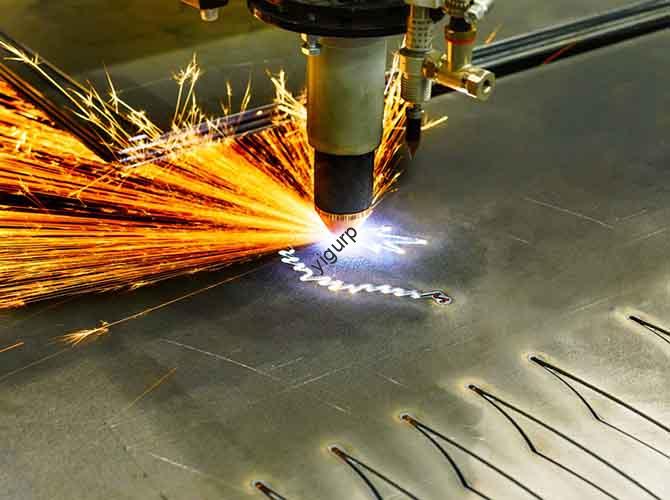
- Laser Machining: Using a high-energy laser beam as a “tool,” it enables non-contact processing for cutting, welding, and marking. In aerospace, laser cutting is used for titanium alloy sheets, producing clean cuts with no thermal deformation at speeds five times faster than traditional methods.
- Five-Axis Machining: With linkage movement in five directions, it can process complex curved parts like impellers and turbine blades in a single setup, avoiding errors from multiple clampings.
- Additive Manufacturing and Hybrid Machining: Additive manufacturing builds parts layer by layer. Hybrid machining combines this with subtractive techniques, like 3D printing a blank and then CNC milling it to final precision. A medical device company uses this to produce personalized implants, first creating blanks via metal 3D printing and then optimizing the surface with CNC milling.
3. How to Balance Efficiency, Quality, and Cost with Process Parameters and Optimization?
The central challenge in machining is balancing “efficiency, quality, and cost.” Factors like cutting parameters, tool selection, coolant and lubrication, and process optimization and simulation directly determine where this balance lies.
Optimization of Key Process Parameters
- Cutting Parameters: These include cutting speed (Vc), feed rate (F), and depth of cut (ap). The optimization principle is “ensure quality first, then improve efficiency.” For example, when machining 45 steel, a cutting speed of 100-150 m/min is typical. For titanium alloys, this drops to 30-50 m/min to protect the tool.
- Tool Selection and Geometry: The tool material and geometry must match the workpiece. Carbide tools are preferred for steel, diamond (PCD) tools for aluminum alloys, and cubic boron nitride (CBN) tools for superalloys.
- Coolant and Lubrication: The core function of coolant is to reduce cutting temperature, lubricate the cut, and flush away chips. Emulsion (water-based) is used for rough turning and milling, while cutting oil (oil-based) is preferred for finishing operations like precision turning and grinding.
Process Optimization and Simulation: Modern software can simulate the machining process, predicting cutting forces, temperature distribution, and tool wear in advance, significantly reducing trial-cutting costs. An aerospace company used Deform simulation software for titanium alloy parts, identifying that original parameters caused excessive vibration. After adjusting the feed and speed, they reduced machining errors from 0.1mm to 0.03mm and saved over $200,000 by cutting the number of trial runs from five to one.
4. Automation and Intelligent Processing: The Core Trend in Modern Manufacturing
With the advancement of Industry 4.0, automation and intelligent processing are key to improving competitiveness. Technologies like machining centers, flexible manufacturing systems (FMS) , industrial robots, the Internet of Things (IoT) , adaptive control systems, and digital twins are enabling unmanned, adaptive, and predictable machining processes.
- Machining Centers and Flexible Manufacturing Systems (FMS) : An auto parts factory introduced an FMS to produce gearbox housings. The system, comprising three five-axis machining centers, two industrial robots, and an intelligent conveyor line, can automatically switch between five different housing models. Production time per piece dropped from 40 minutes to 15, operators were reduced from 12 to 2, and the qualification rate rose from 95% to 99.5%.
- Industrial Robots: Robots are used for repetitive tasks like loading/unloading workpieces, welding, grinding, and inspection, especially in harsh environments.
- IoT and Intelligent Monitoring: Sensors on machine tools collect real-time data on cutting force, temperature, and vibration. This enables real-time warnings for abnormal conditions, full data traceability for quality control, and efficiency analysis to optimize production scheduling.
- Adaptive Control Systems and Digital Twins: Adaptive control systems automatically adjust cutting parameters based on real-time data to maintain quality. Digital twins create a virtual replica of the machining system, allowing processes to be simulated and optimized, and failures to be predicted, without占用 physical machines.
5. Industry Applications and Material Processing: Solutions for Different Scenarios
The key to successful machining operations is “adapting to local conditions.” The needs of different industries and materials vary greatly.
- Aerospace: Parts are often made of difficult-to-machine materials like titanium alloys and require IT5-level accuracy and Ra≤0.4μm surface finish. Solutions include five-axis machining, high-pressure coolant, CBN tools, and digital twin technology.
- Automotive: High-volume production of engine parts demands efficiency, stability, and low cost. Flexible manufacturing systems, high-speed cutting for roughing, grinding for finishing, and robots for loading/unloading are common solutions.
- Medical Devices: Microstructures and biocompatibility are key. This requires micro-machining technologies (micro-milling, laser processing), cleanroom environments, and materials like medical-grade stainless steel and titanium alloys with post-processing passivation.
Conclusion
Machining operations are the fundamental processes that shape our world, from the largest machine tools to the smallest medical implants. Mastering them requires a journey from understanding basic techniques like turning and milling, to leveraging advanced technologies like five-axis CNC and EDM, and finally to integrating them into intelligent, automated systems. The future of machining is data-driven and intelligent, where success depends not just on operating a machine, but on strategically combining process knowledge, material science, and automation to create customized, high-quality solutions.
FAQ
How do I quickly choose the right machining process for my part?
First, define three core elements: the part structure (e.g., shaft parts favor turning, complex surfaces favor five-axis), the material characteristics (e.g., hard materials may require EDM), and the required precision (e.g., IT6 and above likely needs grinding). Then, use a process selection guide, like the table in this article, and consider your cost budget.
What are some simple tips for optimizing cutting parameters?
For roughing, prioritize increasing the depth of cut to improve efficiency. For finishing, reduce the feed rate to ensure surface quality. When machining soft materials like aluminum, you can increase the cutting speed. For hard materials like steel, you should reduce it. If you encounter sticky tools, try increasing the coolant flow or switching to a specialized tool.
How long is the payback period for investing in automated machining?
This depends heavily on your production scale and industry. For high-volume industries like automotive and electronics, the return on investment is typically 1-2 years. For low-volume, highly customized industries like aerospace, the payback period can be 3-5 years, but automation significantly reduces error costs and labor expenses in the long term.
How can small and medium-sized enterprises introduce intelligent processing on a low budget?
You don’t need to do it all at once. Implement it in stages. First, introduce a CNC machining center to replace ordinary machine tools. Second, install sensors on key equipment to achieve basic monitoring. Third, as production needs grow, introduce industrial robots for tasks like loading and unloading to gradually increase your level of intelligence.
Discuss Your Projects with Yigu Rapid Prototyping
Are you ready to bring your next project to life with expert machining operations? At Yigu Rapid Prototyping, we combine deep knowledge of traditional and advanced processes with state-of-the-art CNC and automation technology. Our team can help you navigate the complexities of process selection, parameter optimization, and intelligent manufacturing to deliver high-quality parts on time and on budget.
Contact Yigu Rapid Prototyping today to discuss your project. Let’s build something great together.