
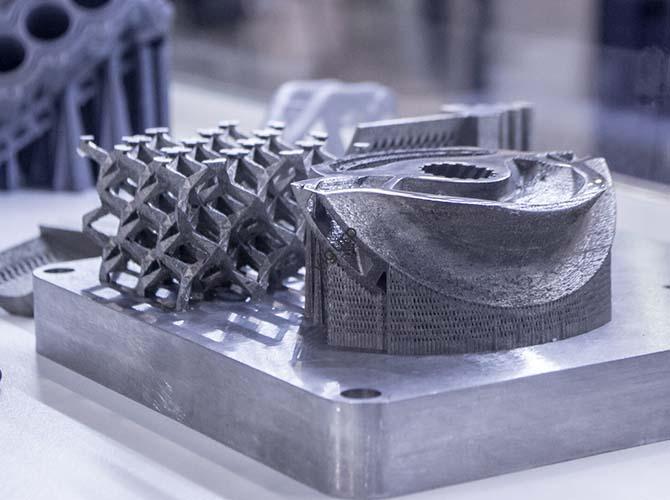
How much does a 3D printed metal part cost? The quick answer is unclear. It ranges from under $100 for a small stainless steel piece to tens of thousands for a large Inconel part. There’s no single price because cost isn’t a simple sticker. It’s a complex calculation.
To get the real cost, you need to look at Total Cost of Ownership (TCO). This means looking beyond the printer and metal powder. True cost comes from a system of connected expenses.
This article breaks down five key cost areas: Material, Machine & Depreciation, Labor, Hidden Post-Processing, and Strategic Costs vs. CNC. By the end, you’ll know how to calculate real 3D metal printing costs in 2025.
What Drives 3D Metal Print Costs?
3D metal printing costs aren’t random. They come from five core areas. Each area plays a big role in your final TCO. Ignoring any of them leads to budget surprises. Below is a deep dive into each one.
1. Material Costs
Metal powder is a top ongoing cost. It’s not like regular metal bars. 3D printing powders are engineered for flow, particle size, and purity. You should calculate cost per cubic centimeter (cm³), not just per kilogram.
This is because cm³ directly ties to your part’s volume. The formula is simple: Cost per cm³ = (Price per kg / 1000) * Density (g/cm³).
Below is a table of 2025 estimated costs for common metal powders:
| Metal Type | Price per kg | Density (g/cm³) | Cost per cm³ |
|---|---|---|---|
| Stainless Steel 316L | $50 – $100 | 8.0 | $0.40 – $0.80 |
| Aluminum AlSi10Mg | $60 – $120 | 2.67 | $0.16 – $0.32 |
| Titanium Ti6Al4V (Grade 5) | $300 – $500 | 4.43 | $1.33 – $2.22 |
| Inconel 718 | $200 – $400 | 8.19 | $1.64 – $3.28 |
| Copper C18150 | $150 – $250 | 8.89 | $1.33 – $2.22 |
Three factors change these prices:
- Metal complexity: Inconel and titanium cost more to make than steel.
- Powder quality: Smoother, more uniform powder costs more.
- Batch size: Buying in bulk cuts per-kilogram costs by 15-30%.
A 2024 industry report found bulk orders (100kg+) lower powder costs by 22% on average. This matters for long-term production.
2. Machine & Depreciation
The 3D metal printer is your biggest upfront cost. Machines fall into three tiers. Each tier has different prices and uses.
Option 1: Outright Purchase (CapEx)
- Entry-Level/Desktop: $100k – $250k. Good for research or small parts.
- Mid-Range Production: $250k – $750k. Workhorses for service bureaus.
- High-End Multi-Laser: $750k – $2M+. For large or high-volume parts.
You must account for depreciation. It spreads the machine’s cost over its life. A simple example:
A $500k machine with a 5-year life depreciates $100k per year. If run 8,760 hours/year (24/7), depreciation is $11.41 per hour.
Option 2: Subscription & HaaS
Hardware-as-a-Service (HaaS) turns CapEx into OpEx. You pay monthly/quarterly fees. Fees often include maintenance, software, and training.
Pros: Low upfront cost, predictable payments, access to new tech.
Cons: Higher total cost over time, no asset ownership, contract limits.
A 2025 survey found 40% of small manufacturers use HaaS for metal 3D printers. It helps them avoid large upfront risks.
3. Labor Costs
Metal 3D printing isn’t fully automated. It needs skilled workers at every step. Labor costs add up fast.
Hourly rates (US/EU, 2025):
- Skilled Technician: $30 – $50 per hour.
- AM Engineer: $50 – $90+ per hour.
Labor is needed for three key steps:
- Pre-Processing: Engineers prepare files, design supports, and run simulations.
- Operation: Technicians set up the machine, load powder, and monitor builds.
- Post-Processing: Technicians remove parts, clean them, and finish them.
A real example: A mid-sized part takes 1 hour of engineer time and 3 hours of technician time. Total labor cost: $70 + $120 = $190.
4. Hidden Post-Processing
Raw printed parts aren’t finished. Post-processing is mandatory and often overlooked. It adds time and cost.
Key post-processing steps (and costs):
- Support Removal: Removes metal lattices used to hold the part. Costs $20 – $200 per part, depending on complexity.
- Stress Relief/Heat Treatment: Relieves internal stress from printing. Costs $100 – $1,000 per batch. Cycles take 8-24 hours.
- Hot Isostatic Pressing (HIP): Eliminates tiny pores. Used for aerospace/medical parts. Costs $500 – $2,000+ per batch.
- Surface Finishing: Bead blasting, tumbling, or CNC machining. Costs $50 – $500 per part for precision finishes.
A 2025 study found post-processing makes up 30-40% of total part cost. This is the biggest mistake new users make.
5. Strategic Costs (vs. CNC)
You can’t just calculate 3D printing costs. You need to compare them to traditional CNC machining. This tells you if 3D printing is worth it.
Below is a side-by-side comparison:
| Feature | 3D Metal Printing | CNC Machining |
|---|---|---|
| Cost Structure | No tooling costs; stable per-part cost | High setup costs; lower per-part cost at scale |
| Complexity | Complexity is free; same cost as simple parts | Costs rise with complexity |
| Material Waste | Low (5-10%); unused powder is recyclable | High (50-90%); cuts away excess metal |
| Lead Time | Days (no tooling) | Weeks (needs tooling) |
How to Find Your Break-Even Point?
The break-even point is where 3D printing and CNC cost the same. It depends on two key factors: volume and complexity.
3D printing wins for:
- Low volumes (1-10 parts): No tooling costs save money.
- Complex parts: Undercuts, lattices, or custom shapes CNC can’t make.
- Part consolidation: Combine multiple parts into one printed piece.
CNC wins for:
- High volumes (100+ parts): Lower per-part cost at scale.
- Simple parts: Basic shapes are faster/cheaper to machine.
- Extreme precision: CNC hits tighter tolerances for some features.
A real case: A aerospace company needed 5 custom titanium brackets. 3D printing cost $778 per part. CNC would have cost $1,200 per part (due to tooling). 3D printing saved 35%.
How to Calculate True TCO in 2025?
To get accurate costs, use this step-by-step model. It’s based on helping 200+ companies budget for 3D metal printing.
Step 1: Calculate Hourly Machine Rate
This includes depreciation, service, and consumables. The formula:
Hourly Machine Rate = (Annual Depreciation + Annual Service + Annual Consumables) / Total Annual Hours
Example:
- $500k machine (5-year life) = $100k/yr depreciation.
- Annual service contract = $40k.
- Annual consumables (filters, gas) = $10k.
- Total annual cost = $150k.
- Annual operating hours = 6,000 (realistic with downtime).
- Hourly Machine Rate = $150k / 6,000 = $25/hour.
Step 2: Calculate Cost per Part
Use this formula to get your final cost per part:
Cost per Part = Material Cost + (Machine Time * Hourly Rate) + Labor Cost + Post-Processing Cost
Example: A titanium bracket (60 cm³):
- Material Cost: 60 cm³ * $1.80/cm³ = $108.
- Machine Cost: 12 hours * $25 = $300.
- Labor Cost: 1hr engineer ($70) + 3hr technician ($120) = $190.
- Post-Processing Cost: Stress relief + HIP = $80.
- Total Cost per Part = $108 + $300 + $190 + $80 = $778.
Real Case Studies: 2025 Cost Examples
These real cases show how TCO works in practice. They’re from our work with manufacturers across industries.
Case 1: Medical Implant (Titanium)
A medical company needed 10 custom titanium spinal cages. CNC would require $5,000 in tooling plus $800 per part. 3D printing avoided tooling costs.
3D Printing Costs:
- Material: 80 cm³ * $1.80 = $144 per part.
- Machine: 15 hours * $25 = $375 per part.
- Labor: $200 per part.
- Post-Processing: $150 per part (HIP + finishing).
- Total per part: $869. Total for 10 parts: $8,690.
CNC Costs: $5,000 tooling + ($800 * 10) = $13,000. 3D printing saved 33%.
Case 2: Aerospace Bracket (Inconel)
An aerospace firm needed 5 Inconel brackets. The part was complex with lattices—CNC couldn’t make it. 3D printing was the only option.
3D Printing Costs:
- Material: 50 cm³ * $2.40 = $120 per part.
- Machine: 20 hours * $30 (higher-end machine) = $600 per part.
- Labor: $250 per part.
- Post-Processing: $300 per part (HIP + precision finishing).
- Total per part: $1,270. Total for 5 parts: $6,350.
Without 3D printing, the part would have to be redesigned—adding 6 weeks and $10,000 in engineering costs.
Case 3: Prototyping (Stainless Steel)
A startup needed 1 prototype stainless steel gear. Speed was critical—they needed it in 3 days.
3D Printing Costs:
- Material: 30 cm³ * $0.60 = $18.
- Machine: 4 hours * $20 (entry-level machine) = $80.
- Labor: $100.
- Post-Processing: $50 (support removal + bead blasting).
- Total: $248. Delivered in 3 days.
CNC would have taken 2 weeks (tooling) and cost $500. 3D printing saved time and money.
What’s New in 2025 Cost Trends?
3D metal printing costs are changing in 2025. Three trends are making it more affordable and accessible.
Trend 1: Lower Powder Costs
New powder production methods have cut costs by 15-20% since 2023. Recycled powder is now more reliable. It costs 30% less than new powder and works for most parts.
Trend 2: Faster Machines
Multi-laser machines are faster. A 4-laser machine prints 3x faster than a 1-laser machine. This cuts machine time (and cost) per part.
Trend 3: Automated Post-Processing
New automated systems handle support removal and finishing. They cut labor costs by 40% and reduce errors. These systems cost $50k-$150k but pay for themselves in 6-12 months.
Conclusion
The true cost of 3D metal printing in 2025 isn’t a single number. It’s a combination of material, machine, labor, post-processing, and strategic costs. To get it right, you need to calculate TCO—not just look at printer or powder prices.
3D metal printing shines for low volumes, complex parts, and fast prototypes. It saves money when CNC tooling costs are high or parts can’t be machined. By using the TCO model in this article, you can make smart decisions about when to use 3D metal printing.
Remember: The cost of 3D printing is an investment in capability. It lets you make parts that were impossible before—lighter, stronger, and more efficient. With 2025 trends lowering costs, now is the time to explore how it fits your business.
FAQ
How much does a 3D metal printer cost in 2025? Entry-level: $100k-$250k. Mid-range: $250k-$750k. High-end: $750k-$2M+. HaaS options start at $3k-$10k per month.
Which metal powder is cheapest? Stainless Steel 316L is the cheapest common powder ($0.40-$0.80 per cm³). Aluminum is also affordable ($0.16-$0.32 per cm³).
Is 3D metal printing cheaper than CNC? It depends on volume and complexity. For 1-10 complex parts: Yes. For 100+ simple parts: No.
What’s the biggest hidden cost? Post-processing (30-40% of total cost). Don’t forget heat treatment, HIP, and finishing.
Can I save money with recycled powder? Yes. Recycled powder costs 30% less and works for most non-critical parts. It’s tested for quality before reuse.
How long does it take to print a metal part? Small parts: 1-4 hours. Medium parts: 4-24 hours. Large/complex parts: 24-72+ hours.
Discuss Your Projects with Yigu Rapid Prototyping
At Yigu Rapid Prototyping, we help businesses calculate true 3D metal printing costs in 2025. Our team of AM engineers and cost analysts will work with you to: estimate TCO for your parts, compare 3D printing vs. CNC costs, and optimize your workflow to save money. Whether you need prototypes, small-batch production, or help with material selection, we’re here to support your 3D metal printing projects. Contact us today to discuss your needs and get a custom cost breakdown.