
Introduction
If you have ever worked on parts with intricate shapes, extremely tight tolerances, or hard-to-cut materials, you know just how challenging complex machining can be. Whether you are a CNC programmer, a manufacturing engineer, or a shop owner, getting complex machining right means carefully balancing advanced technology, smart strategy, and deep expertise. This guide breaks down everything you need to know—from the latest machining technologies to practical tips for avoiding common pitfalls—so you can deliver high-quality parts consistently, even for the most demanding applications.
1. What Is Complex Machining, and Why Does It Matter?
First, let’s clarify what we mean by complex machining. It is not just about work that is “hard.” It is about manufacturing parts with features that demand exceptional precision, specialized tools, or advanced processes. Think of aerospace components with thin-wall structures, medical devices with micro-features, or automotive parts with complex, freeform contours. These parts simply cannot be made with basic 3-axis mills or standard cutting tools. They require a holistic approach to technology, programming, and material handling.
Why does this matter so much? For industries like aerospace and medical, a single mistake in complex machining can lead to failed parts, delayed projects, or even serious safety risks. A 2023 study by the Aerospace Industries Association found that 35% of production delays in aerospace manufacturing stem directly from issues with complex machining. This highlights just how critical it is to get this right.
2. What Advanced Technologies Are Used in Complex Machining?
You cannot effectively tackle complex parts with outdated equipment. Today’s leading manufacturers rely on specialized technologies that offer more flexibility, precision, and efficiency. Here is a breakdown of the most essential ones.
| Technology | What It Does | Real-World Use Case |
|---|---|---|
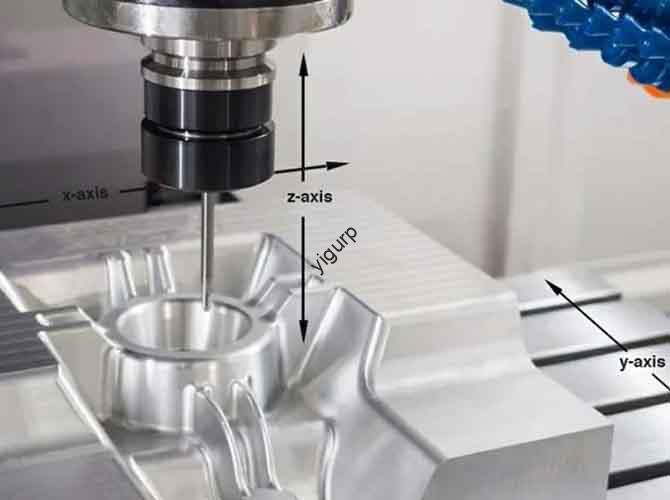
| 5-Axis Machining | Moves the part or cutting tool along five axes simultaneously (X, Y, Z plus two rotational axes) to achieve complex angles in a single setup. | An aerospace shop uses 5-axis machining to produce turbine blades with freeform surfaces. This cut their machining time by 40% compared to using a 3-axis machine. |
| Turn-Mill Centers | Combines turning, for cylindrical parts, and milling, for features like holes or flats, all in one machine. | A medical device manufacturer making bone screws uses turn-mill centers. This eliminates the need to move parts between different machines, cutting positioning errors by 25%. |
| Swiss-Type Lathes | Holds the part with a guide bushing for ultra-precise machining of long, thin parts. | A watchmaker uses Swiss-type lathes to produce tiny gear shafts, only 1mm in diameter, with micro-features and sub-micron tolerances. |
| Hybrid Manufacturing | Combines Additive-Subtractive Integration. It 3D prints a near-net shape, then machines the critical surfaces for final precision. | A defense contractor making complex Inconel brackets saves 60% on material waste by printing the rough shape first, then machining only the mating surfaces. |
3. How Do You Handle Complex Part Geometries?
Often, the biggest hurdle in complex machining isn’t the machine itself—it is the part’s geometry. Features like thin walls, deep cavities, or undercuts can cause vibrations, tool deflection, or poor surface finish. Here are common geometries and how to handle them.
- Thin-Wall Structures: These are common in aerospace housings, with walls often less than 2mm thick. They flex during machining, leading to out-of-tolerance parts. The solution is to use anti-vibration bars to stabilize the part and reduce cutting forces with lighter cuts. One shop used this approach to fix a 20% rejection rate on thin-wall aluminum parts.
- Deep Cavities: Machining deep cavities with a depth-to-width ratio greater than 5:1 leads to poor tool reach and chip buildup. Use long-reach toolholders that are thermally stable to avoid deflection and coolant-thru tooling to flush chips out effectively.
- Micro-Features: For features smaller than 0.5mm, like tiny holes or slots, use micro-tools down to 0.1mm in diameter and on-machine probing to verify positions during the machining process. This helped a medical parts manufacturer achieve a 99.8% yield on micro-nozzles.
4. What Programming and CAM Strategies Are Essential?
Even the best machine won’t help if your programming is off. Complex machining requires CAM (Computer-Aided Manufacturing) strategies that prioritize precision, collision avoidance, and speed.
- Prioritize Collision Avoidance: Collisions are the number one cause of expensive damage. A 2023 survey found that 40% of shops have experienced a collision costing over $10,000. Always use virtual machine simulation (VMS) before running a program. It replicates your exact machine setup to catch potential collisions early.
- Optimize Toolpaths for Speed and Precision: For complex parts, use strategies like adaptive clearing, which adjusts the toolpath to the material thickness, reducing cutting forces. Rest machining uses a smaller tool to clean up material in tight spots after a rough cut, eliminating manual finishing.
- Invest in Post-Processor Development: A post-processor converts your CAM toolpaths into code that your specific machine understands. A generic one can miss machine-specific details, leading to errors. A custom post-processor can pay for itself quickly by eliminating rework.
5. How Do You Manage Specialized Tooling for Complex Machining?
Complex machining relies on specialized tools that can handle tough materials and tight spaces. But these tools are expensive, so managing them well is key.
- Form Tools: These are custom-shaped tools that cut a unique feature in one pass. They save time but need careful storage in a dry, temperature-controlled area to prevent corrosion.
- Quick-Change Systems: These let you swap tools in seconds instead of minutes. A shop using quick-change systems can reduce setup time for small-batch complex parts by 50%.
- Thermal-Stable Toolholders: These reduce tool vibration by maintaining a consistent temperature. They are critical for high-speed machining of composites, and one study found they can improve surface finish by 30%.
6. What Are the Key Challenges with Difficult Materials?
Complex machining often involves difficult-to-machine materials like titanium alloys, Inconel, or ceramic-matrix composites (CMCs). These materials are strong and heat-resistant, but they wear down tools fast.
- Titanium Alloys: Their low thermal conductivity causes heat to build up in the tool. Use high-pressure coolant of over 1,000 psi and reduce cutting speed by 30% compared to steel.
- Inconel: This material work-hardens easily, meaning the cut itself creates a hard layer that dulls tools. Use form tools with very sharp edges and a positive rake angle to minimize this effect.
- Ceramic-Matrix Composites (CMCs) : These are brittle and highly abrasive. Use ultrasonic machining or diamond-coated tools, which can reduce tool wear by 50-70%.
Conclusion
Mastering complex machining is about more than just owning advanced equipment. It requires a deep understanding of how to leverage technologies like 5-axis machining and hybrid manufacturing to their fullest potential. It demands smart strategies for programming, including collision avoidance and optimized toolpaths. And it relies on expert knowledge of how to handle difficult materials and challenging geometries. By integrating these elements—technology, strategy, and precision—you can consistently produce high-quality, complex parts for even the most demanding industries.
FAQ
What is the biggest mistake new manufacturers make with complex machining?
The biggest mistake is often skipping virtual machine simulation or using generic post-processors. Both can lead to expensive collisions or out-of-tolerance parts. One shop lost over $10,000 on a single collision that could have been easily avoided with proper simulation.
How do I choose between 5-axis machining and turn-mill centers?
Use 5-axis machining for parts with complex angles or freeform surfaces, like turbine blades. Use turn-mill centers for cylindrical parts that need both turning and milling operations, like a shaft with cross-holes. If you are unsure, test a small batch on both machines to compare the results.
What is the best way to reduce tool wear when cutting difficult materials like Inconel?
Combine three key strategies. First, use high-pressure coolant to keep the tool cool. Second, use sharp, high-quality inserts with a coating like TiAlN. Third, reduce your cutting speed by 20-30% compared to what you would use for standard steel. This combination can double your tool life.
How do I ensure my parts meet sub-micron tolerances?
Invest in on-machine probing to measure parts during the machining process and correct for any deviation. Use thermal compensation software to account for temperature changes that can cause the machine to expand. Also, keep your machine in a climate-controlled room where the temperature varies by less than 2°C.
Discuss Your Projects with Yigu Rapid Prototyping
Are you facing a challenging complex machining project? At Yigu Rapid Prototyping, we have the advanced technology and deep expertise to handle the toughest parts. From 5-axis machining of aerospace components to hybrid manufacturing of difficult materials, our team is ready to help you succeed.
Contact Yigu Rapid Prototyping today to discuss your project. Let’s build something great together.