
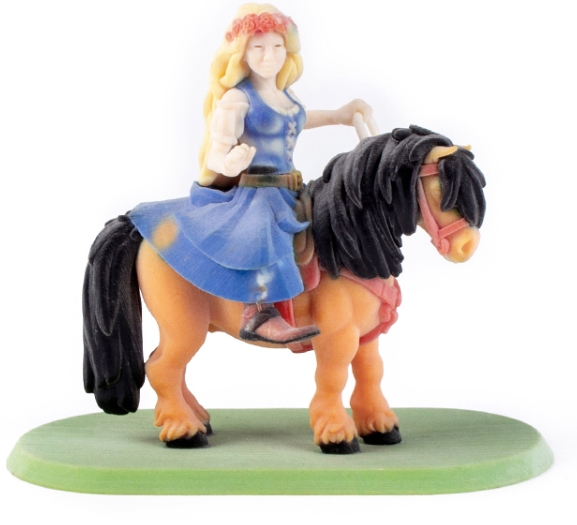
Remember that lifelike figurine of a couple on their wedding day or the incredibly detailed model of a gamer in action that you saw online? That’s the magic of 3D printed live-action models, a technology that has moved from niche novelty to a booming personalized gift and collectible market. This isn’t just a fancy photograph; it’s a tangible, three-dimensional capture of a moment, a person, or a personality.
For consumers, it’s a chance to own a unique piece of memorabilia. For entrepreneurs and businesses, it represents a dynamic opportunity in the personalized goods sector. This guide will walk you through the entire journey—from the initial 3D scan to the finished product on your shelf—covering the detailed process, evolving market, extensive customization options, and key factors that influence cost, empowering you to either create your own perfect model or understand the business behind it.
How is a 3D Live-Action Model Actually Made?
Creating a high-fidelity figurine is a multi-stage craft that blends cutting-edge technology with artistic skill. It’s far more than “pressing print”; it’s a structured pipeline ensuring accuracy and quality at every step.
What Does the Scanning Process Entail?
The journey begins with data capture. Using handheld structured light scanners or multi-camera photogrammetry booths, hundreds of images are taken from every angle to create a precise “point cloud” of the subject. The key is capturing not just shape, but fine surface textures and colors. For instance, a service creating models for athletes will use scanners that capture the dynamic texture of a basketball jersey and the subtle musculature in a posed arm.
Professional Insight: The scanning environment is crucial. Professionals use controlled lighting and neutral backdrops to minimize shadows and reflections, ensuring the cleanest initial data. A scan for a 12-inch model typically takes 5-15 minutes, but the subject must hold a steady pose throughout.
How is the Raw Scan Turned into a Printable Model?
The raw scan data is a rough digital shell. This is where 3D modeling software like Blender or ZBrush comes in. Specialists, often digital sculptors, perform mesh cleanup—filling holes, smoothing noise, and correcting distortions. This stage can also involve model enhancement: refining facial features, ensuring symmetrical details, or even integrating digital accessories. A common request is merging a scanned person with a pre-modeled object, like having a bride hold a perfectly detailed bouquet that was added digitally.
What Happens During Printing and Post-Processing?
With the 3D model perfected, it is “sliced” into thousands of horizontal layers and sent to the printer. Material Jetting (like PolyJet) printers are often the premium choice for live-action models because they can produce millions of colors and varying textures in a single print, perfect for realistic skin tones and clothing details.
After printing, the model isn’t ready. Support material is carefully removed. For the highest-end models, artists then engage in hand-finishing: sanding layer lines, applying sealants, and adding delicate hand-painted details to eyes, jewelry, or logos to make the piece pop. A model intended as a corporate award might receive a custom-polished base with an engraved nameplate at this stage.
What Does the Market for These Models Look Like?
The market for 3D printed figurines has evolved from simple novelty items into a legitimate segment of the personalized consumer goods industry.
How Large and Accessible is the Market?
Driven by falling technology costs and rising demand for unique personal products, the market has seen significant growth. While niche, it taps into the broader e-commerce customization trend. Services range from online platforms where you upload photos to brick-and-mortar “3D photo booths” in malls and tourist areas. For example, startups like Twinkind in Europe have made headlines by opening physical studios where customers can get scanned and receive a high-quality figurine, merging an experiential activity with a product purchase.
Who Are the Primary Customers?
The customer base is diverse:
- Individuals & Families: For commemorating events (weddings, graduations), creating gifts, or preserving memories of children at different ages.
- Hobbyists & Gamers: The rise of tabletop gaming and anime culture has fueled demand for custom character models that represent the player themselves or their unique avatar.
- Businesses & Organizations: Used for unique corporate awards, branded merchandise, or as architectural models featuring real people.
What Customization Options Are Truly Possible?
The true appeal lies in personalization. Modern services offer a tiered approach to suit different needs and budgets.
Core Customization Tiers:
| Customization Tier | Description | Best For | Typical Lead Time |
|---|---|---|---|
| Full-Body 3D Scan | A complete, pose-to-order capture of an individual using a 3D scanner. Highest accuracy for face, body, and clothing. | Wedding figurines, professional portraits, special event commemoratives. | 1-3 weeks |
| Photo-to-3D Model | 2D photos are used to create a 3D likeness, which is then grafted onto a pre-designed template body. | More affordable gifts, online orders, characters in specific costumes (e.g., superhero, historical). | 1-2 weeks |
| Digital Sculpt from Scratch | An artist creates a model entirely from reference photos and descriptions, with no physical scan. | Deceased loved ones, fictional characters, or highly stylized artistic representations. | 3-6 weeks |
Beyond the base model, add-on customization includes choice of material (color plastic, resin, or premium full-color sandstone), scale (from keychain size to life-size busts), base design, and the level of hand-painting.
What Determines the Price of a Custom Model?
Understanding cost drivers helps set realistic expectations. Price is rarely a simple function of size.
What Are the Key Cost Factors?
- Data Source: A professional 3D scan is the most expensive starting point due to equipment and operator time. Photo-based modeling is less costly but may require more artistic interpretation.
- Model Complexity & Editing: A person in a simple pose wearing a t-shirt requires far less digital cleanup and support than someone in a flowing gown with an action pose. Complex edits add artist hours.
- Printing Technology & Material: A full-color, smooth-finish print from a professional Material Jetting machine costs more per unit than a single-color print from a desktop FDM printer. Material choice (standard resin vs. high-detail resin) also affects price.
- Scale: Larger models use exponentially more material and print time. Doubling the height can more than octuple the volume and cost.
- Post-Processing: Basic support removal is standard. Professional sanding, priming, and hand-painting are premium services that significantly increase cost but also quality and realism.
Example Price Ranges (for a single 6-inch/15cm figurine):
- Basic (Photo-to-3D, FDM Print): $50 – $150
- Standard (3D Scan, Color Jet Print): $200 – $500
- Premium (3D Scan, Material Jet Print, Hand-Painted): $500 – $1,500+
What Does the Future Hold for This Technology?
The frontier is moving towards greater accessibility and immersion. Smartphone apps leveraging advanced AI and photogrammetry are emerging, allowing users to create basic 3D selfies at home. On the premium end, integration with VR/AR is possible, where your scanned avatar can be used in virtual worlds. Furthermore, the rise of digital twins—highly accurate digital copies of people—may see these models used not just as keepsakes, but for virtual try-ons, fitness tracking avatars, or personalized digital assistants.
Conclusion
3D printed live-action models sit at the fascinating intersection of technology, art, and personal expression. The process, from precise scanning to skilled digital sculpting and advanced printing, is a craft that turns a moment or a person into a lasting physical object. For the consumer, it offers an unparalleled level of personalization in the gift and memorabilia space. For the business-minded, it represents a growing niche market driven by the universal desire for unique, meaningful products. As scanning becomes faster and more accessible, and printing more detailed and affordable, the only limit will be our own imagination for how to capture and celebrate our three-dimensional selves.
FAQ: 3D Printed Live-Action Models
How long do I have to stand still during a 3D scan?
For a full-body scan with a professional handheld or booth scanner, you’ll need to hold a steady pose for approximately 5 to 15 minutes. Some systems use rapid capture, but movement will cause blurring in the final data.
Can you 3D print a model from just a regular photo?
Yes, through a process called photo-to-3D modeling. Specialists use multiple 2D photos (usually 3-8 from different angles) to reconstruct a 3D likeness. The result is less geometrically accurate than a dedicated 3D scan but can be very effective for facial likeness when combined with a generic body template.
Are the materials used for these models safe and durable?
Commercial services use non-toxic, stable plastics and resins. Common materials like PLA, photopolymer resin, and full-color sandstone are safe for display. Durability varies: resin and sandstone are brittle and best for display, while nylon-based prints are more rugged. All should be kept out of direct sunlight to prevent color fading or material degradation.
What’s the difference between a cheap online service and a high-end studio?
The difference lies in the data source, technology, and artisan skill. Cheap services often rely on AI-generated models from a few photos and use lower-resolution printing. High-end studios use professional 3D scans, expert digital cleanup, high-resolution multi-material printing (like PolyJet), and often include hand-painting and finishing for a museum-quality result.
Discuss Your Live-Action Model Project with Yigu Rapid Prototyping
Whether you’re an individual dreaming of a unique self-portrait or an entrepreneur looking to launch a customized product line, navigating the world of 3D printed figurines requires expert guidance.
At Yigu Rapid Prototyping, we specialize in bridging the gap between your vision and a tangible, high-quality reality. Our expertise covers the entire pipeline:
- Consultation on the best capture method (scanning vs. photo-based) for your needs and budget.
- Professional 3D modeling & design refinement to ensure your model looks its best.
- Access to industrial-grade, full-color printing technologies for unparalleled detail and realism.
- Expert post-processing and finishing, including custom painting and mounting.
Bring your moment to life. Contact Yigu today to discuss your live-action model project and receive a detailed quote tailored to your vision.