
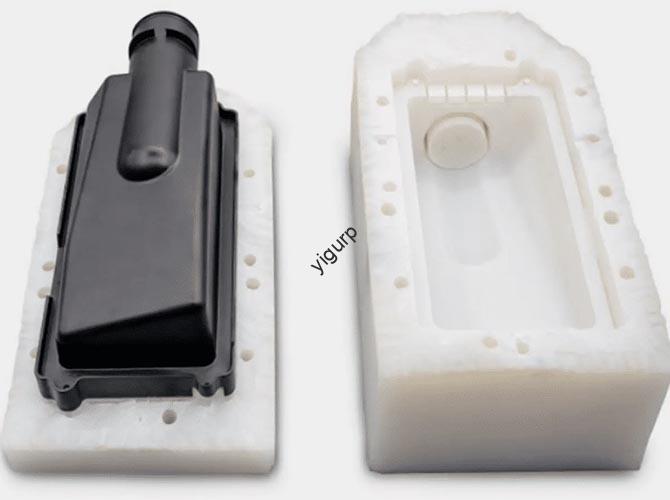
Introduction
You have a master part. Now you want to make copies of it. Maybe it is a prototype for a new product, a statue for a client, or a spare part for a machine. The first big question is always the same: what material should I use to make the replica? The answer depends on what you need. Do you need it to be strong? Cheap? Heat resistant? Fast? Different jobs need different materials. In this guide, we break down the most common materials for mold replication models—silicone, gypsum, resin, and hot melt adhesive. We will look at their strengths, their weaknesses, and exactly when to use each one.
A Quick Overview: How Do the Materials Compare?
Before we dive deep, here is a simple table to compare the top four materials at a glance. Use this to get a general idea of which path might fit your project.
| Material | Best For… | Main Weakness | Typical Cost |
|---|---|---|---|
| Silicone | High-detail parts, flexible molds, heat resistance. | Higher material cost. | Medium-High |
| Gypsum (Plaster) | Low-cost shells, simple blocks, support structures. | Brittle, low detail. | Very Low |
| Resin | Strong, durable, precise parts for function or display. | Toxic fumes, longer cure. | Medium |
| Hot Melt Adhesive | Quick, small, flexible prototypes. | Melts in heat, low precision. | Low |
1. Silicone: The Best Choice for High Detail?
Why Use Silicone?
Silicone is often the top pick when you need a perfect copy. It is a rubber-like material that flows into every tiny crack of your master pattern. This makes it excellent for capturing fine details like 0.1mm surface textures or small logos.
Its main strengths are:
- High Precision: It copies details exactly. There is almost no shrinkage.
- Flexibility: You can bend and stretch it to remove the copy, even if the part has undercuts.
- Heat Resistance: Some silicones handle temperatures up to 300°C. This is useful if you plan to cast hot materials like wax or low-melt metals into the mold later.
- Tear Strength: It is tough. It won’t rip easily when you pull out your replica.
How to Use Silicone for Replication
The process is straightforward but requires careful mixing.
- Mix the Components: Most silicone comes in two parts (A and B). Mix them in the exact ratio given, often 1:1.
- Degas: Stir slowly to avoid bubbles. For best results, put the mixed silicone in a vacuum chamber for a few minutes. This pulls out all trapped air.
- Pour: Pour the silicone gently over your master pattern in its mold box.
- Cure: Let it sit at room temperature. Small molds cure in 4 to 8 hours. Larger ones might take 24 hours.
When Should You Pick Silicone?
- You are making mannequins, dolls, or figure prototypes where every facial detail matters.
- You need automotive prototypes with complex curves and smooth surfaces.
- You are creating a mold that will be used many times (silicone molds are durable).
- The part has undercuts that would lock a rigid material in place.
2. Gypsum (Plaster): The Budget Option?
Why Use Gypsum?
Gypsum, or plaster of Paris, is one of the oldest replication materials. It is cheap and easy to find. You just add water. It is not for high-precision work, but it has its place.
Its main strengths are:
- Low Cost: It is significantly cheaper than silicone or resin.
- Simple to Use: No complex mixing ratios. No special machines needed.
- Rigid Support: Once dry, it is hard and can support other materials. It is often used to make a mother mold—a hard outer shell that supports a soft silicone inner mold.
How to Use Gypsum for Replication
- Mix: Combine gypsum powder with clean water. A common ratio is 2:1 powder to water by weight. Mix until it forms a smooth paste, like pancake batter.
- Apply: Pour the paste over your model or into a mold box. Tap the container to bring bubbles to the surface.
- Set: Let it dry. This can take 6 to 12 hours at room temperature. Do not bake it to speed up drying; it can crack.
- Remove: Carefully separate the hardened gypsum from the model.
When Should You Pick Gypsum?
- You need a one-off decorative replica for a school project or a simple craft.
- You are building a support shell for a flexible silicone mold.
- Your part is simple, large, and does not need tight tolerances.
- You are on a very tight budget.
3. Resin: The Choice for Strong, Functional Parts?
Why Use Resin?
Resin is a broad category. It usually refers to liquid plastics that harden into strong, solid parts. There are two main types: unsaturated resin (cheaper, faster) and epoxy resin (stronger, more precise). Resin replicas feel like real plastic parts.
Its main strengths are:
- High Strength: Resin parts can be tough, rigid, and wear-resistant. They can handle being handled.
- Precision: Epoxy resins, in particular, have very low shrinkage and can hold tight tolerances.
- Mimics Production Plastics: You can get resins that feel like ABS, polycarbonate, or polypropylene. This is perfect for functional prototypes.
Important Safety Note
Resin can be dangerous. The chemicals release fumes that are toxic. You must always work in a well-ventilated area. Wear nitrile gloves and a proper respirator mask. Do not let it touch your skin.
How to Use Resin for Replication
- Mix the Parts: Resin comes with a hardener. Follow the ratio exactly (e.g., 10:1 for unsaturated, 2:1 for epoxy).
- Stir Gently: Mix slowly to avoid creating air bubbles. For perfect parts, put the mixed resin in a vacuum chamber.
- Pour and Cure: Pour into your mold. Cure times vary. Unsaturated resin might harden in 1-2 hours. Epoxy can take 4-6 hours or more.
- Demold and Finish: Pop the part out. You might need to sand the surface for a perfect finish.
When Should You Pick Resin?
- You are making high-end figures or collectible statues that need sharp details.
- You need functional prototypes for a product, like a gear or a housing that will be tested.
- You are replicating automotive parts that need to be strong and dimensionally accurate.
- The part needs to resist mild chemicals or wear over time.
4. Hot Melt Adhesive: The Quick-Fix Solution?
Why Use Hot Melt Adhesive?
Hot melt adhesive is the glue from a hot glue gun. It is not just for sticking things together. You can actually use it to make simple replicas. It is fast and forgiving.
Its main strengths are:
- Incredibly Fast: There is no curing time. It goes from liquid to solid in minutes.
- Flexible and Tough: The cooled adhesive is rubbery and tough. You can bend it a little without it snapping.
- No Special Gear: Anyone with a $10 glue gun can try this.
How to Use Hot Melt Adhesive for Replication
- Heat the Gun: Plug it in and let it warm up (usually 150°C to 180°C).
- Inject: Squeeze the molten adhesive into your mold cavity. Make sure to fill all the spaces.
- Cool: Wait just 5 to 10 minutes for it to cool and harden completely.
- Pop it Out: Remove your replica. It is ready instantly. No post-processing needed.
When Should You Pick Hot Melt Adhesive?
- You need a quick, temporary prototype just to check a shape.
- You are making small decorative items like keychains or charms.
- You need a part that requires a bit of flexibility.
- You have an urgent need and no time to mix chemicals.
How to Choose: A Decision Flow
Still not sure? Ask yourself these three questions:
- How much detail do I need?
- High detail (sharp edges, textures) $\rightarrow$ Use Silicone or Epoxy Resin.
- Low detail (simple shapes) $\rightarrow$ Use Gypsum or Hot Melt.
- Does the part need to be strong?
- Yes, it will be handled or tested $\rightarrow$ Use Resin.
- No, it’s just a visual model $\rightarrow$ Use Silicone or Gypsum.
- How many copies do I need?
- One or two quick copies $\rightarrow$ Hot Melt is the fastest.
- Many copies from one mold $\rightarrow$ You need a durable mold material like Silicone to make the mold, and then you can cast copies in Resin or Gypsum.
Conclusion
Choosing the right material for your mold replication models comes down to matching the material’s properties to your project’s needs. If you need perfect detail and flexibility, choose silicone. If you need strength and a plastic-like feel, choose resin. For low-cost, simple shapes, gypsum works fine. And for a five-minute fix, hot melt adhesive is your friend. By understanding these four options, you can save time, money, and get the quality you need.
FAQ
1. Can I use silicone to make a model that will be used in a hot engine bay?
Yes, you can. You need to select a high-temperature silicone grade. Standard silicone might soften, but specialty silicones are rated for continuous use up to 250°C or even 300°C. This makes them suitable for replicating parts that will be exposed to heat, like a gasket or a small housing near an engine.
2. Is gypsum good for making a detailed action figure?
No, it is not a good choice. Gypsum is too brittle and does not capture fine details well. Small features like fingers or facial details will likely break off or not form correctly. For detailed figures, you should use epoxy resin for the final part, or silicone if you are making a mold of the figure.
3. What safety gear do I need when working with resin?
Safety is critical with resin. You must work in a space with good airflow. Wear nitrile gloves every time—latex gloves may not offer enough protection. Use a respirator mask rated for organic vapors (not just a dust mask). Safety glasses are also a good idea to protect your eyes from splashes.
4. How long does a silicone mold last if I use it to cast resin?
A well-made silicone mold using quality materials can last for 20 to 50 casts with polyurethane resin. The life depends on the complexity of the part. Simple shapes with no sharp corners will last longer. Complex parts with thin, detailed features will wear the mold out faster.
5. Can I paint or finish parts made from these materials?
Yes, all of them can be finished.
- Resin and Silicone parts can be painted with standard spray paints or acrylics after cleaning. You may need a primer first.
- Gypsum is very porous and will soak up paint. It is best to seal it with a shellac or a primer before painting.
- Hot Melt Adhesive can be tricky to paint because it is slightly oily. Specialized spray paints for plastics work best.
Discuss Your Projects with Yigu Rapid Prototyping
Choosing the right material is the first step to a successful replica. At Yigu Rapid Prototyping, we work with all these materials every day. We help product developers, artists, and engineers turn their master patterns into perfect copies. Whether you need a few strong resin prototypes for testing, or a flexible silicone mold for a production run, we have the experience to guide you. Not sure which material fits your budget and performance needs? [Contact Yigu Technology] today. Share your project details, and we will recommend the best path forward.