
Introduction
You see stamped parts every day. The body panels on your car. The stainless steel sink in your kitchen. The metal brackets inside your computer. But what does stamping actually mean in the manufacturing world? It’s more than just pressing metal. It’s a precise, high-speed process that shapes everything from tiny connector pins to entire car doors. This guide breaks down the stamping process, its main types, where it’s used, and why manufacturers rely on it for mass production. Real examples and hard data help you understand exactly how stamping works and when to use it.
What Is the Basic Definition of Stamping?
The simple explanation
Stamping is a metalworking process that uses a press and dies to shape or cut metal. The press applies force to flat metal sheets, strips, or coils. The force pushes the metal into a die—a custom-shaped tool—causing it to either change shape or separate along a line. The result is a finished part with consistent dimensions.
Two possible outcomes
Stamping does one of two things to metal. It can cause plastic deformation—the metal stretches and bends into a new shape without breaking. Think of a car door panel curved smoothly over a die. Or it can cause separation—the metal cuts along a predetermined line. Think of punching a hole in a bracket. Both happen under controlled force.
Why precision matters
Stampings dies are engineered to tolerances as tight as ±0.025mm. That’s thinner than a human hair. Every part comes out identical, which matters enormously when you’re making thousands of parts that must fit together perfectly.
What Are the Main Types of Stamping?
Separation processes: Cutting metal to size
Separation processes cut metal without changing its shape beyond the cut edge. These operations remove material or split it into pieces.
| Operation | What It Does | Common Example |
|---|---|---|
| Blanking | Cuts a flat shape from a sheet | Washers, gaskets, chassis parts |
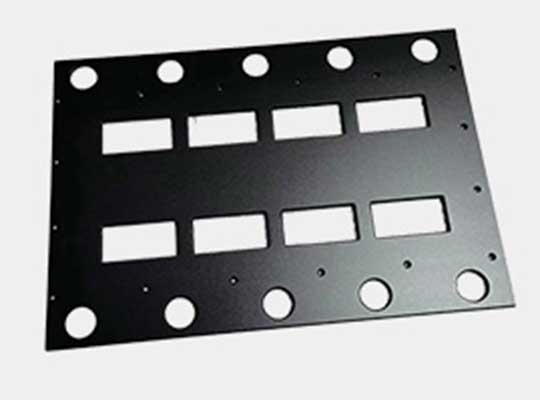
| Punching | Creates holes inside a part | Vent holes in electronics enclosures |
| Shearing | Cuts straight lines | Trimming edges of panels |
| Notching | Cuts out corners or edges | Relief cuts for bending |
A manufacturer making electrical panels uses punching to create 120 holes per minute in each panel for switches and outlets. The holes line up perfectly every time, allowing quick assembly later.
Shaping processes: Forming new geometry
Shaping processes deform metal into three-dimensional forms. The metal stretches and bends but stays in one piece.
| Operation | What It Does | Common Example |
|---|---|---|
| Bending | Folds metal along a straight line | Shelf brackets, frame corners |
| Drawing | Stretches metal over a die | Sink bowls, automotive panels |
| Stretching | Pulls metal to create curves | Aircraft skin sections |
| Embossing | Creates raised or recessed features | Logos on appliances, text on nameplates |
A kitchen sink manufacturer uses drawing to transform flat stainless sheets into deep sink bowls. Each sheet stretches over a die, forming the bowl shape in seconds. One press produces 200 sinks per hour.
Progressive stamping: Multiple operations in one
Progressive stamping combines many steps in a single machine. The metal strip moves through multiple stations. Each station performs one operation—punching, then bending, then cutting free. By the end, a completed part drops out every press stroke.
A connector manufacturer runs progressive stamping for USB-C ports. Each strip produces 50 connectors per minute, with 12 operations happening at different stations. The process runs 24 hours a day, making millions of connectors monthly.
Where Is Stamping Used in Real Industries?
Automotive: The biggest user
The automotive industry consumes more stamped parts than any other sector. Over 60% of a car’s metal components come from stamping. Doors, hoods, fenders, roof panels, chassis brackets, engine oil pans—all stamped.
Real numbers: Toyota’s plant in Kentucky stamps 10,000 body panels daily for the Camry. Each panel fits within 1mm tolerance to ensure proper gaps between doors and body. The stamping line runs three shifts, stopping only for tool changes.
Home appliances: Every kitchen and laundry room
Open your refrigerator. Look at your washing machine. The metal parts inside are almost certainly stamped.
Examples you touch daily:
- Stainless steel washing machine drums
- Refrigerator door panels and shelves
- Microwave oven cavities
- Toaster bodies and crumb trays
- Mixing bowls and baking pans
Samsung stamps 500,000 refrigerator door panels monthly at their South Carolina plant. Each panel gets embossed with the Samsung logo during the same operation that forms the shape.
Electronics: Small parts, tight tolerances
Inside every computer and phone, stamped parts hold things together and connect circuits.
Typical stamped electronics parts:
- Shield cans that block electromagnetic interference
- Connector pins and sockets
- Heat sinks for processors
- Brackets for mounting circuit boards
- Battery contacts
HP produces 1 million printer brackets per week through stamping. Each bracket positions critical components inside the printer. Tolerance holds at ±0.05mm—any looser, and paper jams increase.
Aerospace: Strength with light weight
Aircraft need strong, light parts. Stamping delivers both with aluminum and titanium.
Boeing stamps aluminum seat rails for their 737 series. Each rail supports passenger seats during flight and must withstand 16g crash loads. Stamping produces consistent grain structure that maintains strength while keeping weight low.
Medical devices: Clean and precise
Medical equipment demands sterile surfaces and exact dimensions. Stamped parts deliver both.
A surgical tool manufacturer stamps stainless steel forceps from sheet metal. Each forceps bends to exact angles, then gets electropolished to a sterile finish. Stamping produces 5,000 pieces per day with less than 0.1% rejects.
Why Do Manufacturers Choose Stamping?
Speed that changes everything
Modern stamping presses run fast. Really fast.
Speed comparison:
- High-speed press: 1,000 parts per minute for small parts
- Medium press: 100–300 parts per minute for automotive panels
- Manual alternative: 1–2 parts per minute per worker
A washer manufacturer runs a high-speed press that stamps 500 washers every 30 seconds. That’s 1,000 per minute, or 60,000 per hour. One machine does the work of 50 workers.
Precision that eliminates fitting
Stamped parts come out identical. Always.
Typical stamping tolerances:
- Simple parts: ±0.1mm
- Precision parts: ±0.025mm
- Fine-blanked parts: ±0.013mm
When parts match perfectly, assembly lines run smoothly. No filing, no adjusting, no rework. A car door stamped today fits the same as one stamped six months ago.
Cost that drops with volume
Yes, stamping dies cost money upfront—anywhere from (2,000 for simple dies to )100,000+ for complex progressive dies. But once the die is made, each part costs pennies.
Cost comparison for 100,000 parts:
- Stamping: (25,000 tooling + )0.50 per part = (75,000 total – Machining: )0 tooling + (5.00 per part = )500,000 total
- Casting: (40,000 tooling + )1.50 per part = (190,000 total
Stamping saves 85% versus machining and 60% versus casting at this volume.
Material versatility
Stamping handles almost any metal you can buy in sheet form.
Common stamping materials:
- Steel and stainless steel
- Aluminum and its alloys
- Copper and brass
- Titanium
- Nickel alloys
- Pre-plated or pre-painted metals
A solar panel frame maker stamps aluminum channels for mounting panels. Aluminum keeps weight low for rooftop installation. Stamping forms the channels with mounting holes already punched—ready to assemble.
How Does Stamping Compare to Other Methods?
Stamping vs. Machining
Machining cuts away material to create shapes. Stamping reshapes material without removing it.
Winner for speed: Stamping (100–1,000× faster)
Winner for precision: Machining (can hold tighter tolerances)
Winner for material use: Stamping (minimal waste)
Best use: Machining for low volumes, stamping for high volumes
Stamping vs. Casting
Casting pours molten metal into molds. Stamping works with solid sheets.
Winner for complexity: Casting (can make complex internal shapes)
Winner for speed: Stamping (no cooling time needed)
Winner for strength: Stamping (work-hardened grain structure)
Best use: Casting for complex geometries, stamping for uniform sections
Stamping vs. 3D Printing
3D printing builds parts layer by layer. Stamping forms existing material.
Winner for flexibility: 3D printing (no tooling needed)
Winner for speed: Stamping (seconds versus hours)
Winner for cost at scale: Stamping (pennies versus dollars)
Best use: 3D printing for prototypes, stamping for production
What Should You Know Before Using Stamping?
Minimum quantities matter
Stamping shines at high volumes. Below about 5,000 parts, tooling cost per part gets high. Below 1,000 parts, other methods usually make more sense.
Rule of thumb:
- 1–100 parts: 3D printing or machining
- 100–1,000 parts: Laser cutting + bending
- 1,000–10,000 parts: Simple stamping dies
- 10,000+ parts: Progressive stamping
Die design takes time
A new stamping die needs engineering, machining, and testing. Simple dies take 1–2 weeks. Complex progressive dies take 4–8 weeks. Factor this into your timeline.
Material thickness limits
Stamping works best on sheets from 0.1mm to 6mm thick. Thicker material needs huge presses. Thinner material needs careful handling. Outside this range, other methods may work better.
Conclusion
Stamping means shaping metal with presses and dies—fast, precise, and cost-effective at scale. It powers the automotive industry, builds your kitchen appliances, and creates the tiny parts inside your phone. Separation processes like blanking cut metal to size. Shaping processes like drawing and bending create three-dimensional forms. Progressive stamping combines many operations in one machine. While the upfront tooling cost requires commitment, the per-part savings at volume beat every other metal forming method. For manufacturers making thousands to millions of parts, stamping isn’t just an option—it’s the standard.
FAQ About Stamping
Can stamping work with non-metal materials?
Yes, though less common. Stamping can process certain plastics, rubber sheets, composites, and even paper products. The same principles apply—a press and die shape the material. However, metal stamping dominates because metals need the force and respond well to deformation. A gasket manufacturer stamps 0.5mm rubber sheets into sealing rings for engines, running 200 parts per minute.
How long do stamping dies last?
Quality stamping dies produce millions of parts. A well-maintained die for mild steel might last 1–2 million strokes. Carbide dies for high-volume work reach 10–15 million strokes. Eventually, wear affects tolerances, and dies need refurbishment or replacement. Toyota replaces certain body panel dies after 500,000 parts to maintain showroom quality.
Is stamping environmentally friendly?
Yes, stamping produces minimal waste. Scrap from blanking and punching is clean metal, easily recycled. Modern stamping facilities recycle 98–100% of their scrap. Presses now use servo motors that cut energy use by 30–50% compared to older hydraulic machines. A stamping plant in Ohio reduced their carbon footprint by 40% after upgrading to servo presses.
What’s the difference between stamping and deep drawing?
Deep drawing is actually a type of stamping. Specifically, it’s a stamping operation that creates deep, hollow shapes—like cans, cups, or sinks. The punch pushes the sheet into a die cavity, stretching the material to form walls. The name distinguishes it from shallow stamping where depth is less than the part width.
Can you stamp thick metal plates?
Yes, with enough press capacity. Heavy stamping uses plates up to 25mm thick for parts like bridge bearings or heavy equipment components. These require massive presses—1,000 to 6,000 tons—and robust dies. A construction equipment maker stamps 20mm thick steel brackets for excavators, running at slower speeds to maintain quality.
Does stamping work for prototypes?
For individual prototypes, no—tooling cost is too high. But for 50–100 pilot parts, low-cost “soft tooling” using aluminum or 3D-printed dies can work. These produce parts with the same process but shorter die life. Many manufacturers stamp pilot runs of 200–500 parts before committing to production tooling.
Discuss Your Projects with Yigu Rapid Prototyping
Need expert guidance on stamping for your specific parts? At Yigu Rapid Prototyping, we help manufacturers navigate the stamping process every day. We’ve designed progressive dies for electronics connectors producing 10 million parts monthly. We’ve built simple blanking dies for automotive startups making their first 5,000 parts. We’ve guided medical device companies through material selection for stainless steel stampings. Tell us about your part geometry, volume requirements, and timeline. We’ll recommend the most efficient approach—whether that’s stamping, bending, or another method—and provide a detailed quote within 24 hours. Contact our engineering team today to discuss your project.