
Introduction
If you work in manufacturing, you have likely heard “bending forming” mentioned often. But what does this term actually mean? How does the process work? And why does it matter for the metal products we use daily?
This guide answers those questions. We explain bending forming from the ground up—starting with basic definitions and moving through real applications. By the end, you will understand how this process works and when to use it for your own projects.
What Exactly Is Bending Forming?
A Simple Definition
Bending forming is a sheet metal processing method that uses controlled pressure to reshape metal. The goal is permanent deformation—creating specific angles, curves, or shapes that meet design requirements.
Unlike cutting, which removes material, or welding, which joins pieces, bending forming reshapes metal while keeping its original volume intact. A flat sheet becomes an angled bracket. A straight panel gains a curved edge. The metal itself remains continuous and unbroken.
This is not simply “bending metal” by guesswork. It is a precise technique balancing force, material properties, and tooling. When done correctly, bending forming produces parts without cracks, warping, or inconsistent angles.
Why It Matters
Consider everyday items. Your laptop contains bent metal brackets holding components in place. Your kitchen cabinets have bent frames. Your car includes dozens of bent parts throughout its body and chassis. Each of these requires bending forming to achieve the right shape while maintaining strength.
How Does Bending Forming Work?
The Two Stages of Deformation
Every bending process follows two key stages. Understanding them helps you choose materials and set up equipment correctly.
Stage 1: Elastic Deformation
When pressure first hits the metal sheet, the material stretches slightly. If you release pressure at this point, the metal returns to its original shape. Think of bending a paperclip gently—let go, and it springs back.
This stage is temporary. It sets the foundation for what comes next.
Stage 2: Plastic Deformation
As pressure increases beyond a specific point—called the metal’s yield strength—something changes. The metal enters plastic deformation. Now the shape change becomes permanent. Even after removing pressure, the metal stays bent.
This is where the actual angle or curve forms.
A real example helps clarify. When bending a 1mm aluminum sheet to 90 degrees, the press brake applies force past aluminum’s yield strength of about 70 MPa. The aluminum moves beyond elastic behavior into plastic deformation. The angle holds once the tool lifts away.
What Happens Inside the Metal
At a microscopic level, atoms slide past each other along slip planes. This sliding allows shape change without breaking atomic bonds. Materials with good ductility—like aluminum and mild steel—allow more sliding before cracking. Brittle materials like cast iron allow almost none.
What Are the Key Steps in Bending Forming?
Step 1: Prepare the Material
Start with correctly sized sheet metal. A 300mm by 200mm stainless steel sheet might work for a drawer slide. Clean the surface thoroughly. Oil, dirt, or debris affects how the tool contacts the metal and can ruin precision.
Step 2: Set Up the Press Brake
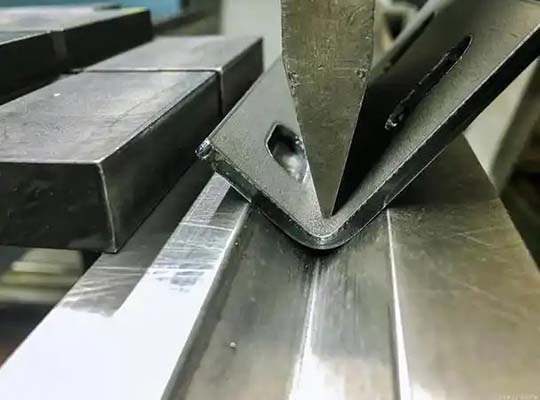
Mount the upper die—a sharp V-shaped tool—and lower die—a V-grooved tool—on the press brake. Adjust the gap between dies to match your sheet thickness. For 2mm steel, the gap typically runs 4mm to 6mm. This prevents cracking during the bend.
Step 3: Position the Sheet
Place the metal sheet on the lower die. Align it carefully so the bend happens exactly where needed. Modern press brakes often use laser guides for positioning. These achieve accuracy within ±0.1mm.
Step 4: Apply Pressure
The upper die descends, pressing the sheet into the lower die’s V-groove. Initially the sheet bends freely. As pressure increases—typically 50 to 200 kN for small parts—the metal contacts the die surfaces.
Step 5: Achieve Full Contact
Continue pressurizing until the sheet makes three-point tight contact. This means the sheet touches the top of the upper die and both sides of the lower die’s V-groove. Full contact ensures the final angle—90 degrees, 45 degrees, 135 degrees—is consistent across the part.
Step 6: Release and Inspect
The press brake retracts. Remove the finished part. Check the angle with a protractor. Inspect for cracks or deformities. Good bending forming produces smooth edges with no visible flaws.
What Types of Bending Forming Exist?
V-Bending: The Most Common Method
V-bending uses a V-shaped upper die and lower die to create angles from 30 to 150 degrees. It is simple and cost-effective for straight bends.
Applications: Brackets, frames, enclosures
Example: Metal brackets inside a desktop computer. The legs of a metal folding chair.
Z-Bending: Creating Offset Shapes
Z-bending forms a Z shape by bending the sheet in two opposite directions. First a 90-degree bend up, then a 90-degree bend down. Precise alignment prevents offset errors.
Applications: Slides, rails, decorative trim
Example: Drawer slides that open and close smoothly. Metal trim on car doors.
Reverse Bending: U-Shaped Parts
Reverse bending—also called U-bending—folds both ends toward the center. This creates a U shape with two 90-degree bends in the same direction. The inner radius matters critically for fitting other components.
Applications: Channels, covers, holders
Example: Metal covers for electrical junction boxes. The tray section of a toolbox where tools sit.
| Bending Type | How It Works | Common Products |
|---|---|---|
| V-Bending | V-shaped dies create angles from 30° to 150° | Computer brackets, chair legs |
| Z-Bending | Two opposite bends create Z shape | Drawer slides, car door trim |
| Reverse Bending | Both ends fold toward center into U shape | Junction box covers, tool trays |
What Equipment Does Bending Forming Require?
Press Brakes: The Workhorse
Press brakes apply the force needed for bending. Two main types dominate the industry.
Mechanical press brakes use a flywheel and crankshaft for consistent force. They work well for small-batch production—making 10 to 50 brackets, for example.
Hydraulic press brakes use hydraulic cylinders for adjustable force. They handle thicker sheets up to 20mm and larger parts like 2-meter panels for industrial machines.
Most modern press brakes include CNC controls. These allow programming angles and repeating bends precisely. Error rates below 0.05mm per bend are achievable.
Dies: Determining Bend Shape
Dies are customizable tools made from hardened steel. They withstand high pressure and can last up to 100,000 bends with proper maintenance.
Common die types include:
- V-dies for V-bending operations
- U-dies for reverse bending
- Edge dies for creating small flanges
Auxiliary Tools for Quality
Several support tools improve bending results:
Angle finders and protractors check bend angles to ±0.5 degrees accuracy.
Laser alignment systems position sheets correctly on the press brake.
Deburring tools smooth sharp edges after bending—preventing injuries and improving part fit.
When Should You Use Bending Forming?
Sample Making and Small Batches
Bending forming requires no expensive molds. This makes it perfect for prototypes and small runs. A startup developing a new smart thermostat can create five to ten metal casings for testing using bending forming. Later they scale up if the product succeeds.
Mold-based methods might cost $1,000 to $10,000 or more just for tooling. Bending forming avoids that investment entirely.
Custom Product Development
Many industries need one-of-a-kind or low-volume custom parts. A furniture designer might create unique metal legs for a limited-edition table. An aerospace company might make custom brackets for a prototype drone. Bending forming handles these unique requirements efficiently.
High-Mix, Low-Volume Manufacturing
Factories producing many different part types rely on bending forming. A contract manufacturer might make parts for medical devices, electronics, and automotive clients all in one week. Bending forming allows quick switching between parts. Changing dies on a press brake takes 10 to 30 minutes—compared to hours for mold changes.
Real-World Example
A small electronics company needed 20 custom metal enclosures for a new sensor. Using bending forming, they completed the project in three days. Mold-based methods would have taken two weeks and cost an extra $3,000 in tooling. The choice was clear.
What Materials Work Best for Bending Forming?
Ideal Material Properties
Good bending materials share common traits. They have high ductility—the ability to deform without cracking. They have consistent grain structure that allows atoms to slide past each other.
Common Materials and Their Uses
| Material | Thickness Range | Typical Applications |
|---|---|---|
| Aluminum | 0.5mm to 10mm | Electronics, lightweight structures |
| Stainless Steel | 0.5mm to 12mm | Medical equipment, food processing |
| Mild Steel | 0.5mm to 20mm | Construction, automotive frames |
| Copper | 0.5mm to 6mm | Electrical components, decorative items |
Aluminum is a top choice for many projects. It bends easily without cracking and weighs little. Stainless steel offers corrosion resistance for demanding environments. Mild steel provides strength at low cost.
Materials to Avoid
Brittle materials like cast iron break during bending. Their atomic structure cannot accommodate plastic deformation. High-carbon steels also cause problems—they may crack before reaching the desired angle.
How Accurate Is Bending Forming?
Precision Capabilities
Modern CNC press brakes achieve impressive accuracy. Angle accuracy within ±0.5 degrees is routine. Length accuracy within ±0.1mm is achievable for well-setup operations.
This precision satisfies most applications. Electronics enclosures fit together correctly. Furniture frames assemble without gaps. Automotive brackets mount securely.
When Extra Precision Matters
Some industries demand even tighter tolerances. Aerospace components may require additional post-bend inspection and adjustment. Medical devices might need 100% dimensional verification. Bending forming can still work—but extra quality steps become necessary.
Can Bending Forming Handle Large-Scale Production?
Automation Makes It Possible
While bending forming excels at small batches, it can scale up. Pairing press brakes with automated feeding systems changes the equation. These systems load metal sheets automatically, reducing labor and ensuring consistency.
Production runs of 1,000 or more parts become feasible this way.
Comparing to Alternative Methods
For extremely high volumes—10,000 identical parts or more—mold-based methods like stamping may prove more economical long-term. The per-part cost eventually drops below bending forming’s variable costs.
However, bending forming offers flexibility that stamping cannot match. If your parts change frequently or your volumes vary, bending forming often wins the cost comparison despite higher per-unit costs.
What Quality Issues Occur in Bending Forming?
Springback
Metal tries to return partly to its original shape after bending. This springback effect means the final angle differs slightly from the tool angle. Skilled operators compensate by over-bending slightly. CNC controls calculate springback based on material properties.
Cracking
Bending too sharply or using brittle materials causes cracks. Cracks appear on the outer surface of the bend where tension is highest. Proper die selection and material choice prevent most cracking.
Wrinkling
Thin materials sometimes wrinkle on the inner bend surface where compression occurs. Proper tooling and pressure control minimize this issue.
Dimensional Variation
Inconsistent positioning or worn tooling leads to parts that vary from each other. Regular inspection and maintenance keep variation within acceptable limits.
Yigu Technology’s Perspective on Bending Forming
At Yigu Technology, we view bending forming as the cornerstone of flexible manufacturing. Supporting small and medium enterprises has taught us something important—bending forming solves a critical problem for growing businesses.
The problem is simple. Mold-based production costs too much for small runs and takes too long for custom work. Bending forming eliminates both barriers.
We typically recommend hydraulic press brakes with CNC controls for our clients. These machines balance precision—achieving ±0.1mm bends—with affordability. They handle the variety of projects that small and medium companies encounter.
Our team also provides guidance on material selection. Choosing aluminum for lightweight parts versus stainless steel for durability makes a real difference in results. Getting this right from the start saves time and money.
For us, bending forming is more than a manufacturing process. It is a way for businesses to innovate faster and stay competitive. When you can create custom parts quickly without massive tooling investments, you can respond to market opportunities that others miss.
Conclusion
Bending forming transforms flat sheet metal into functional parts through controlled plastic deformation. The process relies on understanding elastic and plastic behavior, selecting appropriate materials, and using precise equipment.
Key takeaways from this guide:
Bending forming requires no expensive molds, making it ideal for prototypes and small batches. The process works with most ductile metals including aluminum, stainless steel, and mild steel. Modern CNC press brakes achieve accuracy within ±0.5 degrees and ±0.1mm dimensions. Common techniques include V-bending for angles, Z-bending for offsets, and reverse bending for U-shaped parts. Quality considerations include managing springback, avoiding cracks, and maintaining consistency.
Whether you need custom brackets, electronic enclosures, or furniture frames, bending forming offers a practical path from design to finished part. Understanding how the process works helps you make better decisions for your manufacturing projects.
Frequently Asked Questions
What materials work best for bending forming?
Most thin metal sheets from 0.5mm to 10mm thickness are suitable. Aluminum, stainless steel, mild steel, and copper all bend well. Aluminum is particularly popular because it combines high ductility with light weight. Avoid brittle materials like cast iron that crack under bending stress.
How accurate is bending forming?
Modern CNC press brakes achieve angle accuracy within ±0.5 degrees and length accuracy within ±0.1mm. This precision satisfies most applications including electronics, furniture, and automotive parts. Ultra-high precision parts like aerospace components may need additional inspection steps.
Can bending forming be used for large-scale production?
Yes, especially when paired with automated feeding systems. These systems load sheets automatically, reducing labor and maintaining consistency for runs of 1,000 parts or more. However, for extremely high volumes above 10,000 identical parts, mold-based methods like stamping may eventually become more economical.
What is springback and how do you handle it?
Springback is the tendency of metal to return partly to its original shape after bending. The final angle ends up slightly different from the tool angle. Operators compensate by over-bending slightly beyond the target angle. CNC controls calculate expected springback based on material properties and adjust automatically.
How do I choose between V-bending, Z-bending, and reverse bending?
Consider your part shape. V-bending works for simple angles on brackets and frames. Z-bending creates offset shapes like slides and rails. Reverse bending forms U-shaped channels and covers. Your design requirements determine which technique fits best.
Discuss Your Projects with Yigu Rapid Prototyping
At Yigu Rapid Prototyping, we help clients apply bending forming to real manufacturing challenges. Our team brings hands-on experience with materials, equipment, and techniques that deliver quality results.
When you work with us, you gain partners who understand the details. We help select the right bending method for your parts. We recommend materials that balance performance and cost. We ensure your designs work well with bending processes.
Contact Yigu Rapid Prototyping to discuss your upcoming sheet metal projects. Whether you need prototypes for testing or small production runs for market launch, we deliver precision parts on schedule. Let us show you how bending forming can turn your concepts into finished products efficiently.