
Introduction
If you are exploring CNC machining in the United States—for prototyping, precision parts, or finding a manufacturing partner—you need clear answers. The U.S. CNC machining industry is a massive $60+ billion sector (National Tooling and Machining Association, NTMA 2024). It powers critical industries like aerospace, automotive, medical devices, and defense. American machine shops are known for ultra-precise manufacturing, with tolerances as tight as 0.0001 inches. They use advanced automation and focus on custom solutions. To use this industry effectively, you must understand the market landscape, key processes, top materials, how to pick a reliable shop, regulatory standards, and emerging trends. This guide gives you everything you need.
How Big Is the U.S. CNC Machining Market Today?
Understanding the scale
CNC (Computer Numerical Control) machining uses computerized tools to cut, shape, and form materials. It replaces manual labor with precision and consistency.
The U.S. market is home to over 12,000 CNC shops. These shops employ 350,000+ workers (NTMA 2024).
What drives demand?
The aerospace and defense sector is the largest customer. It accounts for 32% of all demand. Think about turbine blades for jet engines, missile components, and satellite parts. These require near-perfect accuracy.
A Connecticut-based CNC shop supplies Boeing with titanium turbine blades for the 787 Dreamliner. Using 5-axis CNC machining, the shop achieves tolerances of ±0.0005 inches. This is critical for blades that withstand extreme heat and pressure during flight. The shop uses real-time monitoring to keep defects below 0.5% , meeting Boeing’s strict quality standards.
The medical device industry drives 22% of the market (NTMA 2024). CNC machining produces surgical instruments, orthopedic implants like hip replacements, and dental crowns.
The “reshoring” trend is also boosting growth. Since 2022, 48% of U.S. manufacturers have moved some CNC production back from overseas (NTMA survey). They cite better quality control and faster lead times as main reasons.
Core CNC Machining Processes Used in the U.S.
Which process fits your part?
Not all CNC processes are the same. Each is designed for specific tasks, from cutting flat parts to creating complex 3D shapes. Here is a breakdown of the most common processes in U.S. CNC shops.
| Process | How It Works | Common Applications | U.S. Market Share (NTMA 2024) |
|---|---|---|---|
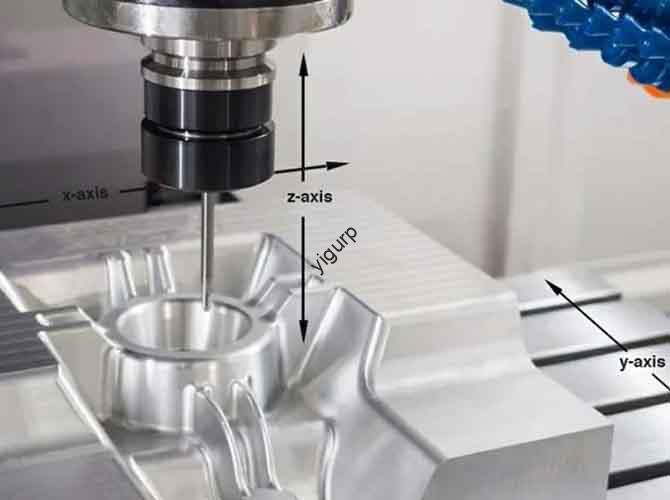
| 3-Axis CNC Milling | Cuts material along three axes (X, Y, Z) for flat or simple 3D parts | Auto brackets, electronic enclosures | 40% |
| 5-Axis CNC Milling | Adds two rotational axes (A, B) for complex, curved parts | Aerospace turbine blades, medical implants | 25% |
| CNC Turning | Spins material while a tool cuts it, ideal for cylindrical parts | Engine shafts, bolts, hydraulic fittings | 20% |
| Wire EDM | Uses electric spark to cut hard materials, no physical contact | Mold inserts, precision gears, surgical blades | 10% |
Real-world process selection
A Minnesota medical shop uses 5-axis CNC milling to create custom hip implants from titanium. The process lets them carve complex, bone-like textures into the implant. This improves bone integration for patients.
For automotive parts, a Michigan shop uses CNC turning to produce 10,000+ aluminum engine shafts per week. They achieve consistent diameter tolerances of ±0.001 inches.
Top Materials for U.S. CNC Machining
Matching material to function
Choosing the right material depends on your part’s needs. Strength, weight, corrosion resistance, and heat tolerance all matter. Here are the most used materials in U.S. CNC shops.
| Material | Key Advantages | Common Applications | U.S. Market Share (NTMA 2024) |
|---|---|---|---|
| Aluminum | Lightweight, low cost, easy to machine | Auto parts, aerospace components, laptop frames | 35% |
| Steel (Carbon/Alloy) | High strength, durable, cost-effective | Structural parts, tools, engine components | 25% |
| Titanium | High strength-to-weight ratio, corrosion-resistant, biocompatible | Aerospace turbine blades, medical implants | 15% |
| Stainless Steel | Corrosion-resistant, easy to clean | Medical instruments, food processing equipment | 12% |
Material choices in action
A California aerospace shop uses titanium for satellite brackets. Titanium’s strength and light weight reduce launch costs. Its corrosion resistance protects the brackets from space radiation.
For medical devices, a Massachusetts shop uses 316L stainless steel for surgical scissors. Stainless steel’s corrosion resistance means the scissors can be sterilized repeatedly. The material holds its sharpness through frequent use.
How to Choose a Reliable CNC Machining Shop in the U.S.
Step 1: Verify industry certifications
Picking the right CNC shop is critical. Poor quality or delayed deliveries can derail your project. Start with certifications.
For aerospace, AS9100 is mandatory. It ensures compliance with NASA and FAA standards for precision and traceability. A Texas shop that supplies Lockheed Martin holds AS9100. They undergo quarterly audits to maintain their status.
For medical parts, ISO 13485 is essential. This standard ensures parts meet FDA requirements for biocompatibility and sterility.
Step 2: Evaluate equipment and capabilities
Ask about the shop’s CNC machines. Do they have 3-axis or 5-axis capability? Ask about their software, like CAD/CAM tools such as SolidWorks or Mastercam.
If you need complex parts like curved aerospace components, a shop with 5-axis machines is a must. A Colorado shop has 10 5-axis CNC mills. They use cloud-based CAD software to collaborate with clients. This lets them share design updates in real time and reduce errors.
Step 3: Review quality control processes
Top shops have in-house QC labs. They use tools like coordinate measuring machines (CMMs) and laser scanners to check part dimensions.
A Washington shop that makes medical implants uses a CMM to inspect 100% of its parts. This ensures each implant meets FDA tolerance requirements of ±0.0002 inches. They provide a detailed QC report with every order, including dimensional data and material certificates.
Step 4: Check lead times and scalability
Most U.S. CNC shops can deliver prototypes in 3–7 days and production parts in 2–4 weeks.
For high-volume orders of 10,000+ parts , ensure the shop has automated equipment. Look for robotic loaders to handle the volume. An Ohio shop uses robotic loaders on its CNC turning machines. They produce 50,000 aluminum bolts per week , cutting lead times by 30% compared to manual loading.
What Regulations Apply to U.S. CNC Machining?
Aerospace and defense compliance
Compliance is non-negotiable in U.S. CNC machining. Rules protect safety, ensure part quality, and support industry standards.
Parts for military or space applications must meet ITAR (International Traffic in Arms Regulations) requirements. Shops must be registered with the U.S. State Department. They must track all parts to prevent unauthorized access.
A Florida shop that makes missile components was ITAR-audited in 2023. They passed because they maintained strict access controls. This included biometric locks on CNC machines and detailed part logs.
Medical device compliance
Parts for healthcare must meet FDA standards. This includes biocompatibility testing for implants. It also requires traceability, tracking materials from supplier to final part.
A Massachusetts shop that makes orthopedic implants keeps records of every titanium batch for 10 years . This follows FDA rules. If defects appear, they can trace back to the source.
Environmental regulations
The EPA regulates waste disposal from CNC machines. This includes metal chips and cutting fluids. It also regulates air emissions.
Shops must recycle metal scrap. Most U.S. shops recycle 90%+ of aluminum and steel scrap (NTMA data). They must treat cutting fluids to prevent water pollution.
An Oregon shop uses a closed-loop system to filter and reuse cutting fluids. This reduces waste by 70% and meets EPA guidelines.
What Trends Are Shaping the Future of U.S. CNC Machining?
Industry 4.0 integration
More shops are using IoT (Internet of Things) sensors to monitor CNC machines in real time. These sensors track temperature, vibration, and tool wear.
A Pennsylvania shop installed sensors on its 5-axis mills. The system predicts maintenance needs before machines break down. This reduced downtime by 25% and cut maintenance costs by 18% in 2024.
Additive manufacturing + CNC hybrid systems
Shops are combining 3D printing with CNC machining. First, 3D printing creates near-net-shape parts. Then CNC machining refines them to precise tolerances.
A California aerospace shop uses this hybrid approach for titanium satellite parts. 3D printing reduces material waste by 60% . CNC machining ensures the parts meet aerospace tolerances.
AI-powered programming
AI software is automating CNC programming. What used to take hours of manual work now takes minutes.
A Michigan shop uses AI to generate CNC programs for automotive parts. Programming time dropped from 8 hours to 30 minutes. The software also optimizes tool paths. This cuts cutting time by 15% , lowering production costs for clients.
Conclusion
CNC machining in the United States offers world-class precision, quality, and innovation. The industry serves critical sectors like aerospace, medical, automotive, and defense with advanced processes and materials. When choosing a partner, verify certifications, equipment capabilities, quality control processes, and scalability. Understanding material options and regulatory requirements helps you avoid costly mistakes. With trends like IoT integration, hybrid 3D printing-CNC systems, and AI-powered programming, the U.S. industry continues to evolve. By following this guide, you can confidently navigate the U.S. CNC machining landscape and find the right partner for your project.
FAQ About CNC Machining in the United States
1. How much does CNC machining cost in the U.S.?
Costs vary by part complexity, material, and batch size. A simple aluminum bracket using 3-axis milling costs $20–$50 per part for small batches of 10–100 parts. A complex titanium aerospace part using 5-axis milling can cost $500–$2,000 per part. For high-volume orders of 10,000+ parts, costs drop by 30–50% due to economies of scale.
2. What’s the typical lead time for CNC machined parts in the U.S.?
Prototypes take 3–7 days. Production parts take 2–4 weeks. Rush service for prototypes is available for an extra 20–30% fee. A Colorado shop once delivered 50 aluminum automotive brackets in 48 hours for a client with an urgent deadline.
3. Can U.S. CNC shops handle both small-batch prototypes and large-volume production?
Yes —most shops are flexible. A Minnesota shop makes 10–20 prototypes for medical startups. They then scale up to 10,000+ parts once the product launches. They use the same CNC machines for both, ensuring consistency between prototypes and production parts.
4. What’s the tightest tolerance U.S. CNC shops can achieve?
For 5-axis milling and wire EDM, shops can achieve tolerances as tight as ±0.0001 inches. This is about the width of a human hair. This precision is critical for aerospace parts like turbine blades, where tiny deviations can cause performance issues.
5. Do U.S. CNC shops offer design assistance?
Most do! Many shops have engineers who review client designs to optimize them for CNC machining. They might add fillets to reduce tool wear or adjust wall thickness to prevent warping. A Texas shop helped an aerospace startup redesign a satellite bracket. This cut machining time by 20% and reduced material costs by 15% .
Discuss Your Projects with Yigu Rapid Prototyping
Navigating CNC machining in the United States requires the right expertise and partners. At Yigu Technology, we specialize in connecting innovators with top-tier U.S. machine shops. These shops meet the highest standards for aerospace, medical, automotive, and defense applications.
Whether you need rapid prototypes in days or high-volume production runs, we offer tailored solutions. Our team provides design for manufacturability feedback, material selection guidance, and end-to-end project management. We work with certified shops across the country that excel in 5-axis milling, CNC turning, and wire EDM processes.
If you have a project ready to move forward, contact Yigu Rapid Prototyping today. Let’s turn your ideas into precision-machined reality.