
Introduction
If you have ever tried to machine hard metals like titanium or needed to cut complex internal shapes, you know the limits of traditional methods. Tools wear out fast. Materials crack or distort. But there is another way. Electric Discharge Machining (EDM) uses controlled electrical sparks to erode material. It never touches the workpiece, so there is no mechanical force, no tool wear, and no distortion. It can cut any conductive material, no matter how hard, and hold tolerances down to a few microns. In this guide, I will explain how EDM works and break down the five main types—Sinker, Wire, Hole Drilling, Micro, and EDM Milling. You will learn what each one does best, with real examples to help you choose the right process for your parts.
How Does Electric Discharge Machining Work?
EDM is simple in concept. An electrode and a conductive workpiece are submerged in a liquid called dielectric fluid—usually deionized water or oil. A voltage is applied, and when the gap between electrode and workpiece is just right, a spark jumps across. The spark generates intense heat, up to 10,000°C, melting and vaporizing a tiny bit of the workpiece. The dielectric fluid cools the area and flushes away the debris. Millions of sparks happen every second, gradually shaping the part.
Because the tool never touches the workpiece, there are no cutting forces. This means you can machine fragile or thin-walled parts without distortion. And since hardness does not matter, you can cut hardened steel, carbide, titanium, and exotic alloys just as easily as soft metals.
Sinker EDM: For Complex 3D Cavities
Sinker EDM is also called ram EDM or die-sinking EDM. It uses a custom-shaped electrode—usually made of graphite or copper—that is the negative of the desired shape. The electrode is slowly lowered into the workpiece, sparking away material to form cavities, pockets, and complex 3D features.
How It Works
The electrode is machined to the exact shape you want to create. It is then mounted on a ram that moves vertically. As it descends into the workpiece, sparks erode the material, creating a precise mirror image of the electrode. Oil is used as the dielectric, and it helps achieve smooth surface finishes.
Real-World Example
An automotive mold maker needed to produce a dashboard component with intricate undercuts. Using a sinker EDM with a graphite electrode, they created the cavity in one setup. The surface finish was Ra 0.2 μm, smooth enough that no post-machining polishing was needed. This cut lead time by 25 percent compared to conventional methods.
Best Applications
- Mold and die cavities
- Aerospace components with complex internal features
- Parts requiring sharp corners and fine details
Wire EDM: For Precise 2D and Tapered Cuts
Wire EDM uses a thin, continuously moving wire as the electrode. The wire travels along a programmed path, cutting through the workpiece like a bandsaw, but with spark erosion instead of teeth. Deionized water is the dielectric, and it flushes away debris as the cut proceeds.
How It Works
A spool feeds brass or molybdenum wire through the workpiece, guided by precision wire guides. The machine moves the workpiece (or the wire head) in two axes to create the desired shape. Modern machines also tilt the wire to cut tapers up to 30 degrees. Multiple passes, called skim cuts, improve surface finish and accuracy.
Key Data
The global wire EDM market is growing fast. It is projected to rise from (2.47 billion in 2024 to )3.33 billion by 2029, a compound annual growth rate of 6.7 percent. Automotive and medical device industries are driving this growth.
Real-World Example
A medical device manufacturer needed titanium surgical blades only 0.5 mm thick. The edges had to be razor-sharp and consistent. Using wire EDM, they held ±1 micron tolerance across hundreds of blades. This precision ensured every blade cut reliably during surgery.
Best Applications
- Punches and dies for stamping
- Extrusion dies
- Precision parts with tight tolerances
- Cutting thick plates or large workpieces
Hole Drilling EDM: For Small, Deep Holes
Hole drilling EDM, also called fast hole EDM or small hole EDM, is designed to drill tiny, deep holes quickly. It uses a hollow electrode—like a tube—through which dielectric fluid is forced at high pressure. This flushes debris out fast, allowing rapid drilling.
How It Works
The hollow electrode spins as it descends, maintaining a small gap for sparking. High-pressure dielectric jets through the electrode, clearing eroded material and cooling the zone. Holes as small as 0.1 mm can be drilled to depths many times their diameter.
Real-World Example
An aerospace supplier needed to drill over 100 cooling holes in a turbine blade made of Inconel 718, a superalloy that is extremely hard to machine. Each hole was 2 mm deep. With hole drilling EDM, they drilled each hole in 12 seconds—much faster than laser drilling—and with no heat-affected zone that could weaken the blade.
Best Applications
- Cooling holes in turbine blades and vanes
- Starter holes for wire EDM
- Holes in hardened materials
- Fuel injector nozzles
Micro EDM: For Miniature Components
Micro EDM (μEDM) is a specialized form of EDM for creating extremely small features. It uses tiny electrodes—sometimes less than 0.1 mm in diameter—and very low energy discharges to achieve precision down to ±0.1 microns.
How It Works
Micro EDM machines use special power supplies, often RC circuits, that produce very small, controlled sparks. The electrodes are often made on the machine itself by wire electrical discharge grinding (WEDG) to ensure perfect concentricity and size.
Real-World Example
A pacemaker manufacturer needed 0.1 mm diameter holes in a titanium housing for wire leads. Using micro EDM, they produced over 500 units with zero defects. The process met all medical device quality standards and allowed the pacemaker to be smaller and more comfortable for patients.
Best Applications
- Medical devices like stents and implants
- Micro-electro-mechanical systems (MEMS)
- Tiny gears and nozzles
- Watch components
EDM Milling: For Flexible 3D Shaping
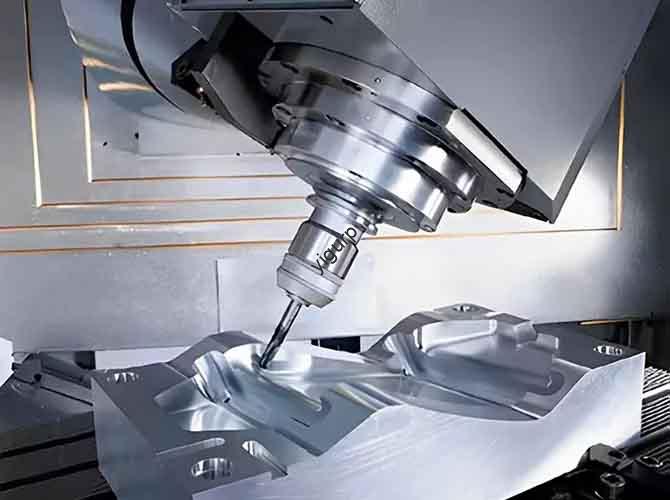
EDM milling combines elements of sinker EDM with the flexibility of CNC milling. Instead of a custom-shaped electrode, it uses simple cylindrical electrodes that move along programmed tool paths to create 3D shapes layer by layer.
How It Works
A rotating cylindrical electrode, like an end mill, moves across the workpiece in multiple axes. Sparks erode material along the path, gradually building up the shape. The electrode wears during the process, but the machine compensates by adjusting the path or using wear-sensing algorithms. Oil is typically used as the dielectric.
Real-World Example
A robotics firm needed a complex 3D gear housing with internal features that would have required expensive custom electrodes for sinker EDM. By using EDM milling with a standard cylindrical electrode, they avoided the $3,000 per part custom tooling cost. During production, they found a design error and adjusted the tool path immediately, reducing scrap by 40 percent.
Best Applications
- Prototyping complex parts
- Low-volume production where custom electrodes are too expensive
- 3D shapes requiring frequent design changes
- Parts with deep, narrow cavities
How to Choose the Right EDM Type for Your Project
| Feature | Sinker EDM | Wire EDM | Hole Drilling | Micro EDM | EDM Milling |
|---|---|---|---|---|---|
| Electrode | Custom shape | Thin wire | Hollow tube | Micro-rod | Simple cylinder |
| Tolerance | ±2–5 μm | ±0.5–2 μm | ±1–3 μm | ±0.1–1 μm | ±1–4 μm |
| Dielectric | Oil | Deionized water | Water or oil | Water | Oil |
| Best for | 3D cavities | Precision 2D cuts | Small deep holes | Miniature features | Flexible 3D shapes |
| Typical part | Mold cavities | Surgical blades | Turbine holes | Pacemaker parts | Robot housings |
What Are the Latest Trends in EDM?
EDM technology keeps advancing. Here are two trends worth watching.
AI and Automation
New EDM machines use artificial intelligence to monitor the sparking process and adjust parameters in real time. This reduces the need for operator intervention by 40 percent and boosts machine uptime by 30 percent. Predictive maintenance alerts operators when components need service, preventing unexpected breakdowns.
Sustainability
Manufacturers are switching to eco-friendly dielectric fluids that are less hazardous and easier to dispose of. Energy-efficient power supplies and generators cut electricity consumption. Some machines now recycle dielectric fluid, reducing waste and operating costs.
Conclusion
Electric Discharge Machining gives you a way to cut hard materials and create complex shapes that traditional methods cannot handle. The five main types—Sinker, Wire, Hole Drilling, Micro, and EDM Milling—each have strengths for different jobs. Sinker makes intricate cavities. Wire delivers precision 2D cuts. Hole drilling punches tiny deep holes. Micro EDM creates miniature features. EDM milling offers flexibility for complex 3D shapes without custom electrodes. By matching the right process to your part, you can achieve tight tolerances, excellent surface finish, and reliable results, even in the toughest materials.
FAQ About Electric Discharge Machining
1. Can EDM machine non-conductive materials?
No. The workpiece must be electrically conductive. Metals like steel, titanium, and copper work. Ceramics and plastics do not. For non-conductive materials, consider laser machining or ultrasonic machining.
2. Which EDM type is cheapest for low-volume runs?
EDM milling is often most cost-effective for small batches. It uses simple cylindrical electrodes instead of expensive custom shapes. For high volumes, the cost of custom electrodes in sinker EDM gets spread over many parts.
3. How does electrode material affect performance?
Graphite electrodes handle high temperatures well and are cheaper. They are great for large cavities. Copper electrodes offer better precision and surface finish for small, detailed parts. The choice depends on your application.
4. What is the smallest hole EDM can drill?
Micro EDM can drill holes as small as 0.08 mm in diameter. That is finer than a human hair. For reference, a human hair is about 0.05 to 0.1 mm thick.
5. Does EDM leave a damaged layer on the surface?
Wire EDM and micro EDM can leave a very thin recast layer, but it is usually less than 1 micron thick. For critical applications, a final skim cut or light polishing removes it. Sinker EDM with oil dielectric often produces surfaces with no visible recast layer.
Discuss Your Projects with Yigu Rapid Prototyping
At Yigu Rapid Prototyping, we have deep experience with all types of electric discharge machining. Our team helps clients in aerospace, medical, and automotive select the right process for their parts. We handle sinker EDM for complex cavities, wire EDM for precision cuts, hole drilling for cooling passages, micro EDM for tiny features, and EDM milling for flexible 3D shaping. We combine modern machines with skilled operators to deliver tight tolerances and excellent surface finishes. Whether you need a prototype or production run, we provide transparent quotes and reliable results. Contact Yigu today to discuss your project and find the best EDM solution for your needs.