
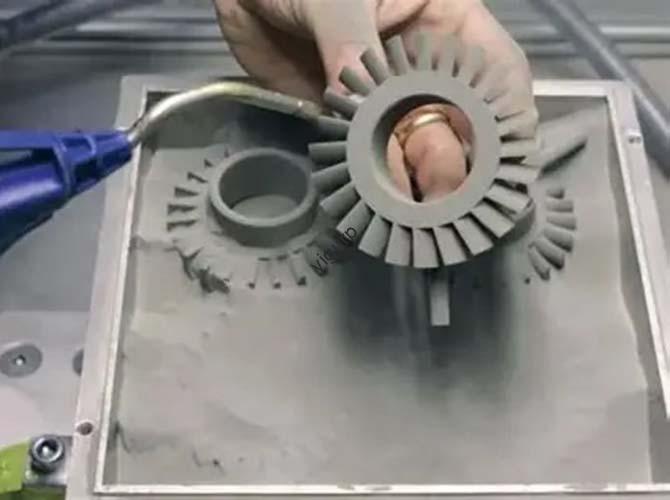
For over 100 years, we made steel parts by casting, forging, or machining. These methods work well but have limits. They struggle with complex shapes, high tooling costs, and slow lead times.
Steel 3D printing (additive manufacturing) changes this. It builds parts layer by layer from a digital file. It doesn’t replace old methods, but it adds a powerful tool to your workflow.
Companies choose steel 3D printing to solve problems traditional methods can’t. This guide helps engineers, designers, and pros master it. We cover materials, technologies, design rules, and real-world examples.
Why Steel 3D Printing?
Better Than Old Methods?
Steel 3D printing fixes key pain points of traditional manufacturing. It unlocks new possibilities for design and production.
It’s not perfect for every job. But it excels where old methods fail—complexity, speed, and part consolidation.
Top Key Benefits?
- Complex Shapes: Make internal channels, mesh structures, and curves impossible to machine or cast.
- Part Consolidation: Print multiple parts as one. This cuts assembly time and reduces weak points.
- Fast Prototyping: Make working steel prototypes or custom tools in days, not weeks.
- Less Waste: Uses only the powder needed for the part. Traditional machining wastes up to 90% of raw material.
Printable Steel Alloys
Which Steel Works?
Steel 3D printing uses metal powder. Each alloy is made for specific jobs. Choosing the right one is key to success.
We break down the most common options, their traits, and best uses. This helps you match material to your project.
Stainless Steels
Stainless steels are the most used in 3D printing. They balance strength, corrosion resistance, and cost.
316L Stainless Steel Properties: Austenitic steel with top rust resistance. It’s flexible, strong, and easy to weld. Costs less than other alloys.
Applications: Medical implants, surgical tools, marine gear, food/chemical processing parts. Great for consumer products needing a smooth finish.
Case Study: A medical firm used 316L to print patient-specific hip implants. The porous surface helped bone grow into the implant. Traditional implants had a 15% failure rate; this dropped to 2% with 3D printed 316L.
17-4 PH Stainless Steel Properties: Precipitation-hardening martensitic steel. Moderate strength when printed. Heat treatment boosts hardness to 40-47 HRC.
Applications: High-strength prototypes, aerospace parts, manufacturing jigs and fixtures. Works well for parts needing strength and corrosion resistance.
Tool Steels
Tool steels are made for extreme hardness, wear resistance, and high-temperature strength. 3D printing lets them take complex shapes.
H13 Tool Steel Properties: Hot-work tool steel with great toughness. Heat-treatable to 50-54 HRC. Resists thermal fatigue well.
Applications: Injection mold inserts, die-casting tools with conformal cooling. These channels (impossible to drill) cut cooling times by 30-50%.
M2 Tool Steel Properties: High-speed tool steel. Keeps hardness and wear resistance at high temps. Good for cutting tools.
Applications: Custom cutting tools, high-wear industrial parts, specialized tool inserts. Lasts 2x longer than traditional M2 tools.
Maraging Steels
Maraging steels are low-carbon, high-nickel alloys. They offer unbeatable strength and toughness with simple heat treatment.
MS1 Maraging Steel Properties: Ultra-high tensile strength (up to 2000 MPa). Low-temperature aging (no quenching) causes minimal warping.
Applications: Aerospace parts, motorsport components, high-strength tooling. Used for parts where stiffness is critical.
Steel Alloy Comparison
This table simplifies alloy choice by highlighting key traits and uses.
| Steel Type | Key Trait | Post-Treat Hardness | Relative Cost | Primary Use |
|---|---|---|---|---|
| 316L Stainless | Corrosion Resistance | ~25 HRC | Low | Medical, Marine, Food-Grade |
| 17-4 PH Stainless | High Hardenable Strength | 40-47 HRC | Medium | Aerospace, High-Strength Fixtures |
| H13 Tool Steel | Thermal Fatigue Resistance | 50-54 HRC | High | Conformal Cooled Tooling |
| MS1 Maraging Steel | Ultra-High Strength | 52-56 HRC | Very High | Aerospace, High-Performance Tooling |
Core Printing Technologies
Which Tech to Use?
There’s no single “steel 3D printing” method. Three main technologies exist. Each has strengths, weaknesses, and best uses.
Your choice depends on part size, detail, cost, and performance needs. We break down each tech clearly.
DMLS / SLM
Direct Metal Laser Sintering (DMLS) or Selective Laser Melting (SLM) is a powder bed process. It’s the most common for high-detail parts.
How it works: A thin layer of steel powder is spread on a build plate. A laser melts and fuses powder into the part shape. The plate lowers, and the process repeats.
Pros: High resolution (0.1 mm), fully dense parts (>99.7%), great surface finish. Mechanical properties match or beat wrought steel.
Cons: Slow build speed, small build volumes, high cost per part. Needs support structures to manage stress.
Binder Jetting
Binder Jetting is a two-step process. It’s fast and cost-effective for batches.
How it works: A printhead deposits liquid binder onto steel powder, gluing particles into a “green” (fragile) part. The part is then sintered in a furnace to fuse powder into solid steel.
Pros: Fast build speed, low cost for batches, no supports needed. Nested parts save time and material.
Cons: Lower density (96-99%), medium resolution (0.2-0.5 mm). Sintering causes 20% shrinkage (must plan for this).
WAAM
Wire Arc Additive Manufacturing (WAAM) is a directed energy process. It’s for large, simple parts.
How it works: A robotic arm uses welding wire to deposit molten steel layer by layer. It’s like automated welding.
Pros: Very fast deposition (kg per hour), large build volumes (over 1m³), low material cost.
Cons: Low resolution (>1.0 mm), rough surface. Needs extensive CNC machining to reach final dimensions.
Technology Comparison
| Feature | DMLS / SLM | Binder Jetting | WAAM |
|---|---|---|---|
| Process | Laser fuses powder bed | Binder glues powder, then sintered | Robotic arm welds with wire |
| Resolution | Very High (0.1 mm) | Medium (0.2-0.5 mm) | Low (>1.0 mm) |
| Part Density | >99.7% | 96-99% | >99.5% |
| Build Speed | Slow | Fast (batches) | Very Fast |
| Best For | High-complexity, high-performance parts | Medium-volume production | Large structural components |
Tech Choice Scenarios
How to Pick?
Use these real-world scenarios to choose the right technology. They match common project needs to the best tech.
Scenario 1: Patient-Specific Cranial Implant Need: Complex lattice structure for bone integration, biocompatible, high precision. Choice: DMLS. 316L powder ensures biocompatibility. High resolution is key for the lattice.
Scenario 2: 500 Small Steel Levers Need: Moderate complexity, low cost, fast delivery. Mechanical loads are low. Choice: Binder Jetting. Nest all 500 parts in one build. Lower cost and faster than DMLS.
Scenario 3: 2-Meter Marine Test Rig Part Need: Large size, high strength, low cost. Fine details not required. Choice: WAAM. Builds large parts fast. CNC machine post-print for final dimensions.
Engineering Part Performance
Are Printed Parts Weaker?
A common myth: 3D printed steel parts are weaker than traditional ones. This is false with proper process and post-processing.
Printed parts can match or exceed wrought steel strength. Key factors are anisotropy and post-processing.
Anisotropy Explained
Anisotropy means properties differ by direction (X, Y, Z axis). Layer-by-layer printing causes this.
Design for this: Orient parts to put stress on the X/Y axis (stronger than Z). Ask your service for orientation guides.
Critical Post-Processing
Post-processing is not optional. It ensures strength, accuracy, and durability. Key steps:
- Stress Relief: Low-heat treatment relieves internal stress. Prevents warping or cracking.
- HIP: Hot Isostatic Pressing uses high temp/pressure to eliminate porosity. Boosts fatigue life.
- Heat Treatment: Aging, hardening, or tempering to reach desired hardness/strength.
Key Mechanical Properties
- Tensile Strength: DMLS 316L reaches 550+ MPa. Elongation (stretch before breaking) is 40%+.
- Hardness: Heat-treated H13 hits 52 HRC. Good for tooling and wear parts.
- Fatigue Resistance: HIP and polishing boost fatigue life. Critical for moving parts.
- Density: >99.5% density needed for aerospace/medical parts. DMLS + HIP achieves this.
Standards & Testing
Steel 3D printing follows strict standards. ASTM and ISO set rules for materials and processes.
Ask for: Certificate of conformance, material data sheet (MDS), and test results for your part’s alloy.
Design Rules (DfAM)
How to Design for 3D Printing?
Designing for Additive Manufacturing (DfAM) optimizes parts for printing. It cuts cost and boosts performance.
Forget traditional design rules. Embrace 3D printing’s strengths with these key tips.
- Embrace Complexity: Complexity is free. Add internal lattices, conformal cooling, or consolidated parts.
- Minimize Supports: Angles >45° are self-supporting. Avoid overhangs to cut material and labor.
- Control Wall Thickness: DMLS needs ≥0.5 mm walls. Binder Jetting needs 1.0-2.0 mm. Hollow thick sections.
- Plan for Machining: Critical surfaces (threads, bearings) need extra stock for post-machining.
- Orient Wisely: Orient parts to reduce supports, improve strength, and speed up printing.
Cost & Lead Time
What Drives Cost?
Understanding cost drivers helps you save money. These are the main factors:
- Material: 316L is cheapest. MS1 maraging steel costs 3x more per kg.
- Machine Time: Driven by part height (Z-axis) and volume. Tall parts cost more than short ones.
- Post-Processing: Heat treatment, machining, or polishing adds cost. Keep it simple when possible.
Typical Lead Times
Lead times vary by complexity and post-processing:
- Simple Parts: 3-7 business days (316L, minimal post-processing).
- Complex Parts: 2-4 weeks (H13 tool steel, heat treatment + machining).
Even complex parts are faster than traditional tooling (which takes 4-8 weeks).
Real-World Examples
Aerospace Bracket Lightweighting
Challenge: An aircraft maker needed to lighten an aluminum bracket. Every gram saved cuts fuel use.
Solution: Redesigned with topology optimization. Printed via DMLS in MS1 maraging steel.
Results: 60% lighter than aluminum, higher stiffness. Passed all flight certification tests.
Conformal Cooling Mold Insert
Challenge: A plastics firm had long cycle times (60 seconds) and part warpage. Straight cooling lines were inefficient.
Solution: 3D printed H13 insert with conformal cooling via DMLS. Channels followed part contours.
Results: Cycle time dropped to 40 seconds. Insert paid for itself in 4 months. Warpage was eliminated.
Conclusion
Steel 3D printing has moved from prototyping to production. It’s a powerful tool for modern manufacturing.
Success depends on three things: choosing the right alloy, picking the best technology, and designing for 3D printing.
It doesn’t replace traditional methods. But it solves problems old methods can’t—complexity, speed, and lightweighting.
As alloys and machines improve, steel 3D printing will become even more accessible. It’s the future of steel part production.
FAQ
Can 3D printed steel replace wrought steel? Yes, for many parts. DMLS + HIP produces parts with matching or better properties.
Is steel 3D printing expensive? It’s cheaper than traditional tooling for small batches. DMLS is costly for large parts; use WAAM instead.
What’s the smallest feature I can print? DMLS can print 0.1 mm features. Binder Jetting needs 0.2 mm minimum.
Do I need special software to design parts? No, but DfAM software (like Autodesk Fusion 360) optimizes parts for printing.
Can I print food-safe steel parts? Yes, use 316L stainless steel. Ensure post-processing removes all powder and contaminants.
How do I handle steel powder waste? Unused powder can be recycled (sieved and reprocessed). Follow safety rules for metal powder.
Discuss Your Projects with Yigu Rapid Prototyping
Whether you need aerospace parts, custom tooling, or medical implants, Yigu Rapid Prototyping is here to help. Our team has years of experience with steel 3D printing—from alloy selection to DfAM and post-processing. Contact us today to discuss your project goals—we’ll turn your digital designs into high-quality steel parts, fast and affordably.