
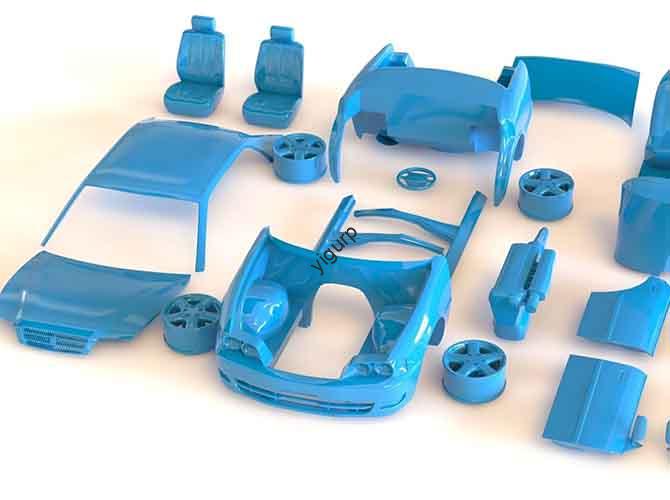
The deadline is tomorrow. The design review is in the morning. Your production line is stopped, waiting for one part. In these moments, a model on a screen is not enough. You need a real part you can hold, and you need it now. For years, engineers have believed you have to choose: speed or quality. Get it fast, and you risk bad measurements, weak materials, and a rough surface that doesn’t represent your final product. This trade-off has caused stress for designers everywhere.
We are here to tell you that this is no longer a real problem. Getting high-quality, accurate, and functional prototypes in 24 hours is not only possible, it can be done reliably. Success doesn’t need a miracle. It needs a deep understanding of the right technologies, a careful approach to preparing your files, and clear communication with your manufacturing partner. This guide gives you the expert framework to navigate the world of quick prototyping, ensuring your next urgent part arrives on time and without compromise.
Is the “Fast vs. Good” Myth Still True?
For decades, manufacturing followed the “Fast, Cheap, Good” triangle. The rule was simple: you could only pick two. This idea came from traditional methods that needed long lead times for tooling and complex machine setups. A “rush job” in that world meant cutting corners, and the results were often predictable.
Engineers developed valid fears about rushed orders based on past experiences:
- Poor surface finish needing hours of hand work.
- Wrong measurements making the part useless for testing.
- Material compromises, using something weaker just because it was available.
- Hidden costs from rework, re-orders, and project delays.
However, modern digital manufacturing is completely different. Technologies like industrial 3D printing and laser cutting work directly from a CAD file. They remove the need for tooling and greatly reduce setup time. This shift challenges the old trade-off. When managed correctly, speed is a natural part of the process, not a compromise on quality. The key is knowing how to use these technologies and workflows to your advantage.
What Technologies Make 24-Hour Prototypes Possible?
Not all processes are built for speed. To achieve a 24-hour turnaround, you must select a technology designed for rapid, direct-from-CAD production. These three are the workhorses of quick prototyping.
| Technology | How It Works | Best For | Common Materials | Key Speed Advantage |
|---|---|---|---|---|
| Selective Laser Sintering (SLS) | A laser fuses polymer powder, layer by layer. | Complex internal channels, functional parts, interlocking assemblies. | Nylon 12 (PA12), Flexible TPU | Self-supporting. Parts can be nested tightly, maximizing build volume. |
| Stereolithography (SLA) | A UV laser cures liquid resin, layer by layer. | High-detail models, smooth surfaces, presentation pieces. | Standard Resins, Tough Resins | Extremely high resolution with a smooth finish, needing minimal post-processing. |
| Laser Cutting | A focused laser cuts a 2D path from a sheet of material. | Flat parts, gaskets, enclosures, mounting plates. | Acrylic (PMMA), Delrin (POM), Plywood, ABS | Incredibly fast for 2D profiles with almost zero setup time. |
How Does SLS Work for Quick Parts?
SLS is a powerhouse for functional quick prototyping. It uses a laser to fuse powder, typically Nylon 12 (PA12) , into solid parts. The main speed advantage is that the unfused powder acts as a support structure for the parts being built. This removes the time-consuming process of designing and removing dedicated supports. It also allows parts to be “nested” or tightly packed within the build chamber. A single machine run can produce dozens of parts at once. The resulting parts are durable, strong, and perfect for functional testing.
Why Choose SLA for Detailed Prototypes?
When visual appeal and fine details are most important, SLA is the best choice. It uses a UV laser to cure liquid resin. With layer heights as thin as 25 to 100 microns, it can produce features and textures that other technologies miss. Parts have an exceptionally smooth surface finish right out of the machine, closely resembling injection-molded plastic. For concept models or form-fit checks where looks are critical, SLA greatly reduces the need for sanding or filling, which saves precious time.
When Is Laser Cutting the Fastest Option?
For parts defined by a 2D profile, nothing beats the raw speed of laser cutting. A high-power laser, guided by a vector file, cuts through sheet material with extreme precision. The process is incredibly fast, and because it’s a 2D operation, file processing and machine setup are almost instant. If your urgent need is for a flat or layered part like a panel, gasket, or bracket, laser cutting offers the most direct and fastest path from file to part, often completing the job in minutes.
What Is Your Pre-Flight Check for a Perfect File?
The single most important factor you control to ensure a 24-hour turnaround is the quality of your digital file. A flawed or unclear CAD file is the number one cause of delays. Before you submit your design for a rush order, run through this checklist. It is the most critical step you will take.
Step 1: Finalize Your Design
This sounds obvious, but it’s a common mistake. Once you submit a file for an express service, the process moves immediately. Any design change will require you to pull the order and resubmit, resetting the clock. A 24-hour turnaround relies on a “design freeze.” Make sure all stakeholders have signed off and you are 100% confident in the geometry before you click “upload.”
Step 2: Verify Watertight Geometry
For 3D printing, your model must be “watertight” or “manifold.” This means it must represent a single, continuous solid volume with no holes in its surface mesh. A small gap will confuse the software and lead to a failed print. Most CAD programs have tools to check this. A few minutes spent verifying your STL file can save a full day of delay.
Step 3: Set Realistic Feature Sizes
Every process has physical limits. Features that are too thin will break or may not form at all. For a robust functional part made with SLS, design for a minimum wall thickness of 0.8mm to 1.0mm. For the fine details possible with SLA, you might achieve features as small as 0.5mm. Designing with these limits in mind prevents manufacturability holds.
Step 4: Export in the Correct Format
For 3D printing (SLS, SLA), the universal standard is the STL format. For 2D laser cutting, a vector-based format like DXF or DWG is standard. Submitting the wrong file type requires a manual conversion, which introduces a potential point of error and delay.
Step 5: Consolidate Your Files
To avoid confusion, put all necessary information into a single, well-organized ZIP file. It should contain:
- The primary manufacturing file (e.g., the STL).
- A simple PDF drawing that calls out 2-3 critical dimensions, specifies the material, and notes any required finish.
This simple package ensures our engineers have everything they need without time-consuming email exchanges.
How Do You Balance Speed and Precision?
In manufacturing, “tolerance” refers to the acceptable range of variation in a dimension. For a 24-hour prototype, it’s essential to understand the relationship between speed and tolerance.
Why Can Speed Affect Tolerances?
It comes down to physics. In processes like SLS and SLA, parts must cool and stabilize after the build. A standard turnaround allows for a longer, more gradual cooling period, which minimizes internal stresses and potential warping. An express service requires a more accelerated cooling cycle. While our processes are highly controlled to manage this, it can introduce slightly more deviation than a standard service. The goal is to balance speed with stability to deliver a part that is both fast and functional.
How Do You Communicate Critical Dimensions?
Most designs do not require every single dimension to be held to the tightest possible tolerance. Usually, only two or three features are truly critical—perhaps a bore diameter for a bearing or the distance between mounting holes.
By clearly identifying these critical-to-function dimensions on a supplementary PDF drawing, you tell our team where to focus. This allows us to optimize the build for overall speed while ensuring our quality control process prioritizes the measurements that matter most to you. This simple act is invaluable for quick prototyping success.
| Service Level | Typical Tolerance Range | Best For |
|---|---|---|
| Standard (5-7 days) | ± 0.15mm or ± 0.15% | Production-quality prototypes, parts with tight assembly requirements. |
| Express (24 hours) | ± 0.30mm or ± 0.3% | Form/fit checks, functional prototypes, rapid iteration where speed is the priority. |
What Is the Real Cost of Speed?
Express services and rush fees are directly tied to the real, tangible costs incurred to prioritize your order above all others. Understanding the logic behind the pricing helps build a transparent and trusting partnership. The rush fee is not a penalty; it is an investment in priority access to resources.
What Are You Paying For?
When you select a 24-hour service, the fee covers:
- Dedicated Machine Allocation: Your job is placed at the front of the queue, often interrupting a previously planned build.
- Operator Overtime: Your part may need to be started after normal business hours or monitored overnight.
- Expedited Post-Processing: Your part jumps the line for cleaning, bead blasting, and final inspection.
How Is the Rush Fee Calculated?
Think of pricing as a multiplier based on urgency. As the turnaround time shrinks, the multiplier increases to cover the logistical costs of prioritization.
| Turnaround Time | Price Multiplier (Conceptual) | Example |
|---|---|---|
| Standard (5-7 days) | 1.0x (Base Cost) | A part with a base cost of $100 costs $100. |
| Priority (2-3 days) | 1.5x – 2.0x | The same part might cost $150 – $200. |
| Express (24 hours) | 2.5x – 3.5x+ | The same part could cost $250 – $350 or more. |
What Is the Final Mile: Getting the Part to You?
Your part has been manufactured, inspected, and packed in 24 hours. The final step is getting it into your hands.
Should You Choose Express Shipping or Local Pickup?
- Express Shipping: For most clients, overnight shipping is the default. It’s convenient and reliable. However, you are dependent on the carrier’s network, which can be subject to weather or logistical delays. A good partner will use robust packaging and provide tracking information immediately.
- Local Pickup: If your partner is geographically close, local pickup is the fastest and most reliable method. It completely eliminates carrier risk. A part finished on a Saturday evening can be in your possession that same day. It also gives you the chance to inspect the part on-site and speak with the engineers who made it.
A Real-World Case Study: How Does It Work in Practice?
Let’s walk through a real scenario that shows how these principles come together.
The Challenge: A medical device company was preparing for a critical production run on Monday morning. On Friday afternoon, an engineer discovered a design flaw in a custom fixture used on the assembly line. Without a redesigned part, the entire production run would be halted, costing thousands per hour in downtime. They needed a functional replacement part by Monday at 8:00 AM.
The 24-Hour Timeline:
- Friday, 2:00 PM: The engineer finalizes the CAD. They verify the STL file is watertight and the wall thicknesses are appropriate for SLS. They submit a ZIP file with the STL and a PDF calling out the critical bore diameter.
- Friday, 2:15 PM: Our engineering team confirms the part is manufacturable in Nylon 12 (PA12) . The client approves the express fee.
- Friday, 4:00 PM: The part is nested into the next express build on an SLS machine. The 17-hour build begins.
- Saturday, 9:00 AM: The build cycle completes. The machine enters a controlled cooldown phase.
- Saturday, 3:00 PM: The chamber is cool. A technician breaks out the part from the powder.
- Saturday, 4:00 PM: The part is cleaned and bead blasted.
- Saturday, 5:00 PM: Quality Control inspects the critical bore diameter, confirming it is within tolerance.
- Saturday, 5:30 PM: The client is notified that the part is ready for local pickup.
The Result: The client picked up the part Saturday evening. The new fixture was installed first thing Monday morning. The production run proceeded on schedule with zero downtime. This is the power of quick prototyping when executed with precision.
Conclusion
The ability to move from an urgent need to a tangible, high-quality part in 24 hours is a transformative capability. It is not about cutting corners. It is about a strategic alignment of factors: choosing the right digital manufacturing technology like SLS or SLA, meticulously preparing your CAD file for success, and maintaining clear communication about your critical requirements. By mastering this process, you can turn a potential crisis into a demonstration of agility, keeping your projects moving forward at the speed of innovation.
FAQ
What is the fastest way to get a prototype part?
The fastest method depends on the part. For a simple, flat part, laser cutting can produce it in minutes. For a complex 3D shape, an express 3D printing service like SLS or SLA with a 24-hour turnaround is the best option. Choosing local pickup over shipping also saves a day.
How much does a 24-hour prototype cost?
It costs more than a standard service. Expect a price multiplier of about 2.5x to 3.5x the base manufacturing cost. For a part that normally costs $100 to make in 5-7 days, a 24-hour express service might cost $250 to $350 or more. This fee covers the cost of prioritizing your job and using expedited workflows.
What file format should I submit for a quick prototype?
For 3D printing (SLS, SLA), submit a high-quality STL file. Make sure it is “watertight” or “manifold.” For laser cutting, submit a vector file like DXF or DWG. It’s also very helpful to include a simple PDF drawing that notes the material and any critical dimensions.
Discuss Your Projects with Yigu Rapid Prototyping
Facing an urgent deadline? Need a high-quality part in your hands tomorrow? At Yigu Rapid Prototyping, we specialize in quick prototyping with 24-hour turnaround options. Whether you need a durable SLS nylon part for functional testing, a high-detail SLA model for a client presentation, or a precisely cut laser-cut component from acrylic or aluminum, we have the technology and expertise to deliver. Our team in Shenzhen follows a rigorous process to ensure your parts are accurate and ready on time. Contact us to discuss your urgent project and get started today.