
Introduction
If you work with plastic parts, you have almost certainly encountered PVC. It is everywhere. From the pipes in your walls to the insulation on your phone charger, this material is a backbone of modern manufacturing. PVC plastic molding is the set of processes used to shape Polyvinyl Chloride into useful products. Its popularity is not an accident. PVC offers a rare combination of low cost, high strength, chemical resistance, and natural flame retardancy. This makes it a go-to choice for industries as diverse as construction, healthcare, and electronics. This guide will give you a complete picture of PVC molding. We will start with the material itself, explaining its unique properties and how additives transform it. Then we will dive into the main molding techniques—injection, extrusion, and blow molding—and help you understand which one to use. Finally, we will explore the real-world applications that make PVC so essential and look at what the future holds for this versatile plastic.
What Makes PVC a Unique Molding Material?
To understand why PVC is molded so often, you first need to understand the material itself. Polyvinyl Chloride is a synthetic thermoplastic polymer. Its chemical structure is (C2H3Cl)n. As a thermoplastic, it can be melted, shaped, and then re-melted and reshaped again. This is a critical property that makes recycling possible.
But the most remarkable thing about PVC is its dual personality. It exists in two very different forms.
- Rigid PVC (uPVC or RPVC): This form is hard, strong, and durable. It does not contain plasticizers. You see it in products like window frames, water pipes, and credit cards.
- Flexible PVC: By adding plasticizers, the material becomes soft and pliable. The more plasticizer you add, the more flexible it gets. This form is used for things like medical tubing, wire insulation, and garden hoses.
This ability to be both rigid and flexible from the same base polymer is a huge advantage. It lets engineers and designers solve a wide range of problems with one material family.
What Are the Key Molding Properties of PVC?
Several key properties make PVC an ideal candidate for high-volume molding.
- Cost-Effectiveness: PVC is made from common salt (chlorine) and ethylene (from natural gas or oil). These are abundant and relatively inexpensive raw materials. This translates directly into a low cost-per-part, especially for large production runs.
- Durability and Toughness: PVC parts are strong and resist wear. They have a long service life, even in tough conditions. PVC water pipes, for example, are estimated to last over 100 years.
- Chemical Resistance: The material resists attack from a wide range of chemicals, including acids, alkalis, and oils. This makes it perfect for pipes, tanks, and containers that hold corrosive substances.
- Excellent Electrical Insulation: PVC is a very poor conductor of electricity. This property makes it the standard material for insulating wires and cables and for making electrical boxes and housings.
- Natural Flame Resistance: Because of its high chlorine content, PVC is difficult to ignite and is self-extinguishing. It will not continue to burn once the flame source is removed. This is a critical safety feature in many applications.
These qualities have made PVC the third-most widely produced synthetic plastic polymer in the world, after only polyethylene and polypropylene.
How Do Additives Customize PVC?
A critical point for any engineer is that pure PVC resin is almost never used on its own. What we call “PVC” in a product is actually a PVC compound. It is a carefully mixed blend of the base resin and various additives. These additives are not fillers; they are performance enhancers that tailor the material for a specific job.
- Plasticizers: These are the most common additives. They are used to create flexible PVC. Molecules like phthalates work their way between the long polymer chains, pushing them apart. This reduces the forces holding the chains together, making the material soft and bendable. The amount of plasticizer controls exactly how flexible the final product will be.
- Heat Stabilizers: These are essential for processing. PVC can start to break down at the high temperatures needed for molding. Without stabilizers, it would release corrosive hydrochloric acid gas, become discolored, and become brittle. Stabilizers prevent this breakdown, protecting both the material and the expensive molding machinery.
- Fillers: Materials like calcium carbonate or talc are often added. They can reduce the overall cost by displacing some of the more expensive polymer. They can also increase stiffness, improve impact strength, and change the surface finish.
- Impact Modifiers: For rigid PVC products that need to be tough, like window frames or pressure pipes, these additives are crucial. They are rubbery materials mixed into the rigid matrix. They work by absorbing the energy from an impact, preventing cracks from forming and spreading.
What Are the Main PVC Molding Techniques?
Shaping PVC into a finished product is done through several well-established molding processes. The right choice depends on the part’s shape, how many you need, and what it needs to do.
Injection Molding: For Complex 3D Parts
Injection molding is the process for making complex, three-dimensional PVC parts in high volumes. It is ideal for components with intricate details and tight tolerances. The process works by injecting molten PVC under high pressure into a precisely machined metal mold.
The cycle has four main stages:
- Clamping: The two halves of the mold are closed and held together tightly.
- Injection: PVC compound pellets are fed into a heated barrel. A rotating screw melts and mixes the plastic. Once enough molten material is ready, the screw pushes forward, injecting it into the mold cavity.
- Cooling: The molten PVC cools and solidifies inside the mold, taking on its exact shape. This is often the longest part of the cycle.
- Ejection: The mold opens, and ejector pins push the finished part out. The cycle then repeats.
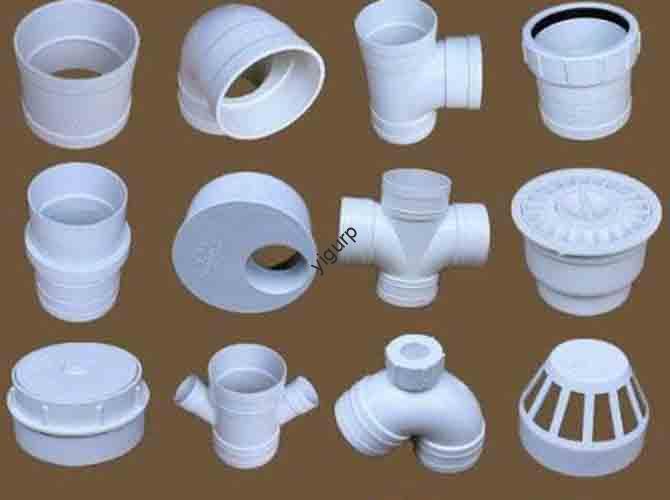
Typical applications: Pipe fittings (like elbows and tees), electrical boxes, automotive interior parts, and housings for electronics.
Extrusion Molding: For Continuous Profiles
Extrusion is the process for making parts with a continuous, linear shape. Think of squeezing toothpaste out of a tube—you get a long, uniform shape. Extrusion works the same way, pushing molten PVC through a shaped die to create a constant profile, which is then cooled and cut to length.
It is a highly efficient, high-volume process. The material is fed into an extruder, melted, and forced through the die. As the hot plastic profile emerges, it is pulled through cooling tanks and sizing tools to hold its precise dimensions.
Typical applications: Water and sewage pipes, window and door frames, vinyl siding, electrical conduit, and the insulation on wires and cables.
Blow Molding: For Hollow Parts
Blow molding is the technique used to create hollow plastic parts, like bottles and containers. It is similar to glass blowing. A tube of hot, molten PVC (called a parison) is placed inside a mold. Air is blown into the tube, inflating it until it pushes against the cool mold walls, taking on the shape of the cavity.
The main steps are:
- Parison Formation: An extruder creates a hollow tube of molten PVC.
- Mold Capture: The mold closes around the parison, pinching off the bottom.
- Inflation: Compressed air is blown into the parison, inflating it to fill the mold.
- Ejection: The part cools, the mold opens, and the finished hollow part is ejected.
Typical applications: Bottles for chemicals and household products, large storage containers, and automotive fluid ducts.
How to Choose the Right Molding Process
This table summarizes the key differences to help you decide.
| Feature | Injection Molding | Extrusion Molding | Blow Molding |
|---|---|---|---|
| Part Complexity | High (complex 3D shapes) | Low (continuous 2D profiles) | Medium (hollow 3D shapes) |
| Tooling Cost | High | Low to Medium | Medium |
| Production Volume | High | Very High (continuous) | Medium to High |
| Best For… | Small, intricate components | Pipes, profiles, sheets | Bottles, tanks, containers |
| Material Waste | Low | Very Low | Low to Medium |
What Are Common Molding Challenges with PVC?
Molding PVC requires careful control. Its unique properties mean you have to watch out for a few specific problems.
- Thermal Degradation: PVC has a narrow window between its melting point and the temperature where it starts to break down. If the material gets too hot, it degrades and releases corrosive hydrochloric acid gas. This gas can damage expensive molds and machine parts. The solution is precise temperature control across the barrel and nozzle, and using the correct heat stabilizers in the compound.
- Dimensional Instability (Shrinkage): Like all plastics, PVC shrinks as it cools. If this shrinkage is not managed, parts can warp or be out of tolerance. The solution involves expert mold design that accounts for the material’s specific shrinkage rate, using the correct holding pressure to pack more material in during cooling, and controlling the cooling rate.
- Weld Lines: When molten plastic flows around an obstacle in the mold (like a hole), it splits and then meets again on the other side. This meeting point is called a weld line, and it can be a cosmetic flaw and a structural weak point. The solution is to optimize the gate location and injection speed to ensure the two flow fronts are hot enough when they meet to fuse together strongly.
What Are the Core Advantages of Using PVC?
The widespread use of PVC is driven by a powerful combination of benefits.
- Unmatched Cost-Effectiveness. The raw materials are cheap, and the high-volume processes are efficient. This results in a very low cost per part, making PVC the default choice for many cost-driven applications.
- Exceptional Durability. PVC products last a long time. They resist weathering, corrosion, and chemical attack. This long life means lower replacement costs over time.
- Superior Chemical Resistance. PVC is inert to many acids, alkalis, and inorganic chemicals. This makes it ideal for pipes, tanks, and medical devices that contact various substances.
- Design Versatility. The ability to make both rigid and flexible versions from the same polymer family is a huge advantage. One material can be used for a rigid window frame and a soft medical tube.
- Reliable Electrical Insulation. Its excellent dielectric properties make it the trusted standard for insulating wires and housing electrical components, ensuring safety.
- Proven Fire Safety. The high chlorine content makes PVC naturally flame-resistant and self-extinguishing. This helps limit the spread of fire.
- Recyclability. As a thermoplastic, PVC can be melted and re-molded. Manufacturing scrap and end-of-life products can be recycled into new items, supporting a more circular economy.
Where Is PVC Used in Industry?
The benefits of PVC are best seen in its widespread use across nearly every industry.
Construction and Building
This is the largest market for PVC, mostly using the rigid uPVC form.
- Pipes and Fittings: For water supply, drainage, and sewage, thanks to its corrosion resistance and long life.
- Window and Door Profiles: uPVC frames are energy-efficient, weather-resistant, and durable.
- Vinyl Siding and Fencing: Low-maintenance, resists rot and insects.
- Flooring: Used in luxury vinyl tiles (LVT) and sheet flooring for its durability and water resistance.
Electrical and Electronics
PVC’s insulating properties make it essential here.
- Cable and Wire Insulation: The most common application, using flexible PVC.
- Electrical Conduit and Trunking: Rigid PVC pipes protect wiring in buildings.
- Junction Boxes and Switch Plates: Injection molded PVC provides safe, non-conductive enclosures.
Healthcare and Medical
Medical-grade flexible PVC is used for its clarity, flexibility, and ability to be sterilized.
- IV Bags and Blood Bags: The material is the industry standard for fluid storage.
- Medical Tubing: Used for catheters and respiratory equipment.
- Inhalation Masks: Soft, pliable PVC is used for single-use masks.
- Blister Packaging: Rigid PVC film protects pills and sterile instruments.
Automotive Industry
PVC contributes to durability and aesthetics in vehicles.
- Interior Trim and Dashboards: A flexible PVC “skin” creates soft-touch surfaces.
- Wire Harnesses: PVC insulation protects the car’s complex electrical systems.
- Weather Stripping: Extruded flexible PVC seals doors and windows.
Consumer Goods
The versatility and low cost of PVC make it a staple for everyday products.
- Footwear: Used for durable and waterproof soles.
- Toys: Its toughness and ability to hold color make it popular.
- Credit Cards: The classic plastic card is made of rigid PVC.
- Garden Hoses: A classic example of a flexible PVC product.
Conclusion
PVC plastic molding remains a cornerstone of modern manufacturing for very good reasons. It offers a rare and powerful combination of low cost, exceptional durability, and incredible versatility. Through techniques like injection molding, extrusion, and blow molding, this single material family can be transformed into everything from the rigid pipes that carry our water to the soft, flexible tubing used in hospitals. The ability to precisely tailor its properties with additives ensures it can meet the demands of countless industries. As we look to the future, its proven performance, economic advantages, and recyclability ensure that PVC will continue to be an essential material for engineers and product designers for decades to come.
Frequently Asked Questions
- What is the main difference between rigid and flexible PVC?
The difference is the addition of plasticizers. Rigid PVC (uPVC) contains no plasticizers and is hard and strong. Flexible PVC has plasticizers added, which make the material soft and bendable. The amount of plasticizer determines just how flexible it becomes. - Is PVC safe for medical and food-contact applications?
Yes, specific grades of PVC are formulated for these sensitive uses. Medical-grade PVC is tested for biocompatibility and is used for IV bags and tubing. Food-grade PVC must meet regulations like those from the FDA and is used for things like blister packs and some food containers. Always ensure the material certification matches your application’s requirements. - How do I choose between injection molding and extrusion for my PVC part?
The choice depends on the part’s shape. If your part is a discrete, three-dimensional object with complex features (like a fitting or a housing), choose injection molding. If your part is a continuous, linear shape with a constant cross-section (like a pipe, a profile, or a sheet), choose extrusion. - Can PVC be recycled?
Yes, absolutely. PVC is a thermoplastic, which means it can be melted and reformed. Manufacturing scrap, like trimmings from extrusion or rejected parts from injection molding, is often ground up and reused. Post-consumer PVC products, like old pipes or window frames, can also be collected, cleaned, processed, and recycled into new products. - What are the main challenges when molding PVC?
The main challenges revolve around its sensitivity to heat. Thermal degradation is the biggest risk—if the material gets too hot, it can break down and release corrosive gas. This requires precise temperature control and the use of proper heat stabilizers. Managing shrinkage to prevent warping is another key challenge that requires good mold design and process control.
Discuss Your PVC Molding Project with Yigu Rapid Prototyping
At Yigu Technology, we have extensive experience working with PVC in all its forms. We understand the nuances of this versatile material, from selecting the right rigid or flexible compound to optimizing mold designs to prevent common issues like degradation and shrinkage. Whether you need injection molded fittings, extruded profiles, or blow-molded containers, our team can guide you through the process. We help you choose the most cost-effective technique, select the right additives for your application, and ensure your parts are manufactured to the highest quality. If you have a project that could benefit from the unique properties of PVC, let’s discuss it. We are ready to help you bring your design to life.