
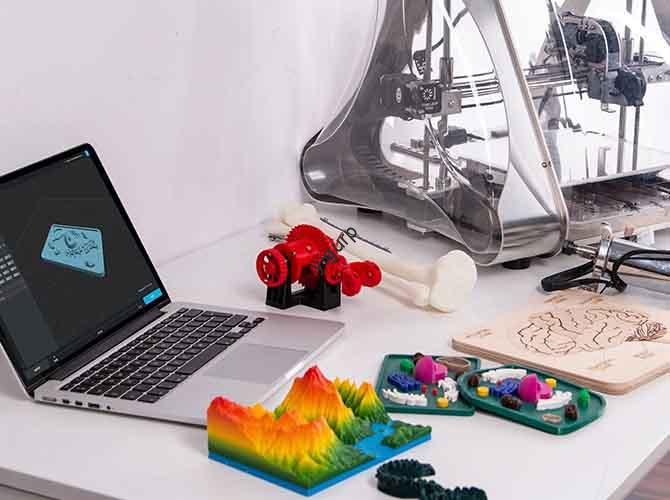
You have a great idea for a new product. Maybe it’s a clever gadget, a helpful tool, or a piece of smart technology. The journey from that initial spark to a real, market-ready product is exciting, but also full of uncertainty and risk. The biggest challenge isn’t a lack of ideas. It’s a lack of a clear, organized process to bring them to life. This guide provides that complete roadmap. We will walk through the entire journey, from your first concept through smart prototyping to final production. This is your blueprint for turning a vision into reality.
What Is the Product Development Process?
To succeed, you must see product development not as one single act, but as an organized, multi-stage journey. This process provides a framework that organizes the chaos, aligns your team, and ensures that every step builds logically on the last.
Product development is more than just building. It is a strategic business process that identifies a market opportunity and carefully translates it into a sellable, valuable product. It includes everything from initial brainstorming and market analysis to engineering, design, testing, and launch. It’s the discipline of making calculated decisions to solve a specific customer problem in a way that is technically possible and financially smart.
What Are the 7 Key Stages?
Successful products rarely emerge by chance. They are developed through a careful, step-by-step process.
- Idea Generation & Scoping: This is the beginning. You brainstorm, identify customer problems, and look at market trends to generate potential product concepts. The goal is quantity and creativity.
- Idea Screening: Not all ideas are good. This stage acts as a filter. You check concepts against your business goals, market size, and technical possibility. Ideas that don’t fit are set aside.
- Concept Development & Testing: The surviving idea is fleshed out. You define its features, benefits, and target user. You then test this concept with potential customers to measure interest and gather feedback.
- Business Analysis & Strategy: The concept is carefully reviewed. This involves forecasting sales, estimating development and production costs, setting a potential price, and calculating profit margins. This stage determines if the product makes business sense.
- Product Development & Prototyping: This is where the idea becomes real. Engineers and designers work together to create the actual product. This phase is all about prototyping, testing, and refining the design.
- Test Marketing: Before a full launch, the product is introduced to a limited market. This “soft launch” tests the product, pricing, and marketing message in a real-world setting, allowing for final adjustments.
- Commercialization & Launch: With a validated product, you commit to full-scale production and market launch. This involves ramping up manufacturing and executing your sales and marketing plan.
Why Does a Structured Process Matter?
Skipping stages in this process is a gamble. Each step is designed to answer critical questions and reduce uncertainty. Trying to jump from a raw idea straight to manufacturing without proper validation is a leading cause of failure. According to CB Insights, 35% of startups fail because they build a product that no one wants. A structured process is your best defense against wasting time and money on the wrong thing.
What Role Does Prototyping Play?
Within the larger process, prototyping is not just a single step. It’s a continuous, vital activity. It’s the engine of learning and risk reduction. It allows you to turn abstract ideas into real forms that can be tested and improved long before you spend money on expensive tools and mass production.
What Is a Prototype?
A prototype is an early, experimental, and often simplified version of a product. Its purpose is not to be perfect, but to be a tool for learning. Whether it’s a simple paper sketch or a fully functional model, a prototype makes your idea real. It shifts the conversation from “What if?” to “What do you think of this?”
What Are the Core Benefits of Prototyping?
Building prototypes early and often is one of the best investments you can make.
- Risk Reduction: Prototypes are your early warning system. They help you find design flaws and usability problems when the cost of change is lowest.
- Early User Feedback: You can validate your idea with real users. Watching someone interact with a prototype gives you unfiltered insights you can’t get from a survey.
- Better Stakeholder Communication: A physical model is far more convincing than a slide deck. It helps secure buy-in from investors and aligns your team.
- Cost Savings: It is exponentially cheaper to fix a problem in a 3D-printed model than after you’ve spent thousands on production molds.
What Are the Different Levels of Prototypes?
Prototypes exist on a spectrum of detail. The right type depends on what you need to learn.
| Detail Level | Examples | Primary Purpose |
|---|---|---|
| Low-Detail | Paper sketches, cardboard mockups, simple wireframes. | Testing basic concepts and user flow. |
| Medium-Detail | Clickable digital mockups, basic 3D prints. | Testing usability, interaction, and look and feel. |
| High-Detail | Fully interactive models, looks-like/works-like models. | Final validation before committing to production. |
Use low-detail prototypes to explore broad ideas. Use medium-detail to refine the user experience. Use high-detail for final testing and approval.
How Does the Step-by-Step Design Loop Work?
Modern product development is not a straight line. It’s a cyclical process. The most successful teams embrace a “build-test-learn” loop, using prototypes to rapidly gather feedback and make improvements.
What Is the Build-Test-Learn Loop?
This is the core concept. The process is simple but powerful.
- Build: Create a prototype that is just good enough to test your most important assumption.
- Test: Put that prototype in front of real users and observe their behavior. Give them tasks to complete and watch what they do.
- Learn: Analyze the feedback. What worked? What confused people? What surprised you?
- Repeat: Use these learnings to build the next, improved version of the prototype, and start the cycle again.
The goal of each cycle is not a perfect product, but a specific learning that reduces risk and moves you closer to a solution customers will love.
How Do You Run a Useful User Test?
The value of a prototype is only realized through effective testing.
- Define your goals: Before you test, write down 1-3 specific questions you want to answer. For example, “Can users find the ‘checkout’ button in under 10 seconds?”
- Recruit the right testers: Find 5-7 people who represent your actual target customer. Avoid testing with friends and family—they will be too polite to give honest feedback.
- Prepare a test script: Don’t just ask “Do you like it?” This invites politeness. Instead, give users tasks to complete.
- Bad question: “Is this interface easy to use?” This is a leading question.
- Good task: “Show me how you would use this to [specific goal]. Tell me what you are thinking as you do it.” This lets you observe real behavior.
- Analyze and prioritize: Look for patterns in the feedback. What problems did multiple users have? Focus on fixing the most critical issues first.
What Common Design Pitfalls Should You Avoid?
Being aware of these biases helps you stay on track.
- Confirmation bias: The tendency to only listen to feedback that confirms what you already believe. Actively seek out criticism. It’s the most valuable data.
- Over-engineering early prototypes: Don’t waste time perfecting a low-detail prototype. The goal is to learn quickly, not to make it beautiful.
- Ignoring negative feedback: It’s hard to hear that people don’t like your idea. But this feedback is a gift. It points directly to what needs improvement.
How Do You Go from Prototype to Production?
After countless iterations, you arrive at a final, validated design. This is your “golden prototype.” Now you face the final hurdle: turning that one perfect model into thousands or millions of identical, high-quality units.
What Is the “Golden Prototype”?
The golden prototype is the final, approved version of your product. It has been thoroughly tested and meets all functional and aesthetic requirements. This model becomes the benchmark for mass production. It is the physical standard your manufacturing partner must copy. Every detail, from the material finish to how it works, is locked in.
What Is Design for Manufacturability (DFM)?
Design for Manufacturability (DFM) is a critical engineering practice. It’s about designing products so they are easy and cost-effective to produce. DFM involves simplifying part shapes, reducing the number of parts, using standard components, and designing for a specific process like injection molding. A design that is easy to prototype might be a nightmare to mass-produce. Engaging in DFM early ensures a smoother, faster, and cheaper launch.
How Do You Choose a Manufacturing Partner?
Choosing a manufacturer is one of the most critical decisions you will make. You often have to choose between domestic and overseas options.
| Factor | Domestic Manufacturing | Overseas Manufacturing |
|---|---|---|
| Unit Cost | Generally higher | Generally lower |
| Lead Time | Shorter | Longer (includes shipping) |
| Quality Control | Easier to monitor | Requires more diligence |
| Communication | Simpler | Can be challenging |
| IP Protection | Stronger legal framework | Higher risk |
Thoroughly vet potential partners. Ask for references and assess their quality control processes. Your manufacturer is not just a vendor; they are a critical partner in your success.
What Are Tooling and First Article Inspection?
Two key concepts in this phase are tooling and First Article Inspection (FAI) .
- Tooling refers to the custom molds and fixtures needed for mass production, like the molds for injection molding. This is often a significant, one-time cost.
- First Article Inspection (FAI) is the quality control step where you carefully inspect the very first parts that come off the production line. You compare these parts against your golden prototype to ensure the tooling is correct before authorizing full-scale production.
How Do You Manage Time and Budget?
Time and money are your two most limited resources. Without careful management, even the best product idea can fail.
How Do You Create a Realistic Timeline?
A project timeline is a communication tool. Break the project down into key milestones, such as “First Prototype Complete” or “User Testing Round 1 Finished.” These milestones make a large project feel manageable and give you clear points to check progress. Always build buffers into your timeline. Unexpected delays are a rule, not an exception.
How Do You Budget for the Entire Process?
A common mistake is underestimating the true cost. Use this checklist to ensure you’re not caught by surprise.
- [ ] Research & Discovery: Market research tools.
- [ ] Design: Fees for industrial or UI/UX designers.
- [ ] Prototyping: Materials, 3D printing services, engineering time.
- [ ] User Testing: Incentives for test participants.
- [ ] Legal & IP: Patent filing fees.
- [ ] Engineering & Development: Salaries for mechanical and electrical engineers.
- [ ] Manufacturing: Tooling (molds), per-unit production cost.
- [ ] Compliance & Certification: Costs for certifications like FCC or CE.
- [ ] Logistics & Packaging: Packaging design and shipping.
What Are Some Strategies for Cost Control?
- Start with an MVP: Build a Minimum Viable Product with only the essential features to get to market faster and with less investment.
- Use off-the-shelf (OTS) components: Buy standard parts instead of designing everything from scratch.
- Focus on DFM: A design that is easy to make costs less to produce.
- Get multiple quotes: Compare pricing from several potential manufacturing partners.
Conclusion
Product development and prototyping is a step-by-step journey, not a straight line. The path from a brilliant idea to a successful product is paved with assumptions that must be tested. Prototyping is your essential compass, providing the data and insight needed to navigate uncertainty. By embracing a structured process and the cyclical rhythm of building, testing, and learning, you transform guesswork into an evidence-based pursuit. You systematically eliminate risk, refine your vision, and dramatically increase your chances of creating a product that truly has an impact. Your journey starts now. Take your idea and build your first prototype. Even a simple sketch is a step in the right direction.
FAQ
How much does it cost to develop a new product?
Costs vary wildly. A simple mechanical product might cost $10,000-$30,000 to develop. A complex electronic product with custom software and industrial design can easily cost $100,000 to $300,000 or more. The cost depends on complexity, materials, and the number of iterations needed.
How long does product development take?
Again, it depends. A simple product might take 4-6 months from concept to production-ready design. A more complex product can take 12-18 months or longer. Rushing the process almost always leads to mistakes and higher costs later.
Do I need a patent before I start?
Not necessarily. In fact, it’s often better to refine your idea and build a prototype first. A prototype helps you understand your invention better, which is valuable when you do work with a patent attorney. Before sharing your idea with anyone, have them sign a Non-Disclosure Agreement (NDA) .
Discuss Your Projects with Yigu Rapid Prototyping
Ready to begin your product development journey? At Yigu Rapid Prototyping, we are here to help you at every stage. From initial industrial design and detailed CAD modeling to creating functional prototypes using 3D printing and CNC machining, we turn your ideas into reality. Our experienced team in Shenzhen follows a clear, structured process with a strong focus on DFM and a smooth path to production. We treat your ideas with confidentiality and are ready to sign an NDA from day one. Contact us to discuss your project and get a detailed proposal.