
Introduction
If you have ever wondered how complex aerospace parts or precise medical components are made, the answer often lies in a machining center. These versatile and powerful machines are the true backbone of modern manufacturing. However, with so many different types, specifications, and options available, it is easy to feel overwhelmed. Let’s break this down step by step. Whether you are thinking of buying one, training your team, or are just curious about how things are made, this guide has you covered.
1. What Are the Different Types of Machining Centers?
Not all machining centers are the same. The right choice for you depends entirely on the parts you make, the materials you use, and your production volume. Here is a breakdown of the most common types with real-world context.
Vertical vs. Horizontal Machining Centers (VMC vs. HMC)
These two are the most widely used, but their strengths are very different. Let’s compare them directly.
| Feature | Vertical Machining Center (VMC) | Horizontal Machining Center (HMC) |
|---|---|---|
| Spindle Orientation | Vertical (perpendicular to the ground). | Horizontal (parallel to the ground). |
| Best For | Top-surface work like plates and small casings. | Multi-sided parts like engine blocks and gearboxes. |
| Chip Removal | Chips pile on the table and need frequent cleaning. | Chips fall away naturally, aided by gravity. |
| Cost & Footprint | Compact and budget-friendly, ideal for small workshops. | Larger footprint and more expensive, suited for high-volume production. |
Real Case Example: A medical device maker uses a VMC to machine small titanium casings, about 30mm x 20mm. The easily accessible table makes loading and unloading simple, and the coolant system can be directed right at the cutting area. Meanwhile, an automotive plant relies on HMCs for machining engine blocks. By cutting four sides in a single setup, they slashed their production time by 35%.
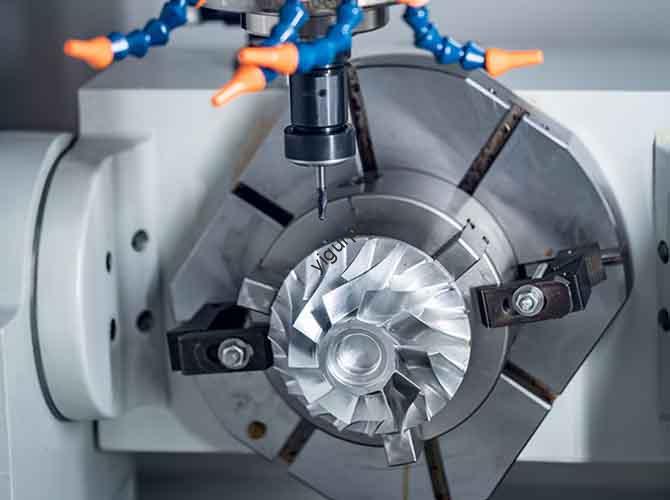
5-Axis Machining Center: Complex Geometry Made Easy
Unlike standard 3-axis models, 5-axis machining centers move along the X, Y, and Z axes, plus two rotary axes (often called A, B, or C). This allows you to machine a part from almost any angle in a single setup. This completely eliminates repositioning errors and dramatically speeds up work.
Case Study: An aerospace supplier needed to produce aluminum housings, about 180mm x 120mm x 60mm, with a very tight tolerance of ±0.008mm for avionics. By using a 5-axis machine, they reduced the setup from four separate operations down to just one. They achieved defect-free parts and easily hit their production target of 8,000 units per year.
Other Common Types
- 3-Axis Mill: This is a basic, affordable machine, great for simple 2.5D work like drilling and face milling.
- Turn-Mill Center: This combines both milling and turning capabilities in one machine. It is ideal for parts that need both types of work, like complex shafts.
- Gantry Machining Center: This is a large, heavy-duty machine designed to handle gigantic parts, such as mold plates over 5 meters long, with high stability.
2. What Are the Key Components of a Machining Center?
Every part of a machining center plays a critical role in its precision and speed. Let’s break down the essential components.
The Core “Brains and Muscles”
- CNC Control System: This is the “brain” of the machine. It runs the programs and controls all movements. A good control system has features like vibration suppression and speed optimization, which are key for smooth, accurate cuts.
- Spindle: This is the “cutting heart”. The spindle speed (RPM) and power are critical specifications. High speeds, like 12,000+ RPM, are great for aluminum. High torque, like 300+ N·m, is necessary for cutting tough steel.
- Tool Magazine and ATC: The tool magazine stores all the cutting tools. The ATC (Automatic Tool Changer) swaps them in and out as needed. For complex parts, a magazine with a capacity of 20 tools or more can cut downtime by 40%.
The Structural Backbone
- Machine Bed and Column: These are typically made of rigid cast iron to reduce vibration. A stable, solid bed ensures the machine maintains its long-term precision.
- Ball Screw and Linear Guideways: These components drive the movement of the axes. Pre-stretched ball screws eliminate backlash, and high-quality linear guideways boost the machine’s rapid traverse rate, which can be up to 60 meters per minute.
Support Systems
- Chip Conveyor: This system automatically removes chips to keep the workspace clean. It is especially critical for HMCs, which generate a high volume of chips.
- Coolant System: This prevents the tool and workpiece from overheating. HMCs often need more robust coolant systems to flush chips out of deep, internal cavities.
3. What Critical Technical Specs Should You Compare?
When you are shopping for a machining center, the specifications are not just numbers on a page. They determine whether the machine can actually do your job. Here is what to focus on.
Precision Metrics
- Positioning Accuracy: This tells you how close the spindle can get to its target. For precision work, you should aim for ±0.005mm or better.
- Repeatability: This tells you how consistently the machine can hit the same target over and over. A value of ±0.003mm or less is ideal for reliable batch production.
Performance Specs
| Spec | What It Means For You |
|---|---|
| Spindle Speed (RPM) | 12,000+ RPM is great for fast aluminum milling. 6,000 RPM is more suitable for cutting steel. |
| Feed Rate | Higher rates, like 20-50 mm/min, mean faster material removal. |
| Table Load Capacity | This must match the weight of your heaviest part. Large molds might need a capacity of 5 tons or more. |
| Pallet Changer | An automated pallet changer swaps workpieces in seconds, which means less downtime and more production. |
Pro Tip: Do not get caught up chasing the biggest numbers. A machine with a 24,000 RPM spindle is overkill if you only ever cut steel. Always balance the specs with your actual needs.
4. What Common Machining Operations Can You Perform?
Machining centers are incredibly versatile and can handle a wide range of tasks.
- Milling: This is the primary operation, using rotating cutters to shape material. It is used for creating flat surfaces or slots.
- Drilling: This creates precise holes. It is often paired with tapping to create threaded holes.
- Contouring and 3D Profiling: This is used to make curved surfaces. It is critical for creating molds or complex aerospace parts.
- Pocketing: This cuts hollow areas, like the cavities inside an engine block.
Case Example: A toy maker used 3D profiling on a VMC to machine mold parts for a popular action figure. The machine ran a tiny 0.15mm cutter for 10.5 hours straight, hitting an accuracy of ±10μm. The finished mold required no post-machining polishing at all.
Conclusion
A machining center is a sophisticated and powerful tool that is essential for modern precision manufacturing. By understanding the key differences between types like VMCs and HMCs, the function of core components like the spindle and control system, and the meaning of critical specs like positioning accuracy, you can make an informed decision. Whether you are machining a simple bracket or a complex 5-axis aerospace component, choosing the right machine for the job is the first step to success.
FAQ
VMC or HMC—Which Should I Buy for Small-Batch Production?
For small-batch production, you should generally go with a VMC. It is cheaper, easier to maintain, and fits in smaller spaces. An HMC only makes financial sense if you are doing high-volume, multi-sided machining for 500 or more parts per month.
How Important Is Spindle Power for My Work?
Spindle power is very important, especially if you cut hard materials. For steel or titanium, aim for a spindle with 15 kW or more. For softer materials like aluminum or plastics, 5-10 kW is usually sufficient. Too little power will lead to slow cuts and rapid tool wear.
Can a 5-Axis Machine Replace My 3-Axis Mill?
It depends entirely on the work you do. If you only perform simple operations like drilling and face milling, a 3-axis machine is more cost-effective. But if you are moving to complex parts with curved surfaces, a 5-axis machine will save you time and significantly improve accuracy.
What Is the Minimum Maintenance Needed for a Machining Center?
Daily, you should clean off chips and check the coolant level. Weekly, you need to lubricate the ball screws and linear guideways. Monthly, you should inspect the spindle for any unusual vibration. Neglecting this basic maintenance can cut the machine’s effective life by 30%.
Discuss Your Projects with Yigu Rapid Prototyping
Are you looking for a trusted partner to handle your precision machining needs? At Yigu Rapid Prototyping, we operate a range of advanced machining centers and have the expertise to tackle projects of any complexity. From simple prototypes to complex production runs, our team is ready to help you succeed.
Contact Yigu Rapid Prototyping today to discuss your project. Let’s build something great together.