
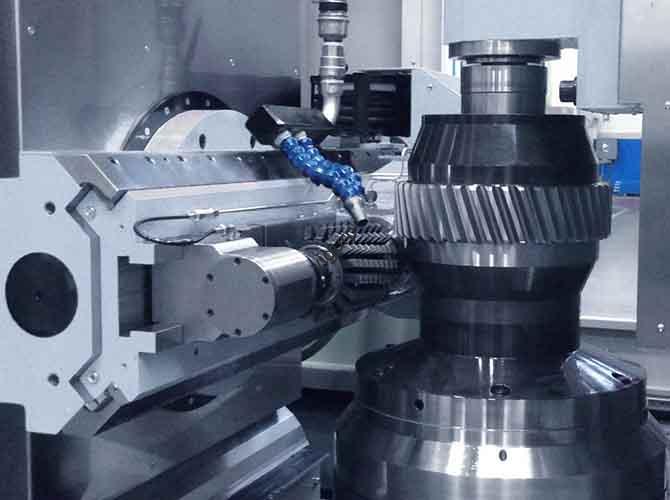
In the heart of modern industrial manufacturing, the humble screw serves as the literal “glue” holding our world together. From the tiny fasteners in your smartphone to the massive bolts securing an aircraft engine, the demand for quality is absolute. Today, over 98% of high-end fastener producers have moved away from traditional manual lathes, favoring CNC machine tool processing screws.
Why the shift? Manual methods are plagued by inconsistent thread dimensions, sluggish production cycles, and high scrap rates. One slip of an operator’s hand can ruin a batch. CNC (Computer Numerical Control) technology solves these “pain points” by introducing digital precision, ensuring that every screw—whether it’s the 1st or the 10,000th—is a perfect carbon copy of the original design. This article explores the professional workflow, technical parameters, and real-world advantages of mastering CNC screw production.
What Is CNC Machine Tool Processing Screws?
CNC screw processing is an automated manufacturing method where high-speed lathes or machining centers use “digital instructions” to shape raw metal into fasteners. Unlike a manual lathe, where a person turns wheels and handles, a CNC system follows G-code and M-code to control tool movements with micron-level accuracy.
Think of the CNC machine as a digital craftsman. It handles the complex geometry of thread pitches, head shapes, and shank diameters without fatigue. For industrial fasteners, this means achieving tolerance levels of ±0.01mm, a feat nearly impossible for human operators to maintain over a long shift.
How Does the CNC Screw Workflow Work?
Creating a high-performance screw is a linear, error-proof sequence. Skipping a single step can lead to structural failure or assembly issues.
1. Material Selection and Preparation
The first step is matching the metal to its future environment.
- Carbon Steel: Best for general-purpose bolts (e.g., DIN 933).
- Stainless Steel (304/316): Essential for medical or marine fasteners that must resist rust.
- Titanium Alloy: The go-to for aerospace screws where high strength and low weight are non-negotiable.
Engineer’s Tip: Always dry your raw material at 80°C for 2 hours if stored in humid areas. Even micro-moisture can lead to surface oxidation during the high-heat machining process.
2. Clamping and Precise Positioning
The raw metal bar (typically 3mm to 50mm in diameter) is secured in the CNC spindle chuck. We use a dial indicator to ensure the “runout” (radial deviation) is less than 0.01mm. If the bar wobbles even slightly, the resulting threads will have uneven depths, making the screw useless for precision machinery.
3. Professional Tool Selection
The tool determines the screw’s surface quality. Using the wrong insert leads to jagged threads and frequent tool breakage.
| Screw Feature | Recommended Tool | Key Advantage |
| Outer Diameter Turning | Carbide Inserts (CCMT) | Handles high speeds (200 m/min) with low wear. |
| Thread Cutting | Indexable Threading Inserts | Ensures a perfect 60° metric thread profile. |
| Head Shaping (Hex/Pan) | HSS End Mills | Sharp edges for clean, burr-free socket shapes. |
4. Programming the “Digital Path”
The CNC machine follows specific codes to execute the “Thread Cutting Cycle.”
- G76: The “master code” for threading. It sets the pitch, depth, and the number of passes the tool takes.
- M03: Controls the clockwise spindle rotation for standard right-hand screws.
For a standard M5 × 0.8mm screw, the program snippet would instruct the tool to move to the starting position and then perform multiple passes, cutting deeper with each stroke until the minor diameter of 4.2mm is reached.
What Are the Optimal Machining Parameters?
To prevent tool wear and ensure a smooth Ra < 1.6 μm surface finish, parameters must be optimized based on the material’s hardness.
| Material | Cutting Speed (m/min) | Feed Rate (mm/rev) | Depth per Pass (mm) |
| Carbon Steel (45#) | 150 – 180 | 0.15 – 0.2 | 0.2 – 0.3 |
| Stainless Steel (304) | 80 – 120 | 0.1 – 0.15 | 0.15 – 0.25 |
| Titanium Alloy | 50 – 80 | 0.08 – 0.12 | 0.1 – 0.2 |
Why Is CNC Better Than Traditional Manual Lathes?
If you are still using manual methods, you are competing at a disadvantage. Let’s look at the hard data comparing the two methods:
Critical Comparison Table
| Aspect | CNC Machine Tool Processing | Traditional Manual Lathe |
| Production Speed | 30–50 screws/hour (M5 size). | 8–12 screws/hour. |
| Thread Accuracy | Pitch tolerance ±0.005mm. | Pitch tolerance ±0.05mm. |
| Scrap Rate | < 1% (via simulation). | 8–12% (human error). |
| Labor Efficiency | 1 operator for 3 machines. | 1 operator per machine. |
Case Study: Precision Screws for Aerospace
An aerospace client recently required Ti-6Al-4V Titanium screws for jet engine mounting. The requirements were brutal: a tensile strength > 900 MPa and a strict 4h thread tolerance.
The CNC Solution:
We utilized Carbide threading inserts with a TiAlN coating to resist the extreme heat generated by titanium. By setting a slower cutting speed of 60 m/min and using 8 precise passes, we achieved the required dimensions.
- The Result: The scrap rate dropped from a previous 15% (manual) to a mere 0.8%.
- Efficiency: Total production time for 1,000 units was slashed from 83 hours to just 20 hours.
How to Handle Inspection and Post-Treatment?
A screw isn’t finished until it’s verified and protected.
- Quality Inspection: We use thread ring gauges for the exterior and CMM (Coordinate Measuring Machines) for critical dimensions. For precision machinery, we aim for a surface roughness (Ra) of less than 0.8 μm.
- Surface Treatment: * Zinc Plating: For carbon steel (stops rust).
- Passivation: For stainless steel (strengthens the oxide layer).
- Deburring: Every screw goes through a vibratory tumbler for 10 minutes. This removes tiny burrs that could cause hand injuries or cross-threading during assembly.
Yigu Technology’s Perspective
At Yigu Technology, we believe that screws are the foundation of engineering integrity. Our YG-2000 series CNC lathes are specifically optimized for this niche. We have integrated auto-tool change systems that reduce downtime by 60% and real-time monitoring sensors that alert operators if a pitch deviates by more than 0.003mm.
As the world moves toward miniaturization, the demand for micro-screws (M1 to M3) is exploding. We are meeting this challenge by integrating ultra-high-precision spindles with runout < 0.005mm, allowing our electronics and medical clients to achieve unprecedented reliability in their fasteners.
FAQ: Mastering CNC Screw Production
What is the smallest screw size a CNC machine can handle?
Standard CNC lathes easily handle M1 screws (1mm diameter). For specialized electronics, custom machines can process M0.5 micro-screws using high-frequency spindles reaching 40,000 RPM.
How do I stop tools from breaking when cutting stainless steel?
Stainless steel is “gummy” and tough. You must use TiAlN or diamond-coated tools and a high-flow, water-soluble cutting fluid (> 5 L/min) to wash away heat and prevent the metal from sticking to the tool.
Can one CNC machine switch between Metric and Imperial threads?
Yes. This is the beauty of CNC. There are no gears to swap manually. You simply change the pitch value in the G76 cycle—for example, 0.8mm for a Metric M5 or 0.0315″ for an Imperial #10-32 screw.
Is heat treatment necessary for all CNC screws?
No, only for high-strength applications. If a screw needs to reach a tensile strength of 800 MPa or higher, it must undergo quenching and tempering after the machining process is complete.
Discuss Your Projects with Yigu Rapid Prototyping
Looking for a partner who understands the micron-level nuances of industrial fasteners? At Yigu Rapid Prototyping, we combine senior engineering expertise with state-of-the-art CNC technology to deliver screws that exceed industry standards. Whether you need a small batch of aerospace titanium bolts or a high-volume run of stainless steel medical fasteners, we have the tools to ensure your project holds together perfectly. Would you like us to review your fastener specifications for a quote? Contact us today!