
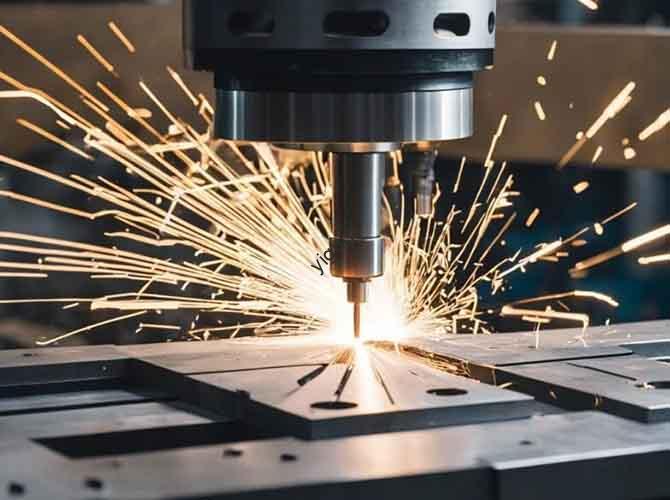
Yigu will focus on the core theme of “CNC How It Works”, starting from the basic cognition of CNC machining, and gradually dismantling the whole process, core terms, process types, practical points and other key contents of its operation. By integrating real industry cases, professional comparative analysis and visual presentation, it helps senior users to master the operation logic of CNC machining, and at the same time answers core problems such as selection, operation, and material adaptation that may be encountered in practice, providing substantial reference value for industrial production, technology research and development and other scenarios.
1. First impression of CNC machining: the core pillar of modern precision manufacturing
In modern manufacturing, CNC (Computer Numerical Control) machining has become an indispensable core technology in high-end fields such as aerospace, automobile manufacturing, medical devices, and electronic components due to its advantages of high precision, high efficiency, and high consistency. Different from the traditional manual machine tool processing mode that relies on the experience of workers, CNC machining accurately controls the movement of the machine tool through computer programs to realize automatic and intelligent cutting of various materials. According to industry data, the accuracy of parts using CNC machining can reach ±0.001mm, and the production efficiency is increased by 30%-50% compared with traditional machining, especially suitable for mass production and the processing needs of complex structural parts.
For senior technicians, production managers, or industry researchers, understanding “CNC How It Works” is not only a technical principle but also a key prerequisite for optimizing production processes, improving product quality, and reducing manufacturing costs. Next, we will comprehensively dismantle the operation logic of CNC machining from the dimensions of origin and development, operation process, and core technology.
2. Exploring the Origin and Development: The Evolution from Manual Control to Intelligent CNC
The development process of CNC machining is the epitome of automation and intelligent upgrading in the manufacturing industry. Understanding its historical evolution provides a clearer understanding of the logical iterations of “CNC How It Works”.
2.1 Origin: The birth of numerical control technology
In the 40s of the 20th century, the United States first proposed the concept of numerical control (NC) to solve the machining problems of complex parts in the aerospace field. In 1952, the Massachusetts Institute of Technology (MIT) collaborated with Parsons to develop the world’s first CNC milling machine, which controlled the movement of the machine tool through perforated paper tape input instructions, marking the birth of CNC machining technology. Although the NC machine tool at this stage solves the simple automatic machining problem, the program modification is cumbersome and the flexibility is poor.
2.2 Development: Computer technology promotes CNC upgrades
In the 70s of the 20th century, with the rapid development of computer technology, NC machine tools were gradually replaced by CNC (computer numerical control) machine tools. The introduction of computers allows programs to be input, stored, and modified directly through the keyboard, greatly improving the flexibility and efficiency of processing. Since then, CNC technology has continued to iterate, from the early 2-axis control to 3-axis, 4-axis, and 5-axis linkage control, and the machining accuracy and complexity have been continuously improved.
In the 21st century, with the integration of industrial Internet and artificial intelligence technology, CNC machining has further developed in the direction of intelligence and digitalization, and intelligent CNC machine tools with real-time data monitoring, remote control, adaptive machining and other functions have emerged, promoting the manufacturing industry to move towards the era of Industry 4.0.
3. In-depth analysis of the working principle: the whole process from the digital model to the finished parts
At its core, “CNC How It Works” is about understanding how digital instructions translate into precise movements of the machine tool to complete the part processing. The entire process can be divided into four core stages, which are interlocked, and the precision of each stage directly affects the final product quality.
3.1 Stage 1: Creation of CAD model – machining “digital blueprint”
CAD (Computer-Aided Design) models are the foundation of CNC machining and are the equivalent of a “digital blueprint” of a part. Technicians use CAD software (such as AutoCAD, SolidWorks, UG, etc.) to create 3D or 2D models according to the design requirements of the part, and clarify key parameters such as the size, shape, and tolerance of the part.
Practical case: When processing the engine block of an auto parts company, the technicians first created a three-dimensional model of the cylinder block through SolidWorks software, accurately marked the diameter, depth, center distance and other key dimensions of the cylinder hole, and set the tolerance range of ±0.005mm to ensure that the subsequent processing met the assembly requirements.
The core requirement of this stage is the accuracy and completeness of the model, and any design errors will directly lead to subsequent processing scrap. Therefore, after creating a CAD model, it is often necessary to perform multiple checksum optimizations.
3.2 Stage 2: Conversion to CNC File – Machine Tool “Operating Instructions”
The CAD model itself cannot be directly recognized by the CNC machine and needs to be converted into a CNC program (i.e., G-code, M-code, etc.) through CAM (Computer-Aided Manufacturing) software. This process is known as “post-processing”.
The specific process is: 1. Import CAD models in CAM software; 2. Set the machining process parameters (such as cutting speed, feed rate, cutting depth, tool type, etc.); 3. The software automatically generates tool paths; 4. The tool path is converted into a CNC program adapted to the specific machine model by the post-processor.
Key tips: Different brands and models of CNC machine tools may have different format requirements for CNC programs, so the selection of post-processors needs to be accurately matched with the machine tool model, otherwise it will lead to program failure or processing errors.
3.3 Stage 3: Machine tool configuration and preparation – “pre-war preparation” for processing
After the CNC program is generated, a series of configurations and preparations are required for the CNC machine tool to ensure smooth machining. It mainly includes the following:
- Workpiece clamping: The material to be processed is fixed on the machine tool worktable through the clamp to ensure firm clamping and accurate positioning, avoiding errors caused by loosening of the workpiece during the processing process.
- Tool installation: According to the requirements of the machining process, select appropriate cutting tools (such as milling cutters, drills, taps, etc.), install them on the machine tool spindle, and set tool length compensation and radius compensation.
- Parameter debugging: Import the CNC program into the machine tool control system, debug the motion trajectory of the machine tool, cutting parameters, etc., and check whether the tool path is reasonable through the empty operation mode to avoid collisions.
Industry experience sharing: In precision parts processing, clamping error is one of the important factors affecting machining accuracy. Senior technicians usually adopt the principle of “unified datum”, select the key surface of the part as the positioning reference, and use dial indicators, dial indicators and other tools to detect the clamping accuracy to ensure that the error is controlled within the allowable range.
3.4 Stage 4: Machining operation execution – physical transformation of digital instructions
After completing all the preparations, the CNC machine tool is started, and the machine tool control system will drive the spindle, worktable and other moving parts to move precisely according to the instructions in the CNC program, and the cutting tool will cut the workpiece. During the machining process, the machine tool will feedback the motion state, cutting force and other data in real time, and if there is an abnormality (such as tool wear, workpiece offset, etc.), the system can alarm or stop in time.
The core of this stage is the motion accuracy and stability of the machine tool. Taking a 5-axis CNC machine tool as an example, it can achieve multi-directional linkage motion and can process complex curved parts (such as aero engine blades) that cannot be completed by traditional machine tools, with machining accuracy reaching the micron level.
4. Interpretation of core terms: understand the “professional language” of CNC machining
To understand “CNC How It Works,” one needs to grasp its core terminology meanings and application scenarios. Here’s a breakdown of the key terms most commonly used in CNC machining, clearly presented in a table format:
| terminology | Full name in English | Core meaning | Application scenarios |
|---|---|---|---|
| CAD | Computer-Aided Design | Computer-aided design for creating digital models of parts | Part design, model optimization, drawing |
| CAM | Computer-Aided Manufacturing | Computer-aided manufacturing, which converts CAD models into CNC programs | Tool path planning, CNC program generation, process parameter setting |
| DNC | Distributed Numerical Control | Distributed CNC to realize centralized control and program management of multiple CNC machine tools | Large-scale production workshops and multi-machine tool collaborative processing scenarios |
| MDC | Manufacturing Data Collection | Manufacturing data collection, real-time collection of machine tool operation, processing quality and other data | Production process monitoring, quality traceability, and efficiency optimization |
| G-code | G-Code | Prepare function codes for controlling the motion trajectory, coordinates, etc. of the machine tool | All CNC machining scenarios such as path control for milling, drilling |
| M-code | M-Code | Auxiliary function codes to control the switching and closing actions of the machine tool (e.g. spindle start-stop, coolant switch) | Auxiliary operation control during machining |
| Rear processor | Postprocessor | A tool that converts CAM-generated toolpaths into CNC programs that are recognizable to a specific machine tool | The last step of CNC program generation is to adapt to different brands of machine tools |
5. The processing technology is revealed: the operating characteristics of different types of CNC machining
Depending on the processing methods and functions, CNC machining has derived a variety of process types, each with its own unique operating principles and applicable scenarios. Here are some of the most common CNC machining processes:
5.1 CNC Milling: The “Engraver” of Complex Contours
CNC milling is the cutting of a workpiece through a rotating milling cutter, which can realize the processing of complex contours such as planes, grooves, curved surfaces, and steps. Its operating principle is: the machine tool spindle drives the milling cutter to rotate at high speed, the worktable drives the workpiece to move according to the path set by the CNC program, and the relative movement between the milling cutter and the workpiece completes the cutting.
According to the number of axes of the machine tool, milling can be divided into 2-axis, 2.5-axis, 3-axis, 4-axis, and 5-axis milling. Among them, 5-axis milling can realize the linkage movement of tools in multiple directions, and can process complex curved parts such as aero engine blades and mold cavities.
Application case: A mold manufacturing enterprise uses a 5-axis CNC milling machine to process the cavity of the automobile bumper mold, and through precise linkage control, it realizes the one-time forming of the complex surface of the cavity, and the processing accuracy reaches ±0.002mm, which greatly improves the service life of the mold and the surface quality of the product.
5.2 CNC Drilling: The “Punching Expert” for Precise Hole Positioning
CNC drilling is a process that uses a drill bit to process holes in the workpiece, and its working principle is: the drill bit is clamped on the machine tool spindle and rotates at high speed, and at the same time feeds along the axial direction to drill the workpiece. CNC drilling can realize functions such as automatic positioning, automatic feeding, and automatic tool change, and can accurately process holes of different diameters and depths.
Compared with traditional manual drilling, CNC drilling has the advantage of high hole position accuracy and good consistency, especially suitable for batch machining multiple evenly distributed holes. In the aerospace field, a large number of precision holes on aircraft parts are processed by CNC drilling technology.
5.3 CNC Grinding: The “Polishing Master” of High-Precision Surfaces
CNC grinding is the use of grinding wheels to grind the surface of the workpiece, mainly used to improve the accuracy and finish of the workpiece surface. Its operating principle is: the grinding wheel rotates at high speed, makes a small amount of cutting on the surface of the workpiece, removes excess material on the surface, and makes the surface of the workpiece meet the specified precision requirements.
CNC grinding has extremely high machining accuracy, with a surface roughness of Ra 0.012μm, and is often used in the final machining process of precision parts, such as bearings, guide rails, tools and other parts grinding processing.
5.4 CNC Routing: The “Cutting Expert” of Non-Metallic Materials
CNC Routing is mainly used for cutting, engraving, and shaping non-metallic materials such as wood, plastic, and acrylic. Its operating principle is similar to milling, but the tools used are usually milling cutters or engraving cutters, which have slower cutting speed and smaller feed to avoid problems such as chipping and cracking of non-metallic materials during machining.
Application scenarios include furniture manufacturing, advertising sign production, plastic parts processing, etc. For example, a furniture company uses CNC routing to machine the pattern of solid wood door panels, which can accurately reproduce the design pattern and improve the aesthetics and personalization of the product.
5.5 Other Machining Types
In addition to the above processes, CNC machining also includes special processes such as laser cutting, waterjet cutting, and plasma cutting. Among them, laser cutting uses high-energy laser beams to melt and vaporize materials, which is suitable for high-precision cutting of metals, non-metals and other materials; Waterjet cutting uses high-pressure water flow entrained abrasives to cut materials, which has the advantages of no thermal deformation and wide cutting range, and is suitable for cutting heat-sensitive materials and complex shapes.
6. Key points of machine tool selection and operation: the key to improving processing efficiency and quality
Mastering “CNC How It Works” requires not only understanding the principles but also mastering key points such as machine tool selection, workpiece clamping, and tool selection in actual operation, which directly affects machining efficiency, quality, and cost.
6.1 Machine tool selection guide: Adaptation requirements are the core
Choosing the right CNC machine tool requires a comprehensive judgment based on factors such as the type of machined parts, precision requirements, batch size, and material characteristics. Here are some common selection points:
- The number of axes is selected according to the complexity of the part: simple parts (such as planes, grooves) can be selected with 3-axis machine tools; For complex curved parts (e.g., molds, aerospace parts), you need to choose a 4-axis or 5-axis machine.
- Choose the machine tool grade according to the accuracy requirements: economical CNC machine tools can be selected for ordinary precision parts; For high-precision parts (such as precision instrument parts), it is necessary to choose high-precision CNC machine tools, with positioning accuracy usually in the 0.001mm level.
- Choose the type of machine tool according to the batch size: small batches and multi-variety parts are suitable for choosing flexible machining centers; For high-volume parts, you can choose a dedicated CNC machine tool or production line to improve processing efficiency.
- Choose machine tool power according to material characteristics: processing hard materials (such as high-strength alloys, steel) requires the selection of high-power and high-rigidity machine tools; For soft materials (e.g. aluminum, plastic), low-power machines can be selected.
6.2 Workpiece loading skills: Accurate positioning is the foundation
The core requirements of workpiece clamping are precise positioning and firm clamping. Here are some commonly used clamping tips and precautions:
- Choose the right fixture: Choose a fixture based on the shape and size of the workpiece, such as flat pliers, pressure plates, special fixtures, etc. For thin-walled parts, flexible fixtures should be selected to avoid deformation of the workpiece caused by excessive clamping force.
- Ensure accurate positioning datum: Select the key surface of the workpiece as the positioning datum, and the datum surface should be flat and smooth to avoid burrs and impurities. If necessary, the datum can be processed first.
- Control the clamping force: The clamping force should be uniform and moderate, not only to ensure that the workpiece is not loose, but also to avoid excessive clamping leading to workpiece deformation. The clamping force can be controlled by means of a torque wrench.
- Perform clamping accuracy testing: After the clamping is completed, use dial indicators, dial indicators and other tools to check the positioning accuracy of the workpiece to ensure that the error is within the allowable range.
6.3 Tool selection strategy: Matching the process is the key
Cutting tools are the “teeth” of CNC machining, and their selection directly affects machining efficiency, quality, and tool life. Here are the core strategies for tool selection:
| Processing technology | Common tool types | Tool material selection | Selection precautions |
|---|---|---|---|
| Milling | End mills, face mills, ball head mills | cemented carbide knives are used for processing steel; High-speed steel knives or diamond-coated knives are used for processing aluminum parts | Tool selection according to the type of surface being machined (face mill for flat surfaces, ball head mill for curved surfaces) |
| Drilling | Twist drill, center drill, deep hole drill | cemented carbide drills are used for processing hard materials; High-speed steel drills are used for processing soft materials | Deep hole drilling requires the choice of deep hole drilling to ensure smooth chip evacuation |
| Grinding | Grinding wheel, grinding head | Grinding wheel material is selected according to the workpiece material (e.g. alumina grinding wheel for steel, silicon carbide grinding wheel for cast iron) | The grinding wheel needs to be trimmed regularly to ensure the grinding accuracy |
| Routing | Straight knife, spiral knife, carving knife | high-speed steel knives are used for wood processing; Diamond coated knives are used to process acrylic | Choose a long-edged knife to cut thick materials to avoid edge chipping |
7. Full analysis of advantages, materials, and applications: the core value and applicable scenarios of CNC machining
The ultimate goal of understanding “CNC How It Works” is to better realize its value in production. The following comprehensively analyzes the core value of CNC machining from three dimensions: processing advantages, applicable materials, and application fields.
7.1 Machining Advantages: Why is it the first choice for modern manufacturing?
Compared with traditional machining methods, CNC machining has the following significant advantages, which are also the core reasons for its widespread application:
- High precision: Through precise control by computer programs, the machining accuracy can reach ±0.001mm, which is much higher than the accuracy of traditional manual machining (usually ±0.1mm), which can meet the machining requirements of high-end parts.
- High efficiency: Realize automatic processing, no manual real-time operation, can continuously process multiple parts, and the production efficiency is increased by 30%-50% compared with traditional processing. At the same time, functions such as quick tool change and automatic positioning further shorten the machining cycle.
- High consistency: Parts machined by the same program are highly consistent in size and quality, with low scrap rates. According to statistics, the scrap rate of CNC machining is usually less than 1%, while the scrap rate of traditional machining can reach 5%-10%.
- Cost savings: Although the initial investment of CNC machine tools is high, in the long run, automated processing reduces labor costs, low scrap rates reduce material waste, and improve production efficiency, which can effectively reduce unit product costs.
- Strong material versatility: It can process a variety of materials such as metals, alloys, plastics, wood, acrylic, etc., suitable for the processing needs of different industries.
- Data traceability: Through the MDC system, processing data (such as cutting parameters, processing time, and quality inspection results) can be collected in real time, which is convenient for production management and quality traceability, and meets the management requirements of modern manufacturing.
7.2 Applicable Materials: What materials can be CNC machined?
CNC machining materials are widely adaptable, and almost all machinable materials can be molded by CNC machining. The following are common applicable materials and processing points:
| Material type | Examples of specific materials | Processing points | Applications: |
|---|---|---|---|
| Metal | steel, aluminum, copper, iron | Carbide tools should be used to improve the cutting speed when processing steel; When processing aluminum parts, attention should be paid to chip removal to avoid sticking knives | Automotive manufacturing, machining, electronic components |
| Alloy | Aluminum alloy, stainless steel, titanium alloy, copper alloy | Titanium alloy has high hardness, so it is necessary to select high-rigidity machine tools and special tools; Stainless steel is prone to work hardening, and the cutting speed needs to be controlled | aerospace, medical devices, high-end equipment |
| plastic | ABS、PC、PP、PVC | The processing temperature should not be too high to avoid plastic deformation; Use sharp tools to reduce cutting forces | Electronic shells, medical devices, daily necessities |
| wood | Solid wood, MDF, plywood | High-speed steel tools are used to control the feed speed and avoid wood chipping | Furniture manufacturing, advertising signs, handicrafts |
| Other materials | Acrylic, carbon fiber, ceramic | Acrylic processing needs to pay attention to scratch resistance; Ceramics have high hardness and require grinding technology | Advertising production, high-end electronics, precision instruments |
7.3 Applications: CNC machining is ubiquitous
With its advantages of high precision and efficiency, CNC machining has been widely used in many industries and has become the core supporting technology of modern manufacturing. Here are examples of the main application areas:
- Aerospace field: processing aircraft engine blades, fuselage structural parts, space vehicle parts, etc. These parts often have complex surfaces and high-precision requirements, necessitating the use of 5-axis CNC machining technology. For example, the engine blades of the Boeing 787 airliner are machined with an accuracy of ±0.002mm through 5-axis CNC milling, ensuring engine performance and safety.
- Automobile manufacturing: Processing key components such as engine blocks, gearbox housings, crankshafts, and camshafts. The high consistency and efficiency of CNC machining can meet the needs of mass production in the automotive industry. According to statistics, more than 60% of the parts of a car are CNC machined.
- Medical device field: processing surgical instruments, implantable medical devices (such as artificial joints, heart stents), etc. These parts require high precision and biocompatibility, and CNC machining ensures the dimensional accuracy and surface quality of the parts, meeting the stringent standards of the medical industry.
- Electronic components: processing mobile phone shells, computer heat sinks, circuit boards, etc. The high precision of CNC machining can meet the development trend of miniaturization and thinness of electronic components.
- Mold manufacturing field: processing plastic molds, stamping molds, die-casting molds, etc. The complex structure of the mold, such as the cavity and core, needs to be processed through CNC milling, grinding and other processes to ensure the accuracy and service life of the mold.
8. Comparison and prospect: the current situation and future of CNC machining
To understand the value of “CNC How It Works” more comprehensively, we need to compare it with traditional machining methods and look forward to its future development.
8.1 Comparison with traditional processing: the advantages are highlighted
The following is a table to clearly compare the differences between CNC machining and traditional manual/ordinary machine tool machining:
| Contrast dimensions | CNC machining | Traditional processing |
|---|---|---|
| Machining accuracy | Height (±0.001mm class) | Low (±0.1mm class) |
| Production efficiency | High, automated continuous processing | low, reliant on manual operation, and requires frequent downtime |
| Consistency | High, the quality of the processed parts in the same procedure is uniform | low, greatly influenced by the experience of workers |
| Labor demand | low, only 1-2 operators need to monitor multiple machines | High, 1 machine tool needs 1 skilled worker |
| Complex parts processing capabilities | It can process complex curved and polyhedral parts | Weak, difficult to machine complex structural parts |
| Cost (long-term) | Low, less labor and material waste | High labor cost and scrap rate |
8.2 Discussion on the difficulty of operation: professional skills are the key
Many people ask, “Are CNC Machines Hard to Operate?” In fact, the difficulty of operating a CNC machine depends on the professional skill level of the operator. For senior technicians, it is not difficult to master the operation of CNC machine tools, the key is to understand the machining principles, familiarize yourself with the programming logic and master the practical skills.
The control system of modern CNC machine tools is becoming more and more intelligent, equipped with graphical operation interfaces, automatic programming functions, etc., which lowers the threshold for operation. However, to become a good CNC operator, you still need to master the following skills: 1. Familiar with the use of CAD/CAM software; 2. Master the programming rules of G code and M code; 3. Understand the processing characteristics of different materials; 4. Have the ability to debug and troubleshoot machine tools.
In addition, through systematic training and practical accumulation, operators can gradually improve their operational skills and adapt to the operational needs of different types of CNC machine tools.
8.3 Future development trends: intelligence, digitalization, and greening
With the development of Industry 4.0, artificial intelligence, big data and other technologies, CNC machining will usher in the following development trends:
- Intelligent upgrades: CNC machine tools will integrate artificial intelligence technology to achieve adaptive machining (automatically adjusting cutting parameters according to material characteristics), predictive maintenance (detecting machine failures in advance through data analysis), remote monitoring and control, and other functions, further improving machining efficiency and reliability.
- Digital integration: CNC machining will be deeply integrated with digital twin technology to create digital models of machine tools and machining processes, realizing virtual simulation and real-time optimization of machining processes. At the same time, through the industrial Internet platform, data sharing and collaborative processing between multiple machine tools and multiple factories will be realized.
- Green development: Environmentally friendly technologies such as environmentally friendly cutting fluids and energy-saving motors are used to reduce energy consumption and environmental pollution during the processing process. At the same time, by optimizing the processing process, material waste is reduced and sustainable production is achieved.
- Miniaturization and large-scale coexist: On the one hand, with the needs of electronic components, medical devices and other industries, CNC machining will develop in the direction of miniaturization, capable of processing smaller precision parts; on the other hand, in order to meet the needs of aerospace, shipbuilding and other industries, the processing capacity of large-scale CNC machine tools will continue to improve.
9. Yigu Technology’s view
As an enterprise deeply involved in the field of intelligent manufacturing, Yigu Technology believes that CNC machining, as the core technology of modern manufacturing, its development level is directly related to the overall competitiveness of the manufacturing industry. Understanding “CNC How It Works” is not only an essential skill for technicians, but also an important foundation for enterprises to achieve transformation and upgrading.
In the current wave of digital and intelligent transformation, enterprises should actively embrace the innovation and development of CNC machining technology, increase investment in intelligent CNC machine tools and digital processing systems, and pay attention to the training of technical talents. By deeply integrating CNC machining with artificial intelligence, big data, digital twins and other technologies, enterprises can achieve precise control of the machining process, efficiency improvement and cost optimization, so as to gain an advantage in the fierce market competition.
In the future, Yigu Technology will continue to focus on technological innovation in the field of CNC machining, launch more solutions with intelligent and digital functions, help enterprises achieve high-quality development, and promote the manufacturing industry to move towards the era of Industry 4.0.
10. FAQ about “CNC How It Works”
Q1: What are the core principles of CNC machining?
A1: The core principle of CNC machining is to control the moving parts of the machine tool through computer programs (numerical control programs), so that the cutting tool and the workpiece can produce precise relative movement, so as to realize automatic and high-precision cutting of the workpiece. The entire process needs to go through four core stages: CAD model creation, CNC program generation, machine tool configuration preparation, and machining operation execution.
Q2: What are the roles of G-code and M-code in CNC machining?
A2: The G code is the preparation function code, which is mainly used to control the core processing parameters such as the motion trajectory, coordinate position, and feed speed of the machine tool, and is the key instruction to realize the shape and size of the part processing; The M code is the auxiliary function code, which is mainly used to control the auxiliary operation of the machine tool, such as the start and stop of the spindle, the switch of the coolant, the replacement of the tool, etc., to ensure the smooth progress of the machining process.
Q3: What is the difference between 5-axis CNC machining and 3-axis CNC machining?
A3: 3-axis CNC machining can only realize the linkage movement of three linear axes: X, Y, and Z, and is suitable for machining parts such as planes, grooves, and simple curved surfaces; 5-axis CNC machining adds two rotating axes on the basis of 3 axes, which can realize the linkage movement of tools in multiple directions, and can process complex curved parts such as aero engine blades and mold cavities, with higher machining accuracy and complexity, but the cost and difficulty of machine tools are also relatively large.
Q4: What materials is CNC machining suitable for?
A4: CNC machining materials are extremely adaptable, and can process a variety of machinable materials such as metals (steel, aluminum, copper), alloys (aluminum alloys, stainless steel, titanium alloys), plastics (ABS, PC), wood, acrylic, carbon fiber, etc., suitable for the machining needs of different industries. The processing of specific materials requires the selection of appropriate tools and machining parameters according to their characteristics.
Q5: Is it difficult to operate a CNC machine? What skills do I need?
A5: Modern CNC machine tools are equipped with intelligent operation interfaces and automatic programming functions, which lower the threshold for operation, but to be proficient in operation, certain professional skills are still required, including: familiarity with the use of CAD/CAM software, mastering the programming rules of G code and M code, understanding the processing characteristics of different materials, and having the ability to debug and troubleshoot machine tools. Through systematic training and practical accumulation, operational skills can be gradually improved.
Q6: What are the advantages of CNC machining over traditional machining?
A6: The core advantages of CNC machining over traditional machining include: (1) High precision, machining accuracy up to ±0.001mm; (2) High efficiency, automatic continuous processing, production efficiency increased by 30%-50%; (3) Good consistency, uniform quality of processed parts with the same procedure, and the scrap rate is less than 1%; (4) low cost, which can reduce labor costs and material waste in the long run; (5) It can process complex parts, suitable for multi-industry needs.
