
Introduction
In industries like aerospace, automotive, and medical devices, CNC factories are the backbone of production. They use computer-controlled machines to turn raw materials into precision parts with speed and accuracy that manual methods cannot match. Industry data shows that manufacturers using CNC technology have boosted production efficiency by an average of over 40 percent and cut scrap rates to below 3 percent. But for many, questions remain: How do you choose the right equipment? How do different materials affect the process? How do you run a CNC factory efficiently? This guide will answer these questions, covering technology basics, equipment selection, material applications, and lean management practices.
What Are the Core Technologies and Principles Behind CNC Factories?
At its heart, CNC technology is simple: Computer Numerical Control uses programmed instructions to automate machine tools. But to use it well, you need to understand the core logic.
How the CNC System Works
The CNC system is the “brain” of the machine. Its workflow has three steps:
- Input: Instructions are written in G-code, the language of CNC.
- Processing: The system parses the code and converts it into electrical signals.
- Action: Signals drive servo motors that move the machine axes.
Real-world example: A precision parts shop was seeing accuracy fluctuations of ±0.02mm. They ignored CNC system parameters. After adjusting the interpolation algorithm and feed rate, accuracy stabilized at ±0.005mm. The lesson: the system matters as much as the machine.
Multi-Axis Linkage and Motion Control
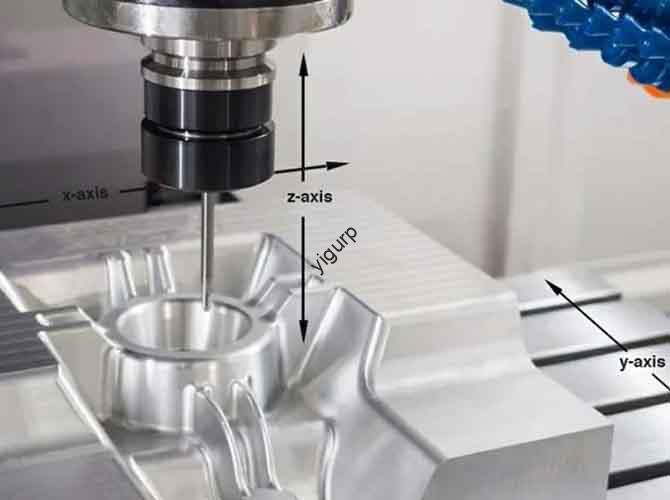
Multi-axis linkage is what separates basic machines from advanced ones. 3-axis is common. 4-axis adds rotation. 5-axis can machine complex parts like turbine blades in one setup. The more axes, the more complex the parts you can make.
Precision motion control determines accuracy. High-end servo systems keep positioning error within 0.001mm. That is the core gap between ordinary and high-end CNC equipment.
The Automated Machining Process
A complete automated process runs:
CAD modeling → CAM programming → Tool selection → Machining → Quality inspection
CAM programming is critical. Optimizing toolpaths based on material and shape can cut machining time by 30 percent and increase tool life by 25 percent, as shown in an auto parts factory case.
How Does Equipment and Facility Configuration Determine Production Capacity?
The hardware in a CNC factory sets the upper limit on what you can produce.
Choosing the Right CNC Machine Type
Different machines suit different jobs. Picking the right one avoids waste.
| Machine Type | Core Use | Advantage | Best For |
|---|---|---|---|
| Vertical Machining Center | Flat surfaces, hole patterns | Cost-effective, easy to operate | General machinery, auto parts |
| Horizontal Machining Center | Complex box parts | Stable, efficient | Aerospace, construction machinery |
| Gantry Machining Center | Large parts | Large stroke, rigid | Mold making, heavy machinery |
| Turn-Mill Machine | Combined turning and milling | Fewer setups, higher accuracy | Precision instruments, medical devices |
The Role of Auxiliary Equipment
- Cutting tools and fixtures: Tools must match the material—carbide for steel, PCD for composites. Fixture accuracy directly affects part positioning.
- Cooling and lubrication: A good cooling system reduces heat and tool wear. A mold shop kept breaking tools until they switched to high-pressure cooling at 30 MPa. Tool life increased by 3 times.
Factory Layout and Environmental Control
- Layout optimization: Arrange raw material, processing, testing, and finished goods areas for “shortest logistics” to reduce handling time. One factory cut production cycle from 48 hours to 36 hours by replanning their layout.
- Temperature and humidity: Ideal conditions are 20±2°C and 40–60 percent humidity. Temperature swings over ±3°C can drift machine accuracy. High humidity causes electrical issues.
- Safety standards: Guarding, emergency stops, and fume extraction are must-haves. Industry data shows 80 percent of accidents come from non-compliance. Training is essential.
Equipment Maintenance Management
Follow a “prevention first” approach with a three-level system:
- Daily: Cleaning, lubrication, fastening.
- Weekly: Accuracy checks, parameter calibration.
- Quarterly: Component replacement, system upgrades.
One plant cut equipment failure rates from 15 percent to 3 percent and reduced annual maintenance costs by 20 percent by implementing this system.
What Materials Can CNC Factories Machine, and in What Industries?
CNC technology’s strength is its ability to work with a wide range of materials, making it vital across many high-end fields.
Mainstream Materials and Processing Points
- Metals: Steel, aluminum, copper, titanium. Titanium is tough—high strength, poor heat conduction. It needs low speeds, high feeds, and special cutting fluid to manage heat.
- Plastics and composites: PC, ABS, carbon fiber. Composites risk delamination and burrs. They need sharp tools and higher speeds—typically 1.5 to 2 times faster than metals.
Core Application Areas
- Aerospace: Turbine blades and fuselage parts demand precision down to 0.001mm, high strength, and light weight. CNC is essential.
- Automotive: From engine blocks to transmission gears, CNC balances high volume with tight tolerances. One manufacturer saw part qualification rates jump from 92 percent to 99.5 percent after adopting a CNC production line.
- Medical devices: Implants and surgical tools need precision and biocompatibility. CNC achieves complex shapes with surface roughness Ra ≤0.8μm.
- Mold making: Cavities and cores rely on CNC. A mold factory cut delivery time from 20 days to 8 days using 5-axis machining.
How Do You Run and Manage a CNC Factory for Maximum Competitiveness?
Technology is the foundation, but lean management is what makes a factory profitable.
Production Planning and Scheduling
Follow the “bottleneck first” principle. Focus on the process that limits overall output. For example, a factory with a CNC lathe bottleneck added automated loading, boosting that process by 40 percent and overall line efficiency by 25 percent. Use MES systems to track progress in real time and adjust plans to avoid delays.
Quality Control System
Build quality into every step:
- Incoming inspection: Check raw material dimensions and hardness.
- In-process checks: Set inspection points at key operations. Use CMMs and laser interferometers.
- Finished product inspection: Sample per AQL standards to ensure quality.
A precision parts factory cut scrap from 5 percent to 1.2 percent with this system, saving over $1 million annually.
Cost-Benefit Analysis: Three Keys to Cost Control
- Equipment cost: Choose cost-effective machines. Do not overspend on capability you will not use.
- Tool cost: Optimize cutting parameters and use coatings to reduce tool consumption.
- Labor cost: Automate where it makes sense. Train employees to increase per-person output.
Digital Factory Transformation
Digitalization is the future. Key elements include:
- Data interconnection: Connect machines, MES, and ERP for real-time data sharing.
- Intelligent decision-making: Use big data to optimize schedules and predict failures.
- Flexible production: Quickly switch between product types for small-batch, high-mix work.
A leading CNC factory that underwent digital transformation saw production efficiency rise 35 percent and order lead times shrink 30 percent.
Conclusion
CNC factories are the core engine of high-end manufacturing because they combine precision, efficiency, and flexibility. They turn raw materials into the complex parts that power aerospace, automotive, medical, and countless other industries. Success comes from mastering the technology—CNC systems, multi-axis control, and automated processes. It comes from choosing the right equipment and maintaining it well. It comes from understanding materials and matching processes to them. And it comes from lean management—smart scheduling, rigorous quality control, cost discipline, and embracing digital transformation. The factories that excel in these areas will lead the future of manufacturing.
FAQ About CNC Factories
Q: What should a beginner prioritize when starting in a CNC factory?
A: Focus first on G-code basics, CNC system operation, common tool selection, and quality inspection methods. Then gradually add advanced skills like multi-axis programming and CAM.
Q: Are CNC machines expensive to maintain, and how can I control costs?
A: Annual maintenance typically runs 5 to 8 percent of equipment value. You can reduce this by 15 to 20 percent with a regular maintenance system, quality parts, and trained technicians.
Q: How can a CNC factory handle small-batch, high-mix orders efficiently?
A: Use modular fixtures and quick-change tooling. Consider flexible production lines. Optimize CAM programming to minimize changeover time and maximize machine utilization.
Q: Is a 5-axis machine worth the extra cost over a 3-axis?
A: If you mainly machine complex parts like curved surfaces or impellers, and volume is stable, yes. The 5-axis machine will boost efficiency and precision. For simple parts, a 3-axis machine is more cost-effective.
Q: What is the ideal temperature for a CNC shop?
A: Aim for 20±2°C. Larger fluctuations can cause machine accuracy to drift. Humidity should be kept between 40 and 60 percent to protect electrical systems.
Discuss Your Projects with Yigu Rapid Prototyping
At Yigu Rapid Prototyping, we operate a modern CNC factory equipped with vertical and horizontal machining centers, turn-mill machines, and 5-axis capability. We work with metals, plastics, and composites for aerospace, medical, automotive, and industrial clients. Our quality system includes in-process inspection, CMM verification, and rigorous finished goods testing. We practice lean management to ensure on-time delivery and competitive pricing. Whether you need prototypes or production runs, we deliver precision parts that meet your specs. Contact Yigu today to discuss your project and get a free quote.