
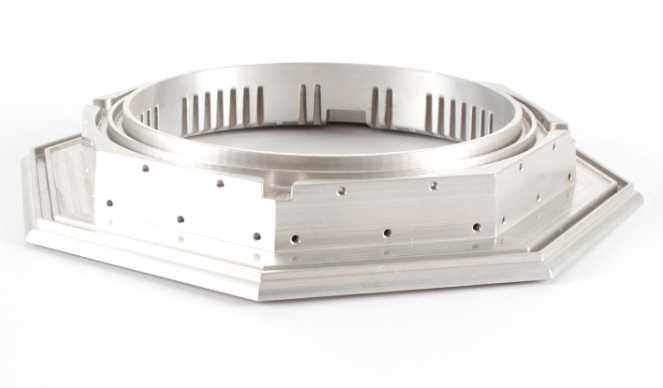
In the precision-driven world of modern manufacturing, the CNC circular prototype machining process has become the gold standard for developing round or cylindrical components. For product engineers and procurement professionals in the automotive, aerospace, and medical sectors, this computer-controlled method is the most reliable way to turn raw material into high-accuracy prototypes.
Whether you need a complex gear, a high-speed shaft, or a cylindrical housing, this process allows you to validate fit, form, and function before committing to mass production. By utilizing Computer Numerical Control (CNC) technology, manufacturers can achieve tolerances as tight as ±0.005 mm, ensuring that even a small batch of prototypes (1–10 pieces) remains perfectly consistent.
What Is CNC Circular Prototype Machining?
At its core, CNC circular prototype machining is a subtractive manufacturing process that uses programmed software to guide cutting tools around a rotating or stationary workpiece. It excels at creating parts where roundness, symmetry, and concentricity are non-negotiable.
Why Precision Roundness Matters
In industries like aerospace, even a microscopic error in a circular shaft can lead to catastrophic vibration. For instance, a startup recently required five titanium circular shaft prototypes (15 mm diameter) for a new engine. By using CNC circular machining, they achieved a roundness error of just 0.002 mm. This level of precision is virtually impossible to maintain with manual machining, which would have taken three times longer and likely failed the strict aerospace quality standards.
What Are the Key Machining Stages?
Creating a high-quality circular prototype requires a disciplined 8-stage workflow. To illustrate this, let’s follow a real-world case study of an automotive manufacturer prototyping a 25 mm diameter aluminum alloy gear.
1. Design and Programming
Everything begins with a 3D model in CAD software (like SolidWorks). Engineers then use CAM (Computer-Aided Manufacturing) software to convert this model into G-code.
- The Goal: Map out every spiral cutting path and tooth profile.
- Value Added: Professional CAM programming can reduce manual coding time by 50%, eliminating human error before the machine even starts.
2. Strategic Material Selection
The choice of material dictates the prototype’s durability and weight. The automotive team chose Aluminum 6061 to reduce the testing weight of their gear assembly.
| Material | Key Property | Tensile Strength | Common Circular Use |
| Aluminum 6061 | Lightweight (2.7 g/cm³) | 310 MPa | Gear prototypes, housings |
| Stainless Steel 304 | Corrosion-resistant | 515 MPa | Medical and marine shafts |
| Titanium (Ti-6Al-4V) | High Strength-to-Weight | 860 MPa | Aerospace engine components |
3. Machine and Tool Setup
For circular parts, a CNC lathe or a turning center is usually the primary machine. In our automotive case, the team used a 3-jaw chuck to secure the aluminum blank. They selected carbide cutting tools (WC-Co), which reduced tool wear by 40% compared to standard high-speed steel.
4. Machining Strategy Planning
To prevent material deformation, especially in thin-walled circular parts, you must plan the path carefully.
- Spiral Cutting: Ideal for gears to ensure even material removal.
- Face Cutting: Used to achieve a mirror-finish on the ends of the cylinder.
- Peck Drilling: Essential for central bores to prevent heat and chip buildup.
How Do Roughing and Finishing Differ?
The machining process is split into two distinct phases to balance speed with surface quality.
5. Roughing and Finishing Cycles
In the automotive gear case:
- Roughing Phase: The lathe removed 80% of the material (from a 35 mm blank down to 27 mm) at 1,500 RPM. This aggressive stage took only 8 minutes.
- Finishing Phase: The machine dialed back the feed rate to 0.05 mm/rev at 2,000 RPM. This slower, precise pass achieved a surface roughness of Ra 0.8 μm, ensuring the gear teeth would mesh perfectly without friction.
How Is Quality and Error Controlled?
Quality control is the most critical step for any CNC circular prototype machining project.
6. Rigorous Quality Inspection
Technicians use a suite of tools to verify the part:
- Digital Calipers: For quick diameter checks (accuracy ±0.001 mm).
- CMM (Coordinate Measuring Machine): To scan the part for symmetry and roundness.
- Roughness Testers: To ensure the Ra value meets the design specs for smooth movement.
7. Post-Processing and Deburring
After machining, the part undergoes:
- Cleaning: Removing degreasers and cutting fluids.
- Deburring: Using 200-grit sandpaper to smooth sharp edges on the gear teeth.
- Anodizing: A common choice for aluminum to prevent scratches during assembly testing.
8. Common Errors and Solutions
Even with CNC, errors can occur. Here is how professional teams manage them:
| Error Type | Impact | Professional Solution |
| Roundness Error | Poor fitment | Reduce finishing feed rate; check chuck pressure |
| Surface Scratches | Increased friction | Replace worn carbide tools; check coolant concentration |
| Material Warping | Dimensional drift | Reduce pass depth from 0.2 mm to 0.1 mm |
Which Innovations are Changing Circular Machining?
Technological shifts are making the CNC circular prototype machining process faster and more sustainable.
AI-Powered Monitoring and High-Speed Milling
- AI Sensors: These detect tool wear in real-time. A medical device firm recently used AI monitoring to save 10 stainless steel prototypes from being scrapped by replacing a tool just before it caused surface scratches.
- High-Speed Milling: Operating at over 10,000 RPM, this tech cuts machining time by 30%, particularly for high-performance plastics like PEEK or POM.
- Sustainable Practices: Modern shops now recycle up to 80% of metal shavings and use filtration systems to reuse 70% of their coolant, significantly lowering the environmental footprint.
Yigu Technology’s View on Circular Machining
At Yigu Technology, we have supported over 400 clients in perfecting their circular designs. We believe that for parts where symmetry is the priority, CNC is irreplaceable. By integrating AI-powered monitoring and high-speed milling, we have successfully reduced lead times to just 3–5 days—nearly half the industry average. For our clients, this translates to faster design validation and significantly lower material waste. We don’t just make parts; we ensure your engineering vision is realized with mathematical precision.
FAQ
What is the minimum order quantity (MOQ) for circular prototypes?
Most professional shops, including ours, accept an MOQ of 1 piece. This allows startups to test a single titanium or aluminum shaft without high upfront costs.
How long does the CNC circular prototype process take?
A simple shaft takes roughly 1–2 days. Complex parts, like the automotive gear mentioned above, typically require 3–4 days to account for programming and multi-stage inspection.
Can you machine circular prototypes from plastic?
Yes. CNC is excellent for plastics like ABS, PC, and POM. We recently produced ABS housings with a surface finish of Ra 0.4 μm, perfect for consumer electronics.
What is the best way to prevent warping in aluminum?
The best method is to use smaller cutting depths (around 0.1 mm) and ensure a constant flow of high-quality coolant to keep the material temperature stable.
Discuss Your Projects with Yigu Rapid Prototyping
Do you have a complex round design that requires extreme precision? At Yigu Rapid Prototyping, we specialize in high-accuracy CNC circular prototype machining. Our team of expert engineers is ready to help you optimize your material choice and machining strategy to get your product to market faster.
Would you like me to review your CAD files and provide a free DFM (Design for Manufacturing) analysis for your circular parts?