
Introduction
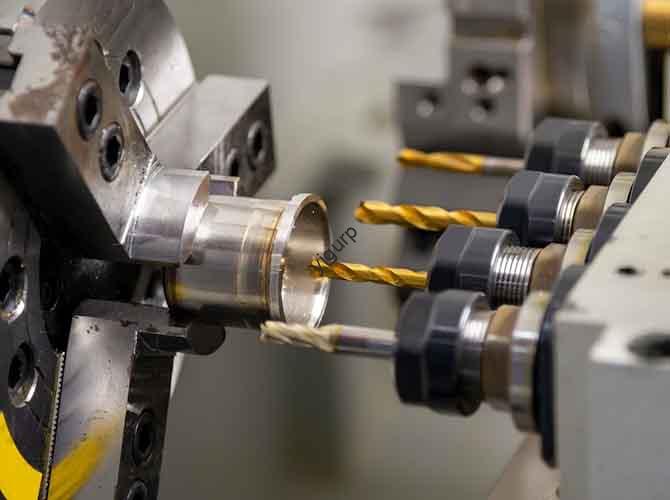
Have you ever wondered how those precise rotating parts in machinery, from the tiny gears in a watch to the massive crankshaft in a car engine, are actually created? The answer is turned parts. These are rotating body parts that are shaped on a lathe through a process called turning. Turning is a classic material removal process and a fundamental part of subtractive manufacturing. In simple terms, it’s like using a knife to peel an apple, but the machining of turned parts is far more precise and systematic. The quality of these parts directly determines the performance and reliability of the final product, making them the basic building blocks of the entire manufacturing industry.
1. What Are the Main Types of Turned Parts?
Turned parts come in a wide variety of forms, but they can be divided into several key categories based on their structural characteristics. Understanding these categories helps you quickly identify and select the right part for your needs.
- Shaft Parts: These are the most common type of turned parts. They act as the “backbone” of mechanical transmission, primarily used to transmit torque and support other components. This category includes optical shafts with smooth surfaces for simple transmission, step shafts with different diameters for complex assemblies, and eccentric shafts used to generate reciprocating motion. For example, a stepped shaft in a car gearbox uses its different diameters to position gears and transmit power, with tolerances often controlled within ±0.02mm.
- Sleeve Parts: These act as guardians of precise positioning. Common examples include bearing sleeves, which protect bearings and reduce wear, bushings, which reduce friction on mating surfaces, and cylinder liners, the core components of an engine cylinder that must withstand high temperatures and pressure.
- Disc Cover Parts: Disc-shaped parts are mostly used for connection, sealing, or power transmission. This group includes flanges for connecting pipes or equipment, end caps for sealing cavities, and pulleys for transmitting power via belts. A flange in wind power equipment, for instance, can be 1.2 meters in diameter and requires a flatness error of ≤0.03mm to ensure a tight seal.
- Threaded Turned Parts: These are the core components for fastening and transmission. They achieve their function by machining external threads like on bolts, or internal threads like in nuts. Common products include screws and bolts. The pitch error of a high-precision screw for a machine tool needs to be controlled within 0.01mm per meter.
- Precision Turned Parts: This category focuses on extremely high precision and small size. They are commonly found in watch parts and medical components. For example, a tiny shaft for a minimally invasive surgical instrument might have a diameter of only 0.8mm and a tolerance requirement of ±0.005mm, achievable only with specialized Swiss-type lathes.
- Non-standard Turned Parts: Also known as custom turned parts, these are special-shaped parts designed for unique scenarios with no standard specifications. They are manufactured to customer drawings.
2. What Processing Technologies Are Used for Turned Parts?
The turning process has evolved significantly, from traditional manual lathes to modern, intelligent, automated equipment. This evolution has brought massive improvements in both precision and efficiency.
| Processing Method | Core Features | Applicable Scenarios | Typical Accuracy Level |
|---|---|---|---|
| CNC Turning | Program-controlled, high degree of automation. | Mass production, complex parts. | ±0.005 to ±0.02mm |
| Swiss-Type Turning | Workpiece rotates at high speed, tool moves precisely. | Long, thin parts (length-to-diameter ratio >10), micro parts. | ±0.002 to ±0.01mm |
| Multi-Axis Turn-Mill | One clamping completes turning, milling, drilling, etc. | Complex special-shaped parts, high-precision parts. | ±0.003 to ±0.015mm |
| Traditional Manual Turning | Manual operation, very flexible. | Single-piece parts, simple parts. | ±0.05 to ±0.1mm |
Turning operations typically follow a standard process. First is rough turning to quickly remove most of the excess material, leaving a small allowance for finishing. Next is precision turning, the key process that determines the final dimensional accuracy and surface finish of the part. Finally, auxiliary operations like grooving or cutting are performed as needed.
3. What Materials Are Used for Turned Parts?
Material selection is a critical prerequisite for the successful processing of turned parts. The mechanical properties, corrosion resistance, and machinability of different materials vary significantly, and the choice must be accurately matched to the application.
- Metal Turned Parts: This is the mainstream choice for applications requiring stable performance. Steel offers high strength and good toughness. Stainless steel provides excellent corrosion resistance for medical and food machinery. Aluminum is lightweight with good thermal conductivity, ideal for electronics and auto parts. Copper alloys like brass and bronze offer excellent conductivity and wear resistance. Titanium alloys and superalloys are used in aerospace for their ability to withstand high temperatures and pressures.
- Plastic Turned Parts: These are a lightweight, low-cost supplement, mainly used in low-load, corrosion-resistant scenarios. Common materials include POM for its high hardness and wear resistance, Nylon for its toughness, and PTFE for its excellent corrosion resistance, making them suitable for gears, bearings, and seals.
Conclusion
Turned parts are fundamental to modern manufacturing, serving as the core components in countless machines and devices across every industry. From simple shafts to complex, high-precision medical instruments, understanding the different types of turned parts, the processes used to create them, and the materials they are made from is essential for anyone involved in product design, engineering, or manufacturing. The quality of these parts directly dictates the performance, reliability, and lifespan of the final product.
FAQ
What is the core difference between turned parts and milled parts?
For turned parts, the workpiece rotates while the cutting tool is fixed or moves, and this process is primarily for creating rotational, cylindrical parts. For milled parts, the cutting tool rotates while the workpiece is fixed or moves, and this process is for creating non-rotational features like flat surfaces, slots, and complex 3D shapes.
How accurate can precision turned parts be?
The tolerance for ordinary precision turned parts can be controlled at ±0.005mm. For very small parts machined on Swiss-type lathes, tolerances can reach an impressive ±0.002mm, meeting the stringent demands of the medical and electronics industries.
How do I choose the right material for my turned parts?
First, you must clearly define the working environment for the part, including temperature, humidity, and any chemical exposure. Then, determine the load and accuracy requirements. Finally, select a material by balancing its mechanical properties, corrosion resistance, and machinability against these needs. When in doubt, consulting with a professional engineer is always recommended.
What is the impact of surface roughness on a turned part’s use?
Surface roughness directly affects a part’s wear resistance, sealing capability, and fit accuracy. For example, if the inner wall of a bearing sleeve is too rough (a high Ra value), it will cause the bearing to wear out much faster. Conversely, a surface that is too smooth might not retain lubrication effectively.
Discuss Your Projects with Yigu Rapid Prototyping
Are you looking for a trusted partner to manufacture high-quality turned parts for your next project? At Yigu Rapid Prototyping, we have extensive experience with a wide range of turning processes, from simple CNC turning to complex multi-axis turn-mill machining. Our team of experts can help you select the right material, optimize your design for manufacturability, and deliver precision parts that meet your exact specifications.
Contact Yigu Rapid Prototyping today to discuss your project. Let’s build something great together.