
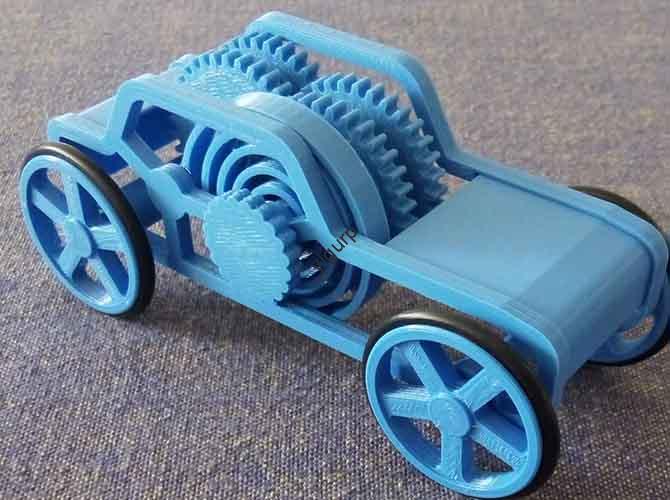
Introduction
You’re building a custom robotics platform, designing a prototype for a new micro-mobility vehicle, or creating a unique display model. The need for a specialized wheel—one that is lightweight, features an integrated design, or exists in a quantity too small for traditional molding—is immediate. 3D printing technology promises a path from CAD file to custom wheel in hours. But can a layer-by-layer printed part truly handle the dynamic loads, abrasion, and cyclic stresses that a wheel endures, or is it destined to remain a conceptual model? This guide moves beyond simple hype to provide a rigorous, engineering-focused analysis of 3D printing wheels. We’ll examine the critical design principles for structural integrity, compare material performance for real-world use, and provide a clear framework for when additive manufacturing is a viable solution versus when traditional methods remain superior.
What Are the Foundational Design Principles for 3D Printed Wheels?
A successful 3D printed wheel is not just a scaled-up version of a toy car wheel. It must be designed from the ground up for additive manufacturability and mechanical performance.
How Do You Architect for Strength and Weight?
The core advantage of 3D printing is the ability to create optimized internal geometries that are impossible with molding or machining.
- Lattice Structures: Replacing solid infill with a triangular, hexagonal, or gyroid lattice can reduce weight by 40-60% while maintaining a high percentage of the original strength. This is critical for rotating mass, where weight directly impacts acceleration, braking, and energy efficiency.
- Spoke Design & Stress Distribution: Spokes are tensile members. Their design must channel forces from the rim (where the load is applied) to the hub (where torque is transmitted). Finite Element Analysis (FEA) simulation is highly recommended to identify stress concentrations. Spokes should be shaped to avoid sharp corners and designed with a cross-section (e.g., aerofoil, oval) that resists buckling.
- Integrated Functional Design: 3D printing allows the wheel, hub, and even gear teeth or mounting features to be manufactured as a single, monolithic part. This eliminates assembly, reduces points of failure, and can lead to more compact designs. For example, a wheel for an agile mobile robot might integrate a precise mounting interface for a specific motor and a compliant tread pattern in one print.
What Are the Critical Print Orientation Considerations?
Anisotropy—the difference in strength between the print layers (XY plane) and between layers (Z-axis)—is a major factor.
- Worst Practice: Printing a wheel flat on the build plate (like a disc). This orientation places the layer adhesion planes parallel to the radial and tangential forces, creating a shear weakness that can cause de-lamination under load.
- Best Practice: Printing the wheel standing on its edge (vertically). This aligns the layer lines radially, so the continuous perimeter of each layer better withstands the hoop stresses. While this increases build height and may require supports for the hub, it results in a significantly stronger part.
Which Materials Are Suitable and for What Applications?
Material choice is dictated by the wheel’s operating environment: load, speed, surface type, and exposure.
| Material | Technology | Key Properties | Best-Suited Applications | Critical Limitations |
|---|---|---|---|---|
| PLA | FDM | Stiff, easy to print, low cost. | Static models, very low-speed display pieces, indoor educational robotics where failure is non-critical. | Brittle, poor impact and heat resistance. Will crack under dynamic load and deform in warm environments. Not for functional use. |
| PETG | FDM | Tough, good layer adhesion, moderate heat and chemical resistance. | Light-duty functional prototypes, moderate-speed robotics, custom furniture casters. A good balance of performance and printability. | Can exhibit creep (slow deformation) under constant load. Wear resistance is moderate. |
| Nylon (PA6/PA12) | FDM or SLS | Excellent toughness, fatigue resistance, and wear resistance. SLS parts are isotropic (equally strong in all directions). | High-performance functional prototypes, drone landing gear, advanced robotics. The leading plastic for demanding applications. | Hygroscopic (absorbs moisture), requiring dry printing and storage. Can be more difficult to print via FDM. |
| TPU/TPE (Flexible) | FDM | Elastic, shock-absorbing, high grip. | Tire treads or compliant wheels for traction on uneven surfaces. Often printed as a tire over a rigid printed hub. | Low load-bearing capacity. Printing flexible materials requires a direct-drive extruder and careful settings. |
| Reinforced Composites (CF-Nylon, GF-PETG) | FDM | High stiffness-to-weight ratio, improved dimensional stability, reduced creep. | Structural components where maximum stiffness is needed, such as high-speed drone wheels or competitive robotics. | Abrasive to printer nozzles (requires hardened steel). Can be more brittle than base material. |
| Metal (AlSi10Mg, Ti64) | SLM/DMLS | Maximum strength, durability, and temperature resistance. | End-use, high-load applications (e.g., custom bicycle hubs, small vehicle wheels, aerospace tooling). | Extremely high cost, both for equipment and material. Requires significant post-processing (heat treatment, machining). |
What Are the Real-World Use Cases and Technical Validation?
Moving from theory to practice requires understanding where 3D printing adds unique value.
When is 3D Printing a Strategic Advantage?
- Prototyping and Iteration: Rapidly test different spoke designs, tread patterns, or hub integrations without tooling costs. A robotics team can iterate a wheel design overnight based on field test data.
- Customization and Low-Volume Production: Produce wheels for vintage model restoration, bespoke furniture, or specialized industrial equipment where off-the-shelf options don’t exist and volume is 1-100 units.
- Integrated and Complex Geometries: Create wheels with embedded channels for wiring or pneumatics, non-pneumatic structures (like the Michelin Uptis concept), or mass-optimized lattices for maximum performance.
Case Study: The University Racing Team
A Formula Student team needed to prototype a custom, center-lock wheel hub for their lightweight electric vehicle. Machining from billet aluminum was too expensive and slow for iterative testing.
- Solution: They 3D printed the hub in Markforged Onyx (a carbon-fiber reinforced nylon) using a high-temp, enclosed FDM printer.
- Process: The hub was printed vertically for optimal strength. Critical bearing and axle interfaces were designed to be slightly undersized and then precision-reamed post-print for a perfect fit.
- Outcome: The printed hub survived rigorous static load testing and dynamic cornering simulations on a test rig. It allowed the team to validate their design before committing to final CNC machining in aluminum, saving weeks of development time and thousands of dollars in machining costs.
What Are the Key Challenges and How to Mitigate Them?
Even with good design and material, specific failure modes must be addressed.
How Do You Ensure the Hub Interface is Durable?
The hub bore and mounting features (e.g., for bolts or a hex pattern) are high-stress areas.
- Challenge: Printed plastic threads or press-fit interfaces can strip or deform.
- Solution: Design for metal inserts. Print a clean, undersized hole and press in a heat-set brass threaded insert or a knurled steel bushing. This provides a durable, wear-resistant metal-on-metal interface for the axle or screws.
How Do You Manage Balancing and Runout?
A wheel that is not balanced or runs out (wobbles) can cause vibrations, especially at speed.
- Challenge: Minor layer shifts or uneven cooling can cause asymmetry.
- Solution:
- Design for Symmetry: Ensure the CAD model is perfectly symmetrical.
- Printer Calibration: A well-calibrated printer with a rigid frame is essential.
- Post-Processing: Light sanding can correct minor imperfections. For high-speed applications, the wheel can be dynamically balanced using small weights, similar to a car tire.
What About Tread Wear and Traction?
A smooth plastic wheel offers poor traction on most surfaces.
- Solution: Adopt a multi-material or hybrid approach. Print a rigid hub in PETG or Nylon, and then either:
- Overprint a tread pattern in TPU (requires a printer capable of multi-material or a precise pause-and-resume).
- Design a groove to accept a standard O-ring or silicone rubber tire, which can be sourced and stretched on.
- Use a textured finish (like a diamond pattern) on the contact surface to increase grip.
Conclusion
3D printing functional wheels is not only possible but is a powerful, strategic tool for prototyping, customization, and low-volume production of specialized designs. Success is not guaranteed by the technology alone; it is achieved through informed design choices that respect additive manufacturing’s strengths and weaknesses. This means prioritizing vertically-oriented prints, leveraging lattice structures for weight savings, selecting engineering-grade materials like Nylon or PETG for functional parts, and reinforcing critical interfaces with metal inserts. For high-load, high-speed, or safety-critical applications, 3D printing serves best as a prototyping bridge to traditional manufacturing or is reserved for non-critical components. By applying this disciplined, application-specific approach, you can leverage 3D printing to create wheels that are not just models, but functional components that drive innovation.
FAQ: 3D Printing Wheels
Q: Can I 3D print a wheel strong enough for a skateboard, longboard, or bicycle?
**A: For a bicycle, a 3D printed *hub* is plausible with high-performance materials (e.g., reinforced nylon), but the *rim and spokes are not recommended* due to the extreme cyclic loads and safety risks. For skateboards/longboards, 3D printed wheels are generally not advised for regular riding. The high impact from drops, constant abrasion on pavement, and heat from sliding would quickly degrade or fail most printed plastics, posing a safety hazard. They are suitable for display or very light, casual use only.
Q: How do I make a 3D printed wheel truly round and smooth?
A: Achieving perfect roundness is challenging with FDM due to the “stair-stepping” effect. To improve:
- Increase Resolution: Use the smallest layer height your printer can reliably manage (e.g., 0.1mm).
- Post-Process: Sand the circumference with progressively finer grit sandpaper while the wheel is slowly spun (e.g., on a powered mandrel or drill).
- Consider Technology: SLA/DLP resin printing will produce a much smoother, more cylindrical surface straight off the printer, but the material choices for functional wheels are more limited.
Q: What infill percentage and pattern should I use?
A: Avoid high, solid infill. It adds weight and print time without proportional strength gain. For a functional wheel:
- Infill Percentage: 15-25% is often sufficient when combined with 3-5 strong perimeter walls.
- Infill Pattern: Gyroid, cubic, or triangular. These patterns offer good strength-to-weight ratios and handle multi-directional forces better than rectilinear grids.
Q: Is it legal and safe to use 3D printed wheels on public roads?
**A: For any vehicle used on public roads (cars, motorcycles, e-scooters), *you must assume it is neither legal nor safe* to use homemade 3D printed wheels as primary load-bearing components.** Wheels are safety-critical parts subject to rigorous industry standards (like JWL for automotive). Failure could lead to catastrophic accidents and serious liability. 3D printed wheels should be restricted to off-road, private property, prototype testing, or non-vehicle applications unless certified by a professional engineer and tested to relevant standards.
Discuss Your Projects with Yigu Rapid Prototyping
Designing and manufacturing a functional wheel requires a synergy of mechanical engineering and advanced manufacturing expertise. At Yigu Rapid Prototyping, we specialize in turning complex concepts into reliable, high-performance parts. Our engineers can perform FEA analysis on your wheel design to optimize spoke geometry and weight, recommend the optimal material and printing technology (from high-temp FDM with composites to industrial SLS with Nylon), and ensure critical features are designed for post-processing and inserts. We provide full-service production, from file preparation to finishing and validation. Contact us for a technical review of your wheel design and a quote for prototypes or low-volume production.