
Você já se esforçou para encontrar um protótipo de metal que se adaptasse ao design exclusivo do seu produto? Quando as peças padrão não atendem às suas dimensões específicas, formas, ou recursos, non-standard prototype sheet metal forming process comes to the rescue. Este método de fabricação personalizado adapta protótipos de metal às suas necessidades exatas, tornando-o uma virada de jogo para o desenvolvimento de produtos, produção de baixo volume, and special part creation. Neste guia, we’ll break down everything you need to know to leverage this process effectively.
1. What Exactly Is Non-standard Prototype Sheet Metal Forming?
Let’s start with the basics.Non-standard prototype sheet metal forming is a specialized metalworking process that creates custom prototypes by shaping sheet metal according to clients’ unique requirements—no more sticking to one-size-fits-all industry standards.
Key Traits vs. Standard Sheet Metal Forming
To better understand its value, let’s compare it with standard sheet metal forming using a simple table:
| Aspect | Non-standard Prototype Sheet Metal Forming | Standard Sheet Metal Forming |
|---|---|---|
| Design Basis | Client’s specific needs (custom dimensions/shapes) | Fixed industry standards |
| Volume de produção | Baixo (prototipagem, small-batch special parts) | Alto (produção em massa) |
| Flexibilidade | Alto (adjustable for unique designs) | Baixo (fixed for standard parts) |
| Use Case | Product design validation, special-purpose parts | Routine, componentes de alto volume |
Real-World Example
Imagine you’re developing a compact medical device that needs a custom sheet metal housing to fit tiny internal components. Standard sheet metal housings are too big or have the wrong cutouts—this is where non-standard prototype sheet metal forming shines. It creates a housing that’s perfectly tailored to your device’s size and feature needs, helping you test the design quickly.
2. The Step-by-Step Non-standard Prototype Sheet Metal Forming Process
The process follows a clear, linear flow to ensure precision and meet your requirements. Let’s walk through each step:
Etapa 1: Design Phase – Lay the Groundwork
This phase is all about turning your ideas into a workable plan.
- 3Modelagem D: Use CAD (Design Assistido por Computador) programas (por exemplo, SolidWorks, AutoCAD) to build a detailed 3D model of the prototype. Every curve, hole, and dimension is designed to match your exact needs—no guesswork here.
- Revisão de projeto: A critical check to avoid costly mistakes. Engineers and designers assess two key points:
- Manufacturability: Can we actually make this prototype with existing tools? Por exemplo, is a super-tight bend angle feasible with our press brakes?
- Funcionalidade: Will the prototype do what it’s supposed to? If it’s a bracket for a machine, will it hold the required weight?
Etapa 2: Seleção de Materiais & Pretreatment – Pick the Right “Building Block”
The material makes or breaks the prototype’s performance.
- Choose the Right Material: Select based on how the prototype will be used:
- Aço inoxidável: Great for parts exposed to moisture (por exemplo, food processing equipment prototypes) – it resists rust and corrosion.
- Alumínio: Lightweight and affordable, perfect for aerospace or automotive prototypes where weight matters.
- Cobre: Ideal for parts needing good electrical conductivity (por exemplo, custom electrical enclosures).
- Material Pretreatment: Get the sheet metal ready for processing:
- Rebarbação: Remove sharp edges from the sheet to prevent injuries during handling and ensure smooth assembly.
- Cleaning: Wipe off oil, dust, or rust—this helps later steps like painting or plating stick better.
Etapa 3: Corte & Shaping – Turn Flat Sheets into 3D Shapes
Now it’s time to transform the flat sheet metal into the prototype’s basic form.
- CNC Cutting: Use computer-controlled machines for precision:
- Corte a laser CNC: Best for intricate shapes (por exemplo, pequenos buracos, complex curves) with accuracy up to ±0.1mm.
- Perfuração CNC: Faster for simple shapes (por exemplo, square or circular cutouts) in low-volume runs.
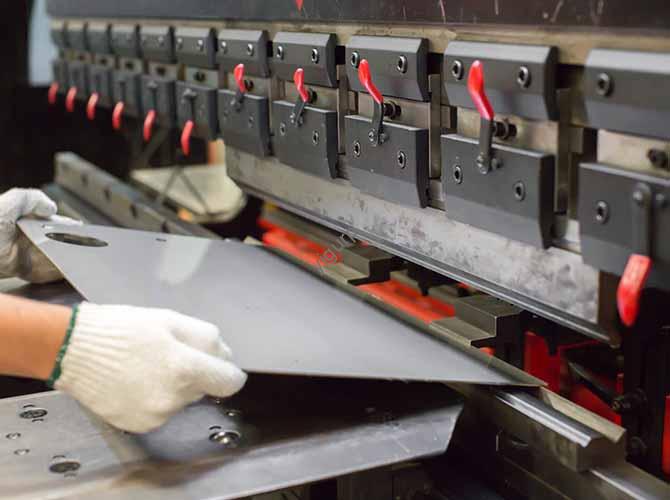
- Dobrando & Formando: Use a CNC press brake to bend the cut sheet to your desired angle (por exemplo, 90 degrees for a box-shaped prototype). The machine’s computer control ensures every bend is consistent—no lopsided parts here.
Etapa 4: Soldagem & Assembly – Put It All Together (Se necessário)
If your prototype has multiple parts (por exemplo, a frame with a base and sides), this step combines them.
- Soldagem: Join components using methods like MIG (para alumínio) or TIG (para aço inoxidável) soldagem. The goal is strong, seamless joints that hold up under use.
- Conjunto: Fit the welded parts together per the design. This might include adding screws or hinges so you can take the prototype apart for testing or adjustments.
Etapa 5: Surface Treatment – Boost Durability & Looks
A prototype isn’t just functional—it should also look professional.
- Lixar & Polimento: Smooth out weld lines and cut edges. Por exemplo, if the prototype is for a consumer product (like a kitchen gadget), a polished finish makes it look market-ready.
- Painting or Plating: Add protection and style:
- Pintura: Use spray paint (por exemplo, epóxi) to resist scratches and add color.
- Chapeamento: Apply a thin metal layer (por exemplo, zinc for rust resistance, chrome for shine).
Etapa 6: Quality Inspection – Ensure Perfection
The final check to make sure the prototype meets your standards.
- Dimensional Check: Use tools like calipers or CMMs (Máquinas de medição por coordenadas) to verify every dimension matches the 3D model. If the design calls for a 150mm length, the prototype should be spot-on (within ±0.5mm).
- Teste Funcional: Test the prototype in real-world conditions. For a custom hinge, does it open and close smoothly 1,000 times? For a bracket, does it hold the weight it’s supposed to?
3. Why Choose Non-standard Prototype Sheet Metal Forming?
You might wonder: “Why not just use standard parts to save time and money?” Here are three key reasons:
- Faster Product Development: Instead of waiting for standard parts that don’t fit, you get a prototype tailored to your design in weeks—not months. This lets you test and tweak your idea faster.
- Reduced Risk: By testing a custom prototype, you catch flaws (por exemplo, a weak weld, wrong dimension) cedo. Fixing these before mass production saves you thousands in rework costs.
- Perfect for Unique Needs: Whether you need a heat-resistant prototype for a furnace or a tiny one for a wearable device, this process adapts to your needs—standard parts can’t do that.
Yigu Technology’s View on Non-standard Prototype Sheet Metal Forming
Na tecnologia Yigu, we seenon-standard prototype sheet metal forming as the backbone of innovation. Many clients—startups to big firms—use it to turn bold ideas into tangible prototypes. Our team blends advanced CAD design, high-precision CNC tools, and strict quality checks to deliver prototypes that meet even complex needs. We prioritize flexibility: whether it’s a single prototype or small-batch parts, we adjust to your timeline and budget. For us, every custom prototype helps clients solve problems and stay ahead in competitive markets.
Perguntas frequentes
Q1: How long does it take to make a non-standard sheet metal prototype?
It depends on complexity. A simple prototype (por exemplo, um suporte plano) leva de 3 a 5 dias. A complex one with welding and plating takes 1–2 weeks.
Q2: Is non-standard prototype sheet metal forming expensive?
While unit costs are higher than standard parts, it’s cost-effective. Spending $500 on a prototype to fix design flaws saves tens of thousands in mass production rework.
Q3: What materials work best for this process?
It depends on use: Stainless steel for corrosion resistance, aluminum for light weight, copper for conductivity. Our team can help you pick the right one for your project.