
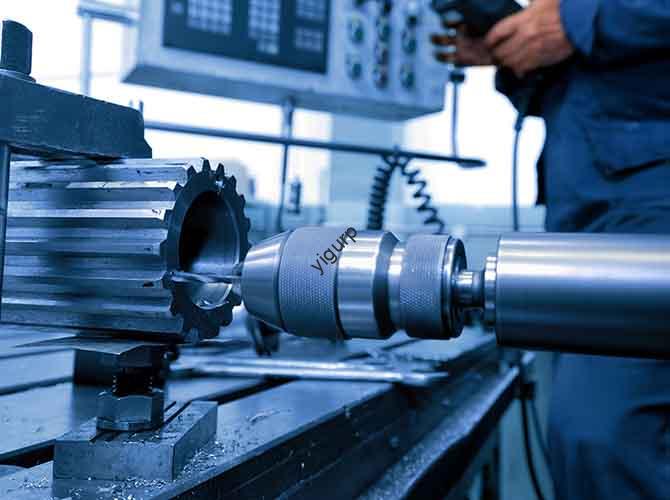
O tempo de usinagem CNC impacta diretamente a eficiência da produção, controle de custos, e cronogramas de entrega – tornando sua estimativa e otimização precisas críticas para os fabricantes. Quer você esteja processando pequenas peças de precisão ou grandes componentes estruturais, compreender os fatores que influenciam o tempo de usinagem e dominar os métodos práticos de cálculo pode reduzir significativamente o desperdício. Este artigo analisa os principais fatores de influência, step-by-step calculation logic, and actionable optimization strategies to help you manage CNC machining time effectively.
1. Core Factors That Influence CNC Machining Time
Machining time is not a fixed value—it depends on a combination of workpiece characteristics, propriedades dos materiais, parâmetros de processo, and equipment performance. Below is a detailed breakdown using a contrast and causal chain structure:
1.1 Workpiece Geometric Characteristics
The complexity and size of the workpiece directly determine tool path length and cutting difficulty, creating a clear causal relationship with machining time:
- Recursos complexos (superfícies curvas, narrow grooves, cavidades profundas): Longer tool paths and lower feed speeds (para garantir precisão) increase time by 30–60% compared to simple flat parts. Por exemplo, a deep cavity with a depth-to-diameter ratio >5:1 requires layered cutting, adding 2–3x more time than a shallow cavity.
- Small features (0.5 mm wide ribs): Limited by machine acceleration, these take 1.5–2x longer to machine than large planes—even with the same material and parameters.
- Peças de paredes finas: Insufficient rigidity forces reduced cutting depth (to prevent vibration), increasing machining time by 30–50% (por exemplo, um 2 mm thick aluminum bracket takes 40 minutos versus. 25 minutes for a solid bracket).
1.2 Material Physical Properties
Different materials demand different cutting strategies, which directly affect speed and efficiency. The table below contrasts key material types and their time impacts:
| Tipo de material | Desafio principal | Required Adjustments | Time Increase Ratio |
| High-hardness metals (CDH >45) | Rapid tool wear | Low spindle speed (1,000–2,000 RPM), small feed rate (0.03–0.05 mm/rev) | × 2–3 times |
| Aço inoxidável | Má condutividade térmica (causes built-up edges) | Frequent pauses for cleaning, baixa taxa de alimentação | × 1.5–1.8 times |
| Metais macios (ligas de alumínio) | Sticky tools (causes surface defects) | Alta velocidade (6,000–8.000 RPM) but careful tool selection | × 0.6–0.8 times (faster than steel) |
| Liga de titânio | Extremely low thermal conductivity | Ultra-low speed (500–1,000 RPM), small cutting depth | × 2.5–3 times |
1.3 Process Parameter Combination
Velocidade do fuso (S), taxa de alimentação (F), e profundidade de corte (ap/ae) form an optimal ratio—any deviation increases time or reduces quality:
- Velocidade do fuso (S) & taxa de alimentação (F): Too high causes tool chipping (requiring rework, adding time); too low leads to inefficiency. Por exemplo, a steel part with S=3,000 RPM and F=0.1 mm/rev takes 30 minutos, but S=5,000 RPM (lascar) adiciona 20 minutes of rework, while S=1,000 RPM (muito lento) leva 60 minutos.
- Profundidade de corte (ap/ae): Roughing can use maximum machine limits (por exemplo, ap=5 mm for steel), but finishing needs ae=0.1–0.3 mm (to ensure surface finish)—finishing alone adds 10–15% of total time for precision parts.
1.4 Machine Tool & Auxiliary Operations
Old equipment and time-consuming auxiliary tasks often become bottlenecks:
- Machine tool dynamic characteristics: Old machines have servo response lag—G00 rapid movement takes 20–30% longer than new 5-axis machines. Automatic tool changers (ATC) vary: a 40-tool magazine takes 15 seconds per change, adicionando 2.5 minutes for 10 tool changes in a multi-process part.
- Auxiliary operations: Precision parts need online CMM inspections (30 minutos cada), and heavy parts take 10–30 minutes to lift/position. Special fixtures with interference risks can take 1–2 hours of trial installation—exceeding actual cutting time.
2. Step-by-Step Logic to Calculate CNC Machining Time
Estimating machining time requires a structured approach: first calculate program execution time, then add non-cutting time, and finally reserve a safety margin.
2.1 Program Execution Time (Pure Cutting Time)
Use the core formula:
T = L / (F × η)
- T: Program execution time (hours/minutes)
- eu: Effective cutting path length (milímetros)
- F: Taxa de alimentação (mm/min)
- η: Cutting efficiency coefficient (0.7–0.9, accounting for acceleration/deceleration, tool lifting, etc.)
Exemplo prático
Machining a Φ50 mm × 100 mm long axis outer circle with aluminum alloy:
- Layered cutting: ap=2 mm, so number of layers = 100 milímetros / 2 mm = 5 layers.
- Path length per layer: Perimeter of the circle = πD = 3.14 × 50 mm = 157 milímetros. Total L = 157 mm × 5 layers = 785 milímetros.
- Parameters: F=600 mm/min, η=0.8.
- Calculation: T = 785 milímetros / (600 mm/min × 0.8) ≈ 1.64 minutos (pure cutting time).
2.2 Non-Cutting Time Accumulation
Add fixed and variable overheads that are often overlooked:
| Overhead Type | Exemplos | Typical Time |
| Fixed Overhead | Start-up warm-up, program call, first-piece trial cut | 10 + 5 + 20 = 35 minutos (média) |
| Variable Overhead | Tool changes (15 sec/change), Inspeções CMM (30 min/inspection), coolant connection | 10 tool changes = 2.5 min; 2 inspections = 60 min → Total 62.5 min |
For the long axis example: Total non-cutting time = 35 + 62.5 = 97.5 minutos.
2.3 Safety Margin Setting
Reserve 15–30% of total time for unexpected issues (desgaste da ferramenta, quedas de energia, process changes):
- Total time before margin = 1.64 (corte) + 97.5 (non-cutting) = 99.14 minutos.
- Safety margin (20%) = 99.14 × 0.2 ≈ 19.83 minutos.
- Final estimated time: 99.14 + 19.83 ≈ 119 minutos (≈2 hours).
3. Practical Strategies to Optimize CNC Machining Time
Reducing machining time doesn’t mean sacrificing quality—focus on smart process, ferramenta, and equipment adjustments:
3.1 CAM Programming Optimization
Use these techniques to minimize empty strokes and redundant moves:
- Spiral down cutting: Replace vertical piercing (which risks tool breakage and slow speed) with spiral paths—reduces empty stroke time by 20–30%.
- Mixed ring + row cutting: For island structures (por exemplo, a part with multiple raised features), this avoids frequent tool lifting—saving 15–25% of path time.
- Residual blank function: Let subsequent processes cut directly into remaining material (instead of re-machining the entire area)—shortens path length by 10–15%.
3.2 Tool Selection Principles
Choosing the right tool boosts speed and reduces wear:
- Desbaste: Use large chip groove dense-tooth milling cutters (por exemplo, 4–6 teeth) to increase material removal rate by 30–40%.
- Acabamento: Opt for fine-tooth plated tools (por exemplo, Revestimento TiAlN) to maintain high feed rates without surface defects.
- Deep cavities: Select long neck shrinking rod tools with high-pressure internal cooling—improves chip removal efficiency, cutting time by 25–35%.
- Material match: Carbide tools last 10x longer than high-speed steel (HSS)—even with higher upfront cost, they reduce tool change time by 50%.
3.3 Machine Tool & Workflow Adaptation
Match equipment to part requirements to avoid bottlenecks:
- Peças grandes: Use gantry machines (better load-bearing and travel range) instead of vertical centers—reduces re-clamping time by 40–50%.
- Peças de precisão: Choose vertical machining centers with good thermal stability (paired with a constant temperature workshop) to avoid rework from thermal drift—saving 1–2 hours per batch.
- Batch production: Invest in special combination machines with parallel stations—e.g., a 2-station machine can cut cycle time by 50% (one station machines while the other loads/unloads).
4. Correction Coefficients for Typical Working Conditions
Adjust estimated time based on common challenging scenarios using the table below (multiply base time by the coefficient):
| Working Condition | Time Correction Coefficient | Reasoning |
| Peças de paredes finas (grossura <3 milímetros) | 1.3–1.5 | Reduced cutting depth and added supports slow progress |
| Deep & narrow grooves (largura <2 milímetros, profundidade >10 milímetros) | 1.4–1.6 | Tool stiffness issues cause chatter, requiring slower speeds |
| Graphite electrode machining | 1.8–2.2 | Dust protection and special coated tools reduce efficiency |
| Microporous processing (diâmetro do furo <1 milímetros) | 3–5 | Micro-drills break easily, requiring high-frequency reversal for chip evacuation |
Perspectiva da Tecnologia Yigu
Na tecnologia Yigu, we believe CNC machining time management is about balancing accuracy and efficiency. For clients across automotive and aerospace, we start with a data-driven approach: our historical database of 5,000+ parts lets us apply precise correction coefficients (por exemplo, ×2.8 for titanium alloy right-angle parts) to avoid overestimating time. We also optimize toolpaths with UG/NX’s residual blank function, cutting empty strokes by 25%, and use carbide tools with high-pressure cooling to boost feed rates by 30% for aluminum parts. Para produção em lote, we’ve deployed 2-station combination machines that cut cycle time by 45% without compromising precision. Em última análise, the goal isn’t just faster machining—it’s predictable, cost-effective timeframes that keep projects on track.
Perguntas frequentes
- How do I adjust machining time estimates for a new material I’ve never used before?
Start with a “three-point estimation method”: calculate optimistic (best-case, por exemplo, high speed with no issues), normal (average parameters), and pessimistic (slow speed with rework) vezes. Use a fórmula: (Optimistic + 4×Normal + Pessimistic)/6. Por exemplo, if titanium alloy parts have optimistic=60 min, normal=90 min, pessimistic=120 min, the estimate is (60 + 360 + 120)/6 = 90 min.
- Can CAM software alone accurately estimate CNC machining time?
CAM software (por exemplo, Mastercam, UG/NX) calculates program execution time well but often misses non-cutting time (mudanças de ferramentas, inspeções) and safety margins. Add 30–40% to CAM’s initial estimate to account for these—this aligns with real-world results for 80% de peças.
- How much time can I save by upgrading from a 3-axis to a 5-axis CNC machine for complex parts?
For parts requiring multiple setups (por exemplo, a 5-sided housing), 5-axis machines eliminate re-clamping—saving 40–60% of non-cutting time. For deep cavities or curved surfaces, 5-axis dynamic cutting also reduces tool path length by 20–30%, cutting total time by 30–50% compared to 3-axis machines.