
Our CNC EDM Machining Services
Unlock unparalleled precision for complex metal components with our CNC EDM Machining services. Leveraging advanced Electrical Discharge Machining technology and cutting-edge CNC Technology, we deliver tight-tolerance parts, versatile material compatibility, and superior surface finishes—tailored to meet the unique demands of aerospace, medical, and automotive industries. Partner with us for reliable, cost-effective machining solutions that turn your most challenging designs into reality.
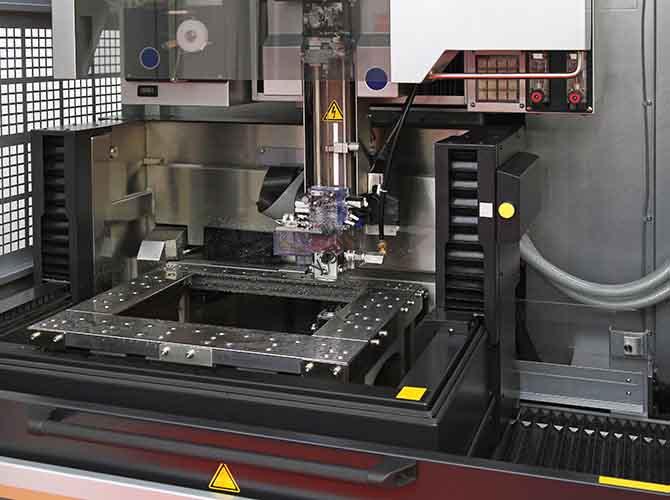
What Is CNC EDM Machining?
CNC EDM Machining (Computer Numerical Control Electrical Discharge Machining) is a non-contact manufacturing process that shapes metal parts by using controlled electrical discharges (sparks) between an electrode and the workpiece. Unlike traditional machining (which relies on physical cutting tools), EDM removes material through thermal erosion—making it ideal for hard, brittle, or complex materials that are difficult to machine with conventional methods.
At its core, Electrical Discharge Machining works by creating a series of tiny sparks (each lasting just microseconds) in a dielectric fluid (e.g., deionized water or oil). These sparks generate extreme heat (up to 8,000–12,000°C), melting and vaporizing small amounts of material from the workpiece to form the desired shape. CNC Technology automates this process, using pre-programmed computer software to control the electrode’s movement with exceptional accuracy—ensuring consistent, repeatable results for high-volume or custom parts.
Our Capabilities: What We Can Deliver
Our CNC EDM Services are designed to handle a wide range of project sizes and complexities, from small prototype components to large-scale production runs. Below is a breakdown of our key Machining Capacity and Precision Machining capabilities:
| Capability Category | Details | Specifications |
| Workpiece Size | Accommodates small, intricate parts and large-scale components | Max workpiece dimensions: 1,500mm (L) × 800mm (W) × 600mm (H) |
| Electrode Compatibility | Supports copper, graphite, and copper-tungsten electrodes | Electrode size range: 0.1mm (micro-electrodes) to 100mm (solid electrodes) |
| Production Volume | Flexible for low-volume prototypes and high-volume production | Prototype: 1–100 units; Production: 1,000–100,000+ units/year |
| Precision Level | Ultra-tight tolerance control for critical applications | Positioning accuracy: ±0.001mm; Repeatability: ±0.0005mm |
| Complexity Handling | Machines 3D contours, deep cavities, and internal features | Can handle undercuts, blind holes (down to 0.5mm diameter), and multi-axis geometries |
Whether you need a single custom part or a continuous supply of precision components, our Capabilities are scaled to meet your timeline and quality requirements.
Process: The CNC EDM Machining Steps
The CNC EDM Process follows a structured sequence of steps to ensure accuracy, efficiency, and consistency. Below is a step-by-step overview of our Machining Process:
- Design & Programming: First, we convert your 3D CAD model (e.g., STL, STEP) into a CNC program. This program defines the electrode’s path, spark parameters (e.g., voltage, current), and dielectric fluid settings—tailored to your part’s material and design.
- Electrode Preparation: We fabricate the electrode (from graphite or copper) to match the inverse shape of your desired part. For complex parts, multiple electrodes may be used for roughing (fast material removal) and finishing (precision shaping).
- Workpiece Setup: The workpiece is secured in a fixture on the EDM machine’s table. The dielectric fluid (deionized water for most metals) is filled into the machining tank to insulate the electrode and workpiece, and to flush away melted material.
- Machining Execution: The CNC system moves the electrode toward the workpiece until a spark gap (typically 0.01–0.1mm) is achieved. Sparks discharge between the electrode and workpiece, eroding material until the part matches the CAD design.
Quality Inspection: After machining, the part is cleaned and inspected using tools like coordinate measuring machines (CMMs) to verify dimensions and tolerances.
Materials: Suitable for CNC EDM Machining
CNC EDM Machining works with any electrically conductive material—making it versatile for industries that require hard or heat-resistant metals. Below are the Common Materials we process, along with their key properties and applications:
| Material | Hardness (HRC) | Key Properties | Typical Applications |
| Tool Steel | 58–65 | High wear resistance, toughness | Dies, molds, cutting tools |
| Stainless Steel | 25–45 | Corrosion resistance, strength | Medical instruments, aerospace components |
| Titanium Alloys | 30–40 | High strength-to-weight ratio, biocompatibility | Orthopedic implants, aircraft parts |
| Inconel | 35–45 | Heat resistance, chemical stability | Gas turbine components, rocket parts |
| Brass/Copper | 15–25 | Excellent conductivity, machinability | Electrical connectors, mold inserts |
Our Material Selection process involves working with you to choose the optimal material for your part’s function, environment, and budget—ensuring performance and cost-effectiveness.
Surface Treatment: Enhancing Part Quality
After CNC EDM Machining, Post-Machining Treatment is often required to improve surface quality, durability, or functionality. Below are the Surface Finishing options we offer, along with their benefits:
| Treatment Method | Surface Roughness (Ra) | Benefits | Ideal For |
| EDM Polishing | 0.1–0.8 μm | Smooth, mirror-like finish; removes EDM recast layer | Mold cavities, optical components |
| Abrasive Blasting | 1.6–6.3 μm | Uniform matte finish; removes contaminants | Automotive parts, decorative components |
| Electroplating | 0.05–0.2 μm | Adds corrosion resistance (e.g., chrome, nickel) | Medical tools, marine components |
| Passivation | 0.8–3.2 μm | Enhances stainless steel’s corrosion resistance | Food processing equipment, medical devices |
We tailor Treatment Methods to your part’s needs—whether you require a cosmetic finish for consumer products or a functional finish for industrial components.
Tolerances: Precision You Can Rely On
Tolerance Control is a cornerstone of our CNC EDM Machining services. We maintain strict Machining Tolerances to meet the most demanding industry standards. Below is a breakdown of our Tolerance Levels for different part features:
| Part Feature | Precision Tolerances | Industry Standard (ISO) |
| Linear Dimensions (e.g., length, width) | ±0.001–±0.01mm | ISO 2768-1 (Fine) |
| Hole Diameters | ±0.0005–±0.005mm | ISO 2768-2 (Very Fine) |
| Angular Tolerances | ±0.005°–±0.02° | ISO 1101 |
| Surface Flatness | 0.002mm/m | ISO 12781 |
These tolerances ensure that your parts fit and function as intended—critical for applications like aerospace (where component alignment is vital) and medical devices (where precision impacts patient safety).
Advantages: Why Choose CNC EDM Machining?
CNC EDM Machining offers unique Benefits that set it apart from traditional machining methods. Below are the key Advantages of CNC EDM:
- No Physical Tool Wear: Since EDM uses sparks (not cutting tools) to remove material, there’s no tool degradation—ensuring consistent precision across large production runs.
- Ideal for Complex Shapes: EDM can machine undercuts, deep cavities, and 3D contours that are impossible with milling or turning. This is especially valuable for mold and die manufacturing.
- Works with Hard Materials: It processes metals with hardness up to 65 HRC (e.g., tool steel, tungsten carbide) without damaging the workpiece—eliminating the need for pre-softening heat treatments.
- Superior Precision: With Precision Advantages like ±0.001mm tolerance, EDM is ideal for micro-components and critical parts (e.g., medical implants).
Cost Advantages: For small-batch or custom parts, EDM reduces tooling costs (no need for custom cutting tools) and shortens lead times—saving you time and money.
Applications Industry: Where CNC EDM Adds Value
Our CNC EDM Services serve a wide range of Industry Sectors, addressing unique challenges in each field. Below are the key Industry Applications and how we support them:
| Industry | Application Fields | CNC EDM Uses |
| Aerospace | Engine components, turbine blades, structural parts | Machining heat-resistant alloys (Inconel, titanium) with tight tolerances for high-performance parts. |
| Medical | Orthopedic implants (knees, hips), surgical tools, dental fixtures | Producing biocompatible parts (titanium, stainless steel) with smooth finishes to meet FDA standards. |
| Automotive | Mold inserts for plastic parts, fuel injection components, gear shafts | High-volume production of precision parts with consistent quality and durability. |
| Electronics | Micro-electrodes, connector pins, semiconductor molds | Machining small, intricate parts (down to 0.1mm) with high conductivity (copper, brass). |
| Mold & Die | Injection molds, stamping dies, extrusion dies | Creating complex cavities and undercuts in tool steel for high-wear mold components. |
Manufacturing Techniques: Advanced Methods We Use
To deliver top-tier results, we employ state-of-the-art Manufacturing Techniques and EDM Techniques tailored to your project. Below are the key methods in our workflow:
- Sinker EDM (Ram EDM): Used for complex 3D shapes, deep cavities, and large workpieces. A solid electrode (graphite/copper) is lowered into the workpiece to create the desired form—ideal for molds and dies.
- Wire EDM: Uses a thin, conductive wire (brass or copper) as the electrode to cut intricate 2D/3D shapes (e.g., gears, punches). It’s perfect for parts requiring tight tolerances and narrow kerfs (cutting width).
- Micro-EDM: Specialized for micro-components (e.g., medical needles, electronics parts). Uses micro-electrodes (down to 0.01mm diameter) to achieve ultra-fine features and sub-micron tolerances.
Adaptive Machining: Our CNC systems use real-time feedback to adjust spark parameters (e.g., voltage, gap) during machining—ensuring consistent quality even for uneven workpieces.
Case Studies: Success Stories from Our Clients
Case Study 1: Aerospace Turbine Blade Component
Challenge: A leading aerospace manufacturer needed a titanium alloy turbine blade retainer with a complex internal cavity (10mm deep, 2mm wide) and ±0.002mm tolerance. Traditional milling couldn’t reach the cavity’s depth without tool breakage.
Solution: We used Sinker EDM with a graphite electrode (shaped to the cavity’s inverse) and deionized water as the dielectric fluid. Our adaptive machining technique adjusted spark parameters to avoid thermal damage to the titanium.
Result: Delivered 500 retainers in 4 weeks with 100% compliance to tolerances. The client reported a 20% reduction in production costs compared to their previous supplier.
Case Study 2: Medical Orthopedic Implant
Challenge: A medical device company required a titanium knee implant with a smooth, biocompatible surface (Ra 0.2 μm) and undercut features for bone integration.
Solution: We used Wire EDM to cut the implant’s outer shape, followed by EDM polishing to achieve the required surface finish. We also performed passivation to enhance corrosion resistance.
Result: The implant passed FDA testing and is now used in 5,000+ surgeries annually. The client praised our ability to meet strict medical-grade standards.
Why Choose Us: Our Strengths as Your CNC EDM Partner
When you select our CNC EDM Machining services, you’re not just getting a supplier—you’re getting a partner focused on your success. Here are the Reasons to Choose us:
- Expertise & Experience: Our team has 15+ years of experience in EDM machining, with certified engineers specializing in aerospace, medical, and automotive applications.
- Advanced Equipment: We use 20+ state-of-the-art CNC EDM machines (from Makino and Sodick) with multi-axis capabilities—ensuring we can handle even the most complex parts.
- Quality Assurance: Our ISO 9001:2015-certified facility includes in-house CMMs and optical measuring tools—guaranteeing 100% compliance to your specifications.
- Flexible Lead Times: We offer rush services for prototypes (as fast as 3 days) and scalable production for high-volume orders—keeping your projects on track.
Competitive Advantages: Our in-house electrode fabrication and material sourcing reduce costs by 15–20% compared to competitors—without compromising quality.