
Ao avaliar se os protótipos de liga de alumínio são “caro,” a resposta depende de vários fatores – incluindo custos de material, métodos de processamento, e requisitos do projeto. Este artigo detalha os principais impulsionadores de custos, compara protótipos de liga de alumínio com alternativas, e ajuda você a determinar se eles atendem ao seu orçamento e às suas necessidades.
1. Why Do Aluminum Alloy Prototypes Cost More Than Plastic Ones? A Direct Comparison
The most common reference point for prototype costs is 3D printed plastic prototypes (por exemplo, PLA, ABS). Below is a side-by-side comparison to highlight the cost differences and reasons:
| Fator | Aluminum Alloy Prototypes | 3D Printed Plastic Prototypes | Cost Gap Reason |
| Raw Material Cost | Mais alto (por exemplo, 6061/6063 liga de alumínio: \(2–)5 por kg) | Mais baixo (por exemplo, PLA: \(0.5–)1 por kg; ABS: \(1–)2 por kg) | Aluminum alloys have higher raw material purity and mechanical property requirements. |
| Processing Waste | 15–30% waste (from CNC cutting/engraving) | <5% desperdício (fabricação aditiva) | Subtractive processes like CNC remove excess material, increasing waste. |
| Equipment Cost | Alto (\(100k–\)500k for CNC machines) | Mais baixo (\(1k–\)50k for FDM/FFF 3D printers) | CNC machines require high precision and automation, driving up depreciation costs. |
| Single-Piece Price | \(200–)2,000 (lote pequeno, 1–10 pieces) | \(20–)200 (same batch size) | Aluminum prototypes need more labor (programação, soldagem) e tratamento de superfície. |
2. Key Factors That Drive Aluminum Alloy Prototype Costs
Not all aluminum alloy prototypes cost the same—their price varies significantly based on 6 fatores principais. Understanding these helps you optimize costs:
2.1 Processing Method
Different processing techniques directly impact labor and time costs:
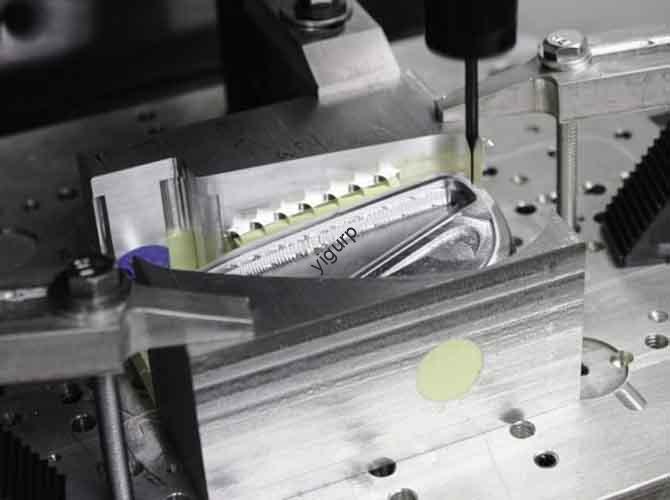
- Usinagem CNC de Precisão: The most common method for aluminum prototypes. It’s ideal for complex structures (por exemplo, furos roscados, hollow chambers) but requires 2–10 hours per piece (contra. 1–3 hours for plastic 3D printing). Costs increase with machining time.
- Welding/Assembly: If the prototype has multiple parts (por exemplo, a 2-piece aluminum housing), welding adds \(50–)200 per joint, plus quality inspection time.
- Tratamento de superfície: Almost all aluminum prototypes need treatments to improve durability and appearance—each adds to the cost:
- Jateamento de areia: \(30–)80 por peça
- Anodização (clear/colored): \(50–)150 por peça
- Galvanoplastia (chrome/nickel): \(80–)250 por peça
2.2 Precision and Complexity
Higher precision or complexity = higher costs. Por exemplo:
- A basic aluminum bracket with ±0.1mm tolerance costs ~$200.
- A medical device component with ±0.05mm tolerance and internal hollow channels costs ~\(800–)1,500.
Why? Complex designs require:
- More detailed CNC programming (2–3x longer than simple designs).
- Multiple machining setups (por exemplo, flipping the part for 5-axis CNC).
- Pós-processamento (por exemplo, deburring tiny gaps).
2.3 Quantidade: Small Batches Hurt, Large Batches Don’t Help Much
Ao contrário dos protótipos de plástico (where injection molding reduces costs for large batches), aluminum prototypes have limited economies of scale:
| Tamanho do lote | Aluminum Alloy Prototype Cost per Piece | Plastic Prototype Cost per Piece (Moldagem por injeção) |
| 1–10 pieces | \(200–)2,000 | \(20–)200 (3D impresso) |
| 100–500 pieces | \(150–)1,200 | \(5–)30 (injection molded) |
| 1,000+ pedaços | \(100–)800 | \(2–)15 (injection molded) |
Why? Aluminum prototypes rely on CNC machining (no mold sharing), while plastic injection molding spreads mold costs across thousands of parts.
3. When Are Aluminum Alloy Prototypes Worth the Cost?
Aluminum prototypes are “caro” only if they’re used for the wrong scenarios. They’re econômico when:
- You need to test mechanical performance: Aluminum has higher strength (6061 liga: 276 Resistência à tração MPa) e resistência ao calor (ponto de fusão: 660°C) than plastic—critical for prototypes like engine parts or industrial tools.
- You require a premium texture: Anodized aluminum has a metallic finish that plastic can’t replicate (por exemplo, high-end smartphone casings, audio equipment).
- You need to verify metal component assembly: If the final product uses aluminum, testing with an aluminum prototype avoids fit issues (por exemplo, 螺丝 holes alignment, part mating).
4. Yigu Technology’s Perspective on Aluminum Alloy Prototype Costs
Na tecnologia Yigu, we believe “expense” is relative to value. Aluminum alloy prototypes are not cheap, but they deliver irreplaceable benefits for high-stakes projects: they prevent costly design flaws in mass production (por exemplo, a misaligned aluminum bracket could ruin an entire device line). We often advise clients to prioritize their core needs: if functional testing (por exemplo, load-bearing) or aesthetic display is critical, aluminum is a wise investment. For budget-limited, low-stress scenarios (por exemplo, early-stage appearance models), we recommend starting with 3D printed plastic prototypes and upgrading to aluminum only when necessary. Our team also optimizes designs—simplifying curved surfaces or reducing thin walls—to cut CNC machining time by 15–25%, balancing cost and performance.
5. Perguntas frequentes: Common Questions About Aluminum Alloy Prototype Costs
1º trimestre: Can I reduce aluminum alloy prototype costs without sacrificing quality?
Sim. Optimize your design: remove unnecessary complex surfaces (por exemplo, non-functional arcs), use standard aluminum grades (6061 is cheaper than 7075), and limit surface treatments to only what’s needed (por exemplo, sandblasting instead of electroplating for internal parts).
2º trimestre: Is metal 3D printing a cheaper alternative to CNC-machined aluminum prototypes?
Não. Impressão 3D de metal (por exemplo, SLM for aluminum) is more expensive (\(500–)3,000 por peça) and less mature. It’s only used for ultra-complex designs (por exemplo, estruturas treliçadas) that CNC can’t produce. Para a maioria dos projetos, CNC-machined aluminum is cheaper and more reliable.
3º trimestre: When should I choose injection-molded aluminum over aluminum prototypes?
Injection-molded aluminum (fundição sob pressão) is for produção em massa (10,000+ pedaços). The mold cost (\(50k–\)200k) is high, so it’s not feasible for prototypes. Use aluminum prototypes to verify your design first, then switch to die casting for large batches.