
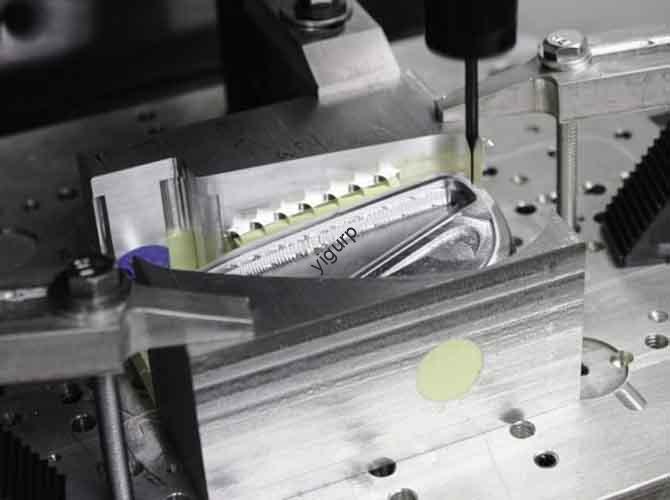
Usinagem CNC has become the backbone of precision manufacturing, mas como você atinge consistentemente essas metas de tolerância rígidas? Esteja você produzindo peças médicas ou componentes aeroespaciais, CNC machining accuracy directly impacts product performance and customer trust. Este artigo analisa os fatores críticos que afetam a precisão, soluções práticas, e benchmarks do mundo real para ajudá-lo a otimizar seu processo.
1. Core Factors Affecting CNC Machining Accuracy: A Comparative Table
Not all accuracy issues stem from the same source. Below is a side-by-side look at the top 6 factors, their impact, and quick fixes:
| Fator | Impact on Accuracy | Quick Optimization Tips |
|---|---|---|
| Machine Quality | Alto (30-40% of errors) | Choose machines with rigid cast iron frames |
| Tool Quality | Alto (25-30% of errors) | Use ferramentas de metal duro; replace after 50 horas de uso |
| Controle de temperatura | Médio (15-20% of errors) | Maintain shop temp at 20-22°C (±1°C) |
| Programming Accuracy | Médio (10-15% of errors) | Test tool paths with simulation software |
| Velocidade de usinagem | Low to Medium (5-10% of errors) | Reduce speed by 10% for tolerances <0.01milímetros |
| Fixture Accuracy | Médio (15-20% of errors) | Use hydraulic clamps for stable clamping force |
2. Let’s Dive Deeper: Critical Factors Explained
Machine Quality: The Foundation of Precision
A CNC machine is only as accurate as its components. High-precision machines use:
- Rigid structures: Cast iron frames reduce vibration during cutting.
- High-quality ball screws: Minimize backlash (ideal for tolerances down to 0.001mm).
- Precision linear guides: Ensure smooth, consistent movement of the spindle.
Por exemplo, a mid-range CNC mill might achieve 0.01mm accuracy, while a high-end model (like those used in semiconductor manufacturing) can hit 0.001mm—10 times more precise.
Tool Quality: Don’t Overlook the Cutting Edge
Imagine using a dull pencil to draw a straight line—tools work the same way.
- Geometric accuracy: A tool with uneven edges will leave rough surfaces and miss tolerance.
- Wear state: Depois 8 hours of continuous cutting, a high-speed steel tool can lose up to 0.005mm of its edge—enough to ruin a part requiring 0.003mm accuracy.
Solução: Usarcoated carbide tools (por exemplo, Revestimento TiAlN) to extend life and check tool wear with a micrometer every 2 horas.
Controle de temperatura: The Hidden Accuracy Killer
Why do bakeries keep ovens at a fixed temperature? Because materials expand and contract with heat—same for CNC machining.
- A 5°C temperature rise can cause a 1-meter aluminum workpiece to expand by 0.06mm (more than the typical 0.01mm tolerance!).
- Even spindle heat matters: A hot spindle can shift by 0.002mm mid-machining.
Fix: Install HVAC systems with precise controls and usesistemas de refrigeração to keep tools and workpieces at a steady temp.
3. Real-World Accuracy Benchmarks: What’s Achievable?
How do these factors translate to actual results? Here’s a breakdown of typical accuracy levels for different industries:
| Indústria | Required Accuracy | Common CNC Setup |
|---|---|---|
| Automotivo | 0.05-0.1milímetros | Mid-range CNC lathe + HSS tools |
| Dispositivos Médicos | 0.005-0.01milímetros | High-precision mill + carbide tools + temp control |
| Aeroespacial | 0.001-0.005milímetros | Ultra-precision machine + ferramentas de cerâmica + vibration dampening |
4. Yigu Technology’s Perspective on CNC Machining Accuracy
Na tecnologia Yigu, we believeaccuracy is not just a specification—it’s a process. Our CNC solutions combine rigid machine designs with intelligent temperature monitoring to reduce errors by up to 30%. We often advise clients to start with a “accuracy audit”: test their current process against the factors in this article, then prioritize fixes (por exemplo, upgrading tools before buying a new machine). Para a maioria dos fabricantes, pequeno, targeted changes (like better fixture clamping) yield faster ROI than full overhauls.
Perguntas frequentes
- P: Can I achieve 0.001mm accuracy with a standard CNC machine?UM: Não. Standard machines typically top out at 0.01mm. Ultra-precision machines (with specialized components) are needed for 0.001mm tolerances.
- P: How often should I calibrate my CNC machine to maintain accuracy?UM: Para produção de alto volume, calibrate every 3 meses. Para baixo volume, precision work, calibrate monthly.
- P: Does faster machining always mean lower accuracy?UM: Not always. Some modern machines use “high-speed precision” technology (por exemplo, adaptive feed rates) to maintain accuracy at faster speeds. Test with your specific part and material first.