
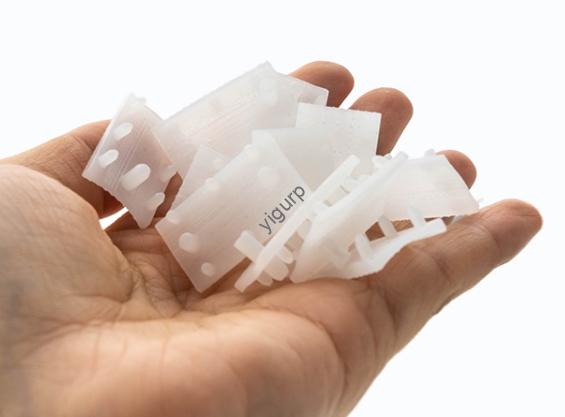
No mundo acelerado da pesquisa biomédica e do diagnóstico clínico, a demanda por eficiência, flexível, e dispositivos microfluídicos econômicos estão disparando. 3D printing microfluidic a tecnologia surgiu como uma virada de jogo, oferecendo uma solução que rompe as limitações dos métodos tradicionais de fabricação. Este artigo se aprofunda nas principais técnicas de impressão, suas aplicações no mundo real, and how they’re shaping the future of biomedicine—helping you choose the right technology for your specific needs.
1. What Is 3D Printing Microfluidic Technology?
Em sua essência, 3D printing microfluidic technology uses additive manufacturing to build microfluidic chips—devices that manipulate tiny volumes of fluids (usually microliters or nanoliters) for tasks like chemical analysis, cell culture, or disease detection. Ao contrário dos métodos tradicionais (such as photolithography, which is time-consuming and expensive), 3D printing enables rapid prototyping, personalização, and low-cost production.
Por exemplo, a team at Stanford University used 3D printing microfluidic to create a portable COVID-19 test chip in 2022. The chip, made via Stereolithography (SLA), could detect viral antigens in 15 minutes and cost less than $5 to produce—far cheaper than commercial PCR tests at the time. This case shows how the technology solves critical problems: velocidade, acessibilidade, and portability.
2. Key 3D Printing Techniques for Microfluidic Chips
Diferente 3D printing microfluidic methods excel in different scenarios. Below is a detailed breakdown of the most popular techniques, including their principles, prós, contras, e usos no mundo real.
| Technique | Technical Principle | Vantagens | Limitações | Aplicações Típicas |
| Moldagem por Deposição Fundida (FDM) | Extrudes heated thermoplastics (por exemplo, ABS, PLA) through a nozzle, camada por camada. | Wide material choice; good biocompatibility; baixo custo (~(500–)5,000 impressoras). | Low accuracy (50–200 μm); leakage risks; precisa de pós-processamento. | Disposable cell culture chips (used by small biotech startups for preliminary tests). |
| Estereolitografia (SLA) | Uses UV laser to selectively cure polymer resin layer by layer. | Alta precisão (10–50 μm); ideal for complex structures; fast iteration. | Z-axis micron-level accuracy issues; over-curing risks; expensive high-res printers (~$10,000+). | Academic research (por exemplo, MIT’s 2021 study on 3D-printed organ-on-a-chip models). |
| Processamento Digital de Luz (DLP) | Cross-links entire resin layers at once to build 3D structures. | Alta precisão (10–30 μm); good uniformity; low cost for desktop models (~(3,000–)8,000). | Resin removal challenges; channel sealing issues. | Portable diagnostic chips (por exemplo, um 2023 project by the University of Tokyo for blood glucose testing). |
| Nanofiber Self-Supporting Additive Manufacturing (NSCAM) | Uses electrospun nanofibers as supports; achieves micro-patterning via electrostatic writing. | No sacrificial layers; integrates high-density functional units; avoids microstructure failure. | Newer technology; limited commercial availability. | 3D fluid microvalves (developed by Xiamen University’s Professor Sun Daoheng team for lab-on-a-chip systems). |
| Inkjet 3D Printing | Sprays binders or light-curing droplets to build 3D structures. | Integrates antibodies/reactants directly; multi-printheads for color 3D structures. | Liquid leakage; low resolution (50–100 μm) limits high-performance use. | Immunoassay chips (used by diagnostic companies to detect biomarkers like cancer proteins). |
| Sinterização Seletiva a Laser (SLS) | Sinters metal powders (por exemplo, aço inoxidável) to make high-strength parts. | Resistência a altas temperaturas; alta resistência; suitable for harsh environments. | Custo muito alto (~$50,000+ printers); narrow application range. | Industrial microreactors (used by pharmaceutical firms for high-temperature chemical synthesis). |
3. How to Choose the Right 3D Printing Microfluidic Technique?
Selecting the best method depends on three key factors: your application needs, orçamento, and required accuracy. Here’s a step-by-step guide with examples:
- Define your application goal:
- If you need a disposable chip for basic cell tests (low budget, no ultra-high precision), FDM é ideal. Por exemplo, a startup in Boston used FDM to make $2 cell culture chips for testing drug toxicity—cutting their material costs by 70%.
- If you’re developing a complex organ-on-a-chip for research, SLA ou DLP é melhor. A lab at Harvard used DLP to print a liver-on-a-chip with 20 μm channels, mimicking human liver function more accurately than traditional chips.
- Consider your budget:
- Desktop solutions (FDM, entry-level DLP): \(500–)8,000. Perfect for small labs or startups.
- High-precision options (SLA, industrial DLP): \(10,000–)30,000. Suitable for academic research or mid-sized companies.
- Specialized tech (SLS, NSCAM): $50,000+. Only necessary for industrial or cutting-edge research needs.
- Check accuracy requirements:
- For microchannels smaller than 50 μm (por exemplo, for single-cell analysis), escolher SLA ou DLP.
- For channels larger than 100 μm (por exemplo, for bulk fluid mixing), FDM ou Inkjet funciona.
4. Future Trends in 3D Printing Microfluidic for Biomedicine
The future of 3D printing microfluidic is bright, with three key trends leading the way:
- Functional unit integration: Researchers are now 3D printing chips with built-in sensors, bombas, and valves—eliminating the need for separate components. Por exemplo, um 2024 study in Lab on a Chip showed a DLP-printed chip that combines fluid mixing, cell trapping, and pH sensing in one device.
- Portability: Demand for on-site diagnostics (por exemplo, in remote areas) is driving smaller, battery-powered 3D printing microfluidic fichas. A company in Kenya recently tested a DLP-printed malaria test chip that works with a smartphone—no lab equipment needed.
- Personalized medicine: 3D printing allows chips tailored to individual patients. Por exemplo, doctors at Johns Hopkins are exploring SLA-printed chips that use a patient’s own blood to test cancer drug responses—reducing trial-and-error in treatment.
Yigu Technology’s Perspective on 3D Printing Microfluidic
Na tecnologia Yigu, we believe 3D printing microfluidic is pivotal for democratizing biomedical innovation. We’ve supported clients—from startups to large pharma—in choosing the right tech: por exemplo, helping a diagnostic firm switch from FDM to DLP, cutting their chip production time by 50% while improving accuracy. We see huge potential in NSCAM and DLP for portable, low-cost devices, and we’re investing in resin R&D to solve sealing/removal issues. Moving forward, we’ll focus on integrating AI with 3D printing to automate chip design, making the technology even more accessible.
FAQ About 3D Printing Microfluidic
- P: Can 3D printing microfluidic chips be used for clinical diagnostics?
UM: Sim! Many chips (por exemplo, DLP-printed COVID or malaria test chips) are already in clinical trials. The key is choosing a technique with enough accuracy (por exemplo, DLP/SLA) and biocompatible materials (por exemplo, PLA for FDM).
- P: How much does it cost to start using 3D printing for microfluidic chips?
UM: For small labs/startups, entry-level FDM or DLP printers cost \(500–)8,000, plus materials (\(20–)100 per roll/resin). High-precision setups (SLA) start at $10,000.
- P: What materials are most commonly used in 3D printing microfluidic chips?
UM: Termoplásticos (ABS, PLA) para FDM, photopolymer resins for SLA/DLP, and metal powders (aço inoxidável) para SLS. Biocompatible resins are growing in use for medical applications.