
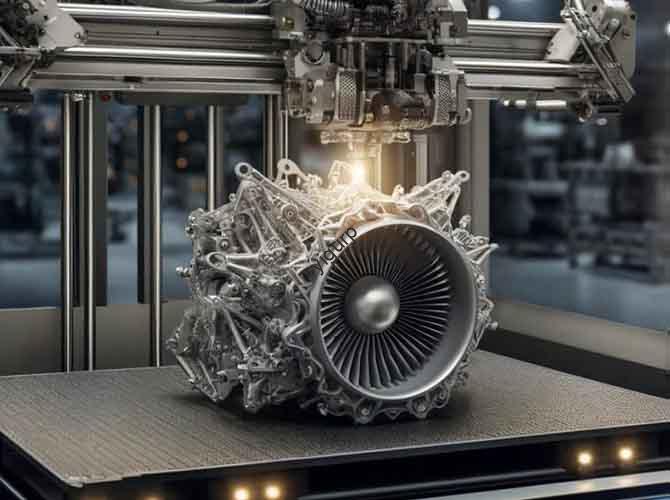
Motores de aeronaves exigem extrema precisão, durabilidade, e eficiência – requisitos que a fabricação tradicional muitas vezes tem dificuldade em atender, especialmente para componentes complexos. 3Motor de aeronave de impressão D technology has emerged as a transformative solution, permitindo a produção de peças complexas enquanto reduz custos e peso. Mas como isso supera as limitações tradicionais? Quais são as aplicações do mundo real? And how can you address its current challenges? This guide answers these questions to help you leverage 3D printing for aircraft engine projects.
1. Technical Advantages of 3D Printing for Aircraft Engines
3D printing outperforms traditional manufacturing (such as casting and multi-process machining) in three critical areas for aircraft engines. The table below highlights the key benefits with concrete examples:
| Advantage Category | 3D Printing Performance | Traditional Manufacturing Shortcomings | Impact on Aircraft Engines |
| Complex Structure Manufacturing | Accurately produces parts with intricate internal features (por exemplo, canais de resfriamento, complex turbine blade geometries) without molds | Requires expensive, custom molds for complex parts; multi-process machining increases error risk | Reduces part count (por exemplo, GE LEAP-1A fuel nozzles went from 20+ assembled parts to 1 3D-printed part) |
| Lightweight Design Realization | Creates hollow, lattice, or topology-optimized structures—cuts weight by 20–25% while maintaining strength | Struggles to produce lightweight, high-strength designs without compromising durability | Improves fuel efficiency (um 20% weight reduction in engine parts lowers aircraft fuel consumption by ~5%) |
| High Material Utilization | Adds material only where needed—material waste as low as 5–10% | Subtractive processes (por exemplo, usinagem) generate 70–80% material waste | Lowers costs for expensive aerospace materials (por exemplo, titânio, nickel-based superalloys) |
Exemplo: GE’s GE9X engine uses 3D-printed low-pressure turbine blades made from TiAl alloy. Compared to traditional nickel-based superalloy blades, these 3D-printed parts reduce the low-pressure turbine’s weight by 20%—directly boosting the engine’s thrust-to-weight ratio.
2. Aplicações do mundo real: 3D-Printed Aircraft Engine Components
Major aerospace manufacturers have already integrated 3D printing into aircraft engine production, with certified, peças de alto desempenho. Below are key application cases:
2.1 Key Manufacturers & Their 3D-Printed Engine Parts
| Manufacturer | Aircraft Engine Model | 3D-Printed Component | Performance Improvements | Certification Status |
| Safran | eAPU60 (Auxiliary Power Unit) | Bocal (core component) | Reliable operation in Leonardo AW189 helicopter | Certified by European Aviation Safety Agency (AESA) |
| Rolls-Royce | Trent XWB-97 (Airbus A350-1000) | Front bearing housing (1.5m diameter, 0.5m thick, 48 internal wings) | Simplifies production (replaces 10+ peças tradicionais) | Planned for full-scale production |
| Elétrica Geral (GE) | GE90-94B | T25 sensor housing | First FAA-certified 3D-printed metal aircraft part | Installed in 400+ motores |
| GE | LEAP-1A | Fuel nozzle | 25% redução de peso; 5x increase in durability | FAA-certified; widely used in commercial airliners |
| GE | GE9X | 304 3Peças impressas em D (bicos de combustível, low-pressure turbine blades, combustion chamber mixers, etc.) | Improves engine efficiency by 10% contra. previous GE engines | Powers Boeing 777X; FAA-certified |
2.2 Why These Components Are Ideal for 3D Printing
- Fuel Nozzles: Need intricate internal channels for fuel-air mixing—3D printing creates these in one piece, eliminating leakage risks from assembled parts.
- Lâminas de turbina: Require complex cooling channels to withstand 1,000°C+ temperatures—3D printing optimizes channel design for better heat dissipation.
- Bearing Housings: Grande, thick components with internal features (por exemplo, Rolls-Royce’s 48 asas)—3D printing avoids mold costs and reduces machining time.
3. Key Challenges of 3D Printing Aircraft Engines & How to Solve Them
While 3D printing offers huge benefits, it still faces hurdles in aircraft engine applications. Below is a breakdown of challenges and practical solutions:
3.1 Alto custo: Reduce Expenses Without Sacrificing Quality
| Challenge Aspect | Causa raiz | Solução |
| Machine & Custos de materiais | 3D printing machines (especially metal SLS/EBM) custo \(500k–\)2M; materiais especializados (TiAl, nickel alloys) custo \(50–)100 por kg | 1. Para produção de pequenos lotes: Use shared manufacturing facilities to avoid machine purchase costs. 2. Para peças de alto volume: Negotiate bulk material discounts with suppliers (cuts material costs by 15–20%). |
| Low Cost-Effectiveness for Small Batches | Setup costs (programação, calibração) outweigh part savings for <100 peças | 1. Group small-batch orders (por exemplo, combine 3–5 different sensor housing orders) to spread setup costs. 2. Use low-cost FDM machines for non-critical prototypes before scaling to metal 3D printing. |
3.2 Slow Printing Speed: Meet Production Deadlines
- Problema: 3D printing large parts (por exemplo, GE9X turbine blades) takes 12–24 hours per part—slower than traditional casting (which produces 10+ blades per hour).
- Soluções:
- Use multi-laser 3D printers (por exemplo, machines with 4–8 lasers) to double or triple printing speed.
- Prioritize 3D printing for high-value, peças de baixo volume (por exemplo, GE’s 304 GE9X parts) and use traditional manufacturing for high-volume, peças simples (por exemplo, basic engine brackets).
- Optimize print parameters (por exemplo, espessura da camada, potência do laser) to reduce time—test with prototypes first to avoid quality issues.
3.3 Difficult Quality Control: Ensure Aviation Safety Standards
Aviation engine parts must meet strict FAA/EASA standards—3D printing’s layer-by-layer process creates unique quality risks. Here’s how to mitigate them:
Etapa 1: Control Print Parameters
- Monitor key variables: Laser power (±5%), velocidade de digitalização (±10%), espessura da camada (±0,01 mm)—use AI-driven software to auto-adjust parameters if deviations occur.
- Exemplo: GE uses real-time sensors to track temperature during GE9X blade printing—if temperature drops by >20°C, the software increases laser power to prevent layer adhesion issues.
Etapa 2: Implement Post-Print Testing
- Mandatory tests for 3D-printed aircraft engine parts:
- CT Scanning: Verifica se há defeitos internos (porosidade, rachaduras) with 0.001mm resolution.
- Tensile Strength Testing: Ensures parts meet material standards (por exemplo, TiAl blades must withstand 800 MPa of stress).
- Heat Resistance Testing: Exposes parts to engine-like temperatures (1,000°C+) to verify durability.
Etapa 3: Follow Industry Standards
- Adhere to guidelines like ISO/ASTM 52900 (3D printing terminology) e FAA AC 20-168 (additive manufacturing for aircraft parts) para garantir o cumprimento.
4. Perspectiva da Tecnologia Yigu
Na tecnologia Yigu, we believe 3D printing is reshaping aircraft engine manufacturing by solving traditional complexity and weight issues. Many clients struggle with cost and speed—our advice is to start with high-impact parts (por exemplo, bicos de combustível) to demonstrate ROI, then scale. We’re developing AI tools to optimize print parameters for aerospace materials (por exemplo, TiAl), cutting print time by 25% and defect rates by 30%. As 3D printing machines become more affordable and materials more accessible, it will become the standard for aircraft engine production—and we’re committed to supporting this shift with practical, soluções escaláveis.
5. Perguntas frequentes: Answers to Common Questions
1º trimestre: Are 3D-printed aircraft engine parts as durable as traditionally made parts?
A1: Yes—when properly tested. 3Peças impressas em D (por exemplo, GE’s LEAP-1A fuel nozzles) often exceed traditional parts in durability (5x increase for the LEAP-1A nozzle) because they have fewer seams and optimized geometries. Strict post-print testing (Tomografias computadorizadas, testes de resistência ao calor) ensures they meet aviation standards.
2º trimestre: Can 3D printing be used for large-scale aircraft engine production (1,000+ parts per year)?
A2: It depends on the part. For complex, peças de alto valor (por exemplo, lâminas de turbina), yes—GE produces 10,000+ 3D-printed fuel nozzles yearly. For simple, peças de alto volume (por exemplo, colchetes), traditional manufacturing is still cheaper. The best approach is a hybrid model: 3D printing for complex parts, traditional methods for simple ones.
3º trimestre: What’s the lead time for 3D-printed aircraft engine parts?
A3: Para protótipos, 1–2 semanas (incluindo design, impressão, e testes). For production parts, 4–6 semanas (bulk printing + certificação). This is faster than traditional manufacturing (8–12 weeks for custom mold-based parts) because 3D printing eliminates mold development time.