
When your project demands microscopic detail, a glass-smooth surface, and rapid turnaround all at once, few 3D printing technologies can compete with MultiJet Printing (MJP). Operating like a high-precision inkjet printer for plastics, MJP jets tiny droplets of liquid photopolymer and instantly cures them with UV light, building parts with exceptional accuracy. However, its unique process—using simultaneous build and support materials—requires a specific mindset to master. The difference between a good MJP part and a perfect one lies in understanding the interplay between material chemistry, advanced support strategies, and meticulous post-processing. This guide dives deep into the key factors that ensure you consistently leverage MJP’s full potential for producing visually stunning prototypes, intricate masters, and functional components that stand out.
What Makes Material Selection for MJP So Critical?
Unlike single-material processes, MJP involves a precise chemical dance between the build resin and a proprietary, removable support wax. Your choices here dictate everything from mechanical performance to how easily the part is finished.
How Do You Navigate the Specialized MJP Resin Portfolio?
MJP resins are engineered for the technology’s specific jetting and curing mechanics. Using the wrong resin is not an option.
| Resin Type (Typical Brand: VisiJet®) | Key Properties & Use Case | Critical Consideration | Post-Processing Note |
|---|---|---|---|
| M3 (Rigid Plastic-like) | High detail, smooth finish, dimensional stability. Ideal for visual prototypes, snap-fits, and masters for molding. | The workhorse. Excellent balance of stiffness and detail. | Can be sanded, painted, and plated. Minimal moisture absorption. |
| CR-BK (Castable) | Designed for complete, clean burnout in investment casting for jewelry and dental applications. | Must not be cleaned with water. Only use recommended solvents to prevent residue that ruins casts. | Requires specific burnout cycles; follow foundry guidelines precisely. |
| CE-BK (Dental) | Biocompatible (Class I/IIa), certified for surgical guides and models. High accuracy for dental arches and implants. | Strict post-processing protocol (wash & cure) is mandatory for certification. Cannot be intermixed with other resins. | Often requires dental-specific sintering for final models. |
| Elastomeric / Flexible | Simulates rubber (Shore A 50-80). Used for gaskets, seals, and soft-touch features on prototypes. | Support removal is trickier; requires more care to avoid tearing. Printing orientation affects flexibility. | Avoid sanding; use solvent wiping for cleaning. |
Expert Insight: A medical device company needed patient-specific anatomical models for pre-surgical planning. Using a transparent M3-like resin allowed clinicians to see internal structures, while the material’s sterilizability via low-temperature ethylene oxide (EtO) made it suitable for the operating room environment. The 0.016mm layer resolution captured fine vascular details impossible with other rapid prototyping methods.
Why is Material Handling a Matter of Printhead Health?
MJP resins are viscosity-controlled to flow through micron-sized printhead nozzles. Contamination or improper storage is a direct path to clogs and failed prints.
- The Enemies: Light, Heat, and Moisture: Resins must be stored in their opaque, original containers below 25°C (77°F). UV exposure causes pre-gelling, and heat increases viscosity, both leading to jetting failures. Always shake resin cartridges gently before installation to homogenize.
- The Support Wax is Not an Afterthought: The wax support material has a specific melt point and flow characteristic. Using an off-brand or improperly stored support can cause poor interface layers, making support removal a nightmare, or even damaging the part during melt-out.
How Do You Master Support Strategy for Complex Geometries?
MJP’s greatest advantage—the ability to print dissimilar support material—also demands the most strategic planning.
Beyond Automatic Generation: Designing for Clean Detachment
The software’s auto-support is a starting point, not a solution.
- The Interface Layer is Key: The thin layer where support wax meets the model resin is engineered to hold during printing but release cleanly afterward. For upward-facing surfaces (e.g., the underside of a dome), this can leave a slightly textured “matte” finish compared to the glossy “free surface” cured against air.
- Proactive Design for Support Minimization:
- Self-Supporting Angles: While 30 degrees is the rule of thumb, you can often push to 45 degrees for MJP due to the wax’s instant support, especially for short overhangs.
- Critical Cosmetic Surfaces: Orient your model so that high-visibility faces are built upward or vertically, minimizing support contact on those surfaces. For a figurine’s face, printing it looking upward yields a perfect finish.
- Internal Channels: MJP excels at closed internal cavities because the wax support is fully removable via melting, leaving a smooth internal passage. This is ideal for fluidic manifolds or ducting prototypes.
What Are the Professional Support Removal Techniques?
There are three primary methods, chosen based on part geometry and material:
- Melting-Out (Most Common): Place the part in a wax melt station or oven at 60-70°C. The wax liquefies and drains away. For parts with trapped wax, cycle the temperature (heat, cool, invert, heat) to encourage drainage.
- Solvent Dissolution: Using a biodegradable, terpene-based solvent in an ultrasonic bath. This is faster and better for complex internal geometries. The used solvent can be distilled and reused.
- Manual Removal (for delicate parts): Use dental picks and soft brushes after a partial melt to gently pry supports away from fine details.
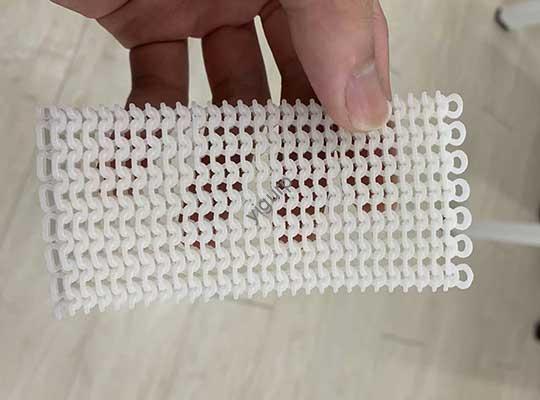
A Cautionary Tale: An engineer printed a fine-mesh filter using the highest support density for stability. Using the melt-out method alone left wax trapped in every pore. The solution was a combined approach: brief melting to remove bulk wax, followed by ultrasonic solvent bathing to completely clear the mesh, preserving its functional geometry.
How Do You Control the Process for Optimal Accuracy and Finish?
MJP’s precision is a function of machine calibration, environmental control, and slicing intelligence.
What Does True Machine Calibration Involve?
This goes beyond bed leveling. A properly calibrated MJP printer ensures perfect droplet placement and consistent UV curing.
- Printhead Jetting Calibration: This is often an automated routine. It verifies that all hundreds of nozzles are firing correctly and that droplet placement is accurate to within ±10 microns. A single clogged nozzle can create a streak defect across every layer.
- UV Lamp Intensity & Uniformity: The UV lamps must provide consistent energy across the entire build platform. Intensity is measured regularly with a radiometer. A fading lamp will cause incomplete curing, weak layers, and a tacky surface.
- Build Platform Temperature: Maintaining a stable platform temperature (typically 30-40°C) is crucial. It controls resin viscosity for optimal jetting and ensures dimensional stability as layers are built, preventing curl or warp.
Slicing Strategy: The 16 vs. 32 Micron Decision
The choice between ultra-fine (16µm) and high-speed (32µm) layers isn’t just about resolution.
| Layer Setting | XY Detail | Z-Axis Resolution | Typical Surface Finish (Ra) | Best For |
|---|---|---|---|---|
| 16 Microns | Exceptional. Can hold < 0.1mm features. | Very high. Almost eliminates layer lines. | < 1.0 µm (near injection-molded finish) | Visual masters, micro-fluidics, optical prototypes, jewelry. |
| 32 Microns | Very good. Reliable for > 0.2mm features. | Good. Subtle layer lines may be visible. | ~2-3 µm (smooth but not glossy) | Functional fit-test prototypes, enclosures, fast-turn models. |
The Speed Trade-off: A 32-micron layer can be up to 2x faster than a 16-micron layer for the same part height. For a 50mm tall prototype, this could mean a 4-hour print vs. an 8-hour print.
What Does a Comprehensive Post-Processing Pipeline Look Like?
Leaving a part with residual wax or uncured resin is the most common mistake that undermines MJP’s quality.
The Step-by-Step Professional Workflow:
- Primary Support Removal: Use the recommended method (melt/solvent) for the bulk of the wax.
- Solvent Rinse & Ultrasonic Clean: Immerse the part in a gentle solvent (like Tripropylene Glycol Monomethyl Ether – TPM) in an ultrasonic cleaner for 5-10 minutes. This removes the microscopic wax film and any uncured surface resin, revealing the true color and finish. Never skip this step.
- Post-Curing: While MJP parts are mostly cured during printing, a final UV post-cure cycle (in a controlled curing station) ensures complete polymerization, maximizing the material’s mechanical properties (hardness, temperature resistance) and long-term stability.
- Advanced Finishing: For show-quality parts:
- Sanding & Polishing: Start with 1200+ grit wet sandpaper, moving to micro-mesh polishing pads.
- Priming & Painting: Use a high-fill primer and fine spray paints. MJP’s smooth base takes paint exceptionally well.
- Clear Coating: For protection and enhanced gloss.
Environmental & Safety Controls are Non-Negotiable
- Lighting: Operate in a room with yellow or UV-filtered lights to prevent stray UV from curing resin in the printheads or on the build platform.
- Ventilation: Solvents and some resins require adequate fume extraction. Always wear nitrile gloves and safety glasses during handling and post-processing.
Conclusion
MJP 3D printing stands apart in its ability to deliver high-fidelity, ready-to-use parts directly from the printer. However, its full potential is only unlocked through a disciplined, knowledge-driven approach. By treating material selection as a chemical specification, viewing support structures as a designed interface, and implementing a rigorous post-curing and cleaning regimen, you transform MJP from a detail-oriented tool into a predictable, high-throughput production asset. The result is not just a prototype, but a part that often requires no tooling and can go straight to form, fit, and even some functional testing.
FAQ
What materials are used in MJP 3D printing?
MJP uses proprietary liquid photopolymer resins for the build material and a specialized, melt-away waxy polymer for supports. These materials are formulated to work together, with resins available in rigid, castable, dental-certified, and flexible variants to suit specific applications.
How do I handle support structures in MJP printing?
Handling is a multi-stage process. First, remove the bulk wax via melting (60-70°C) or solvent dissolution. Second, and most critical, clean the part in an ultrasonic bath with a recommended solvent to remove the final thin wax film and any surface residue. This ensures a clean, fully cured part.
What layer thickness should I choose for MJP prints?
Choose based on the function vs. aesthetics trade-off. For the highest detail and glossiest finish, use 16-micron layers. For faster, functional prototypes where slight layer lines are acceptable, 32-micron layers can cut print time nearly in half. Most applications find an excellent balance at 25 microns.
Can MJP parts be used for functional testing?
Yes, but with material-aware limits. Rigid MJP resins are excellent for fit, form, and assembly testing, and can simulate snap-fits. They have good dimensional stability but lack the impact strength and high-temperature resistance of engineering thermoplastics like ABS or Nylon. They are ideal for low-stress functional validation.
How do I achieve a perfectly smooth, painted finish on an MJP part?
The key is in the post-processing: 1) Ensure complete ultrasonic solvent cleaning after support removal. 2) Apply a high-build filler primer to eliminate any microscopic layer lines. 3) Lightly sand with 1000+ grit paper. 4) Apply your color coat and a clear protective topcoat. The inherently smooth MJP surface provides a superior base for painting compared to FDM or SLS.
Discuss Your Projects with Yigu Rapid Prototyping
Leveraging MJP technology to its fullest requires not just the right printer, but also deep material knowledge, controlled environments, and specialized post-processing equipment. For projects where detail, speed, and surface quality are paramount, partnering with an expert service provider guarantees you get the best the technology can offer.
At Yigu Rapid Prototyping, our MJP production is built for precision and scale:
- Industrial-Grade Equipment & Calibration: We operate the latest PolyJet (a subset of MJP) systems from Stratasys, maintained under strict calibration schedules to ensure micron-level accuracy and consistent droplet jetting across every build.
- Full Material Ecosystem Access: We offer the complete range of VisiJet® and Digital ABS® materials, enabling us to select the perfect resin for your needs—from transparent and color-capable visual models to high-temperature, functional Digital ABS prototypes.
- Professional Post-Processing Facility: Our dedicated finishing department handles support removal, ultrasonic cleaning, UV post-curing, sanding, priming, and painting to deliver parts that are not just printed, but production-ready.
Need photorealistic prototypes or complex, detailed parts in record time? Send us your 3D model for a comprehensive feasibility analysis and a transparent quote. Experience the Yigu difference, where precision meets professionalism.