
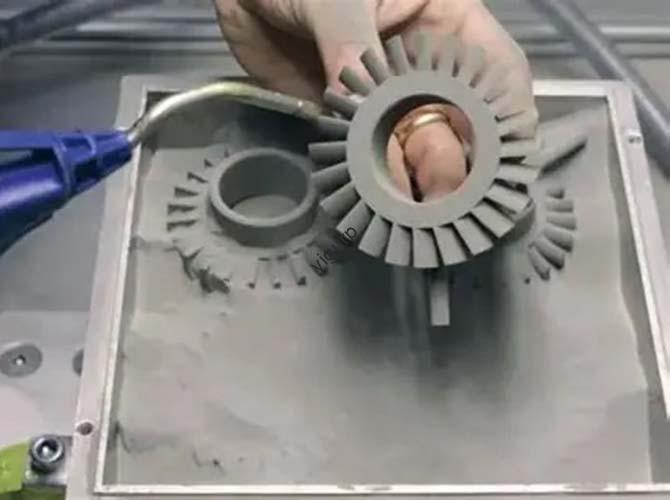
Pressofusione per gravità (noto anche come fusione in stampo permanente) è un processo fondamentale di formatura dei metalli che si basa sulla forza naturale della gravità per riempire le cavità dello stampo con metallo fuso. A differenza della pressofusione ad alta pressione, evita complessi sistemi di pressione, making it a cost-effective and reliable choice for specific industrial scenarios—especially for thick-walled parts requiring heat treatment and structural stability. Tuttavia, to maximize its value, manufacturers must understand its core principles, vantaggi chiave, application boundaries, and technical innovations. This article systematically breaks down gravity die casting to help you solve practical problems like process selection, defect prevention, and efficiency improvement.
1. Core Principles & Process Flow of Gravity Die Casting
To master gravity die casting, it’s essential to first grasp its working mechanism and standardized workflow. This section uses a 总分 + linear 叙述 struttura, with critical steps and parameters highlighted for clarity.
1.1 Fundamental Principle
Gravity die casting operates on a simple yet precise logic: molten metal flows into the mold cavity solely under its own weight, without external pressure (per esempio., hydraulic or mechanical force). The mold—typically made of heat-resistant alloy steel (per esempio., H13 or HT300)—is reusable and designed with a “top-down” filling path. This natural flow minimizes turbulence, reducing the risk of air entrainment and ensuring uniform metal distribution in thick-walled areas (>8mm)—a key advantage over high-pressure die casting, which often traps gas in thick sections.
1.2 Standard Process Flow
The workflow of gravity die casting follows 6 sequential steps, each with strict operational requirements:
- Preparazione dello stampo:
- Preheat the mold to 150-300°C (varies by alloy: 150-200°C for aluminum, 250-300°C for cast iron) to prevent molten metal from solidifying prematurely.
- Apply a thin layer of release agent (per esempio., graphite-based or water-based) to the cavity surface—this reduces mold sticking and extends mold life by 20-30%.
- Molten Metal Melting:
- Heat the metal (per esempio., lega di alluminio A356, cast iron HT250) to its liquid state: 670-720°C for aluminum, 1400-1450°C for cast iron.
- Degas the molten metal (per alluminio, use argon purging for 10-15 minuti) to reduce hydrogen content to <0.15ml/100g—this prevents porosity after solidification.
- Controlled Pouring:
- Use a ladle to pour the molten metal into the mold’s sprue at a steady speed (0.5-1.0 L/min for aluminum). Avoid fast pouring, which causes splashing and oxide inclusions.
- Ensure the metal fills the cavity gradually, starting from the bottom and rising to the top—this pushes air out through dedicated vent channels (1-2mm di larghezza, 50-100mm long).
- Natural Exhaust & Solidificazione:
- Rely on the mold’s vent channels and parting surface gaps for exhaust—no complex vacuum systems are needed.
- Let the metal solidify naturally: 5-30 minuti (a seconda dello spessore della parte: 5 minutes for 10mm walls, 30 minutes for 50mm walls). Slow solidification forms a uniform grain structure, supporting subsequent heat treatment.
- Mold Opening & Rimozione parte:
- Once the metal is fully solidified (verified by temperature sensors: <200°C for aluminum), open the mold using hydraulic or manual actuators.
- Use ejector pins (spaced 50-80mm apart) to gently remove the part—avoid excessive force, which can cause deformation in thin-walled features.
- Post-elaborazione:
- Trim excess material (per esempio., sprue, risers) using a bandsaw or CNC router.
- For parts requiring high precision, perform machining (per esempio., fresatura, perforazione) to achieve dimensional tolerance of ±0.1mm.
- Conduct heat treatment (per esempio., T6 for aluminum: solution treatment at 530°C + aging at 120°C) to enhance mechanical properties—this step is impossible for most high-pressure die cast parts due to porosity.
2. Key Advantages of Gravity Die Casting: Why It’s Irreplaceable
Gravity die casting’s unique value stems from its ability to solve pain points that other processes struggle with—such as thick-walled part quality, heat treatment compatibility, e controllo dei costi. This section uses a problem-solution + specific 数字 structure to highlight its core benefits.
2.1 Superior Quality for Thick-Walled Parts
- Problema: High-pressure die casting traps air in thick-walled areas (>8mm), leading to porosity and making parts unsuitable for pressure-bearing applications (per esempio., blocchi motore).
- Soluzione: Gravity die casting’s natural flow eliminates turbulence, reducing porosity to <1% (contro. 5-10% in high-pressure die casting). Per esempio, a 20mm-thick aluminum engine block produced via gravity die casting has a leakage rate of <1×10⁻⁶ mbar·L/s—meeting automotive hydraulic system standards.
- Data Support: According to QYResearch, gravity die cast parts have a 60% lower defect rate than high-pressure die cast parts for components with wall thicknesses >15mm.
2.2 Compatibility with Heat Treatment
- Problema: High-pressure die cast parts contain hidden pores, which expand during heat treatment and cause cracking or deformation.
- Soluzione: Gravity die casting’s low porosity enables full heat treatment. For aluminum alloy A356 parts:
- Tensile strength increases from 220MPa (as-cast) to 320MPa after T6 heat treatment.
- Elongation rises from 3% A 8%, improving toughness for high-load applications (per esempio., heavy machinery brackets).
- Esempio di applicazione: Volvo uses gravity die cast aluminum cylinder heads (heat-treated to T7) for its heavy-duty trucks—these heads withstand 300°C+ temperatures and 10MPa combustion pressure without failure.
2.3 Cost-Effectiveness for Medium Batches
- Problema: High-pressure die casting requires expensive molds (\(50,000-\)500,000), making it uneconomical for small-to-medium batches (1,000-10,000 parts/year).
- Soluzione: Gravity die casting molds cost 70-90% meno (\(1,000-\)50,000) and have a lifespan of 10,000-50,000 shots. For a 5,000-unit order of cast iron machine tool beds:
- Gravity die casting total cost: \(80,000 (muffa: \)15,000 + costo per parte: $13).
- High-pressure die casting total cost: \(250,000 (muffa: \)200,000 + costo per parte: $10).
- Key Insight: Gravity die casting achieves the “sweet spot” between low upfront cost (sand casting) and high efficiency (high-pressure die casting).
2.4 Wide Material Compatibility
- Problema: High-pressure die casting is limited to low-melting-point non-ferrous metals (alluminio, zinco, magnesio) and cannot process ferrous metals (cast iron, acciaio) or high-temperature alloys.
- Soluzione: Gravity die casting works with:
- Ferrous metals: Ghisa (HT200, HT300), acciaio al carbonio (Q235), and alloy steel (40Cr).
- High-temperature alloys: Superleghe a base di nichel (Inconel 625) per componenti aerospaziali.
- Applicazione: GE uses gravity die casting to produce Inconel 625 turbine blades for gas turbines—these blades operate at 800°C and withstand 500MPa centrifugal force.
3. Gravity Die Casting vs. Other Casting Processes: A Comparative Guide
To help you select the right process for your project, the table below compares gravity die casting with high-pressure die casting and sand casting across 7 dimensioni critiche:
| Comparison Dimension | Pressofusione per gravità | Pressofusione ad alta pressione | Sand Casting |
| Filling Force | Gravity (no external pressure) | Alta pressione (3,000-15,000 kPa) | Gravity |
| Applicable Wall Thickness | >8mm (optimal: 10-50mm) | <8mm (optimal: 0.5-5mm) | Any (0.5-100mm) |
| Porosity Level | Basso (<1%) | Alto (5-10% in thick walls) | Medio (2-5%) |
| Heat Treatment Compatibility | SÌ (full range: T6, T7) | NO (porosity causes cracking) | SÌ (but surface quality limits performance) |
| Mold Cost | \(1,000-\)50,000 | \(50,000-\)500,000 | \(500-\)5,000 (disposable) |
| Production Cycle | 5-30 minutes/part | 10-60 seconds/part | 1-24 hours/part |
| Batch Suitability | Lotti medi (1,000-10,000 parts/year) | Produzione di massa (>10,000 parts/year) | Piccoli lotti (<1,000 parts/year) |
4. Application Scenarios & Technical Innovations
Gravity die casting is not a “taglia unica per tutti” solution—it excels in specific industries and is evolving with automation and new materials. This section uses applicazione + innovazione segmentation to provide practical guidance.
4.1 Key Application Industries
- Automobilistico (Heavy-Duty & NEV):
- Parti: Blocchi motore, teste dei cilindri, Telai per batterie EV (thick-walled, pressure-bearing).
- Esempio: Daimler uses gravity die cast aluminum battery frames for its eActros electric trucks—these frames (20mm-thick walls) weigh 15% less than steel frames and withstand 200kN crash loads.
- Macchinari pesanti:
- Parti: Hydraulic valve bodies, alloggiamenti del cambio (require heat treatment and low leakage).
- Dati: 70% of hydraulic valve bodies for excavators are produced via gravity die casting—due to its <1% porosity and dimensional accuracy of ±0.15mm.
- Aerospaziale (Low-Volume High-Performance):
- Parti: Nickel-based superalloy combustion chambers, titanium alloy structural brackets (resistenza alle alte temperature).
- Vantaggio: Gravity die casting avoids the high cost of forging for small aerospace batches (100-500 parts/year).
4.2 Latest Technical Innovations
- Automation Upgrades:
- PLC-Controlled Pouring Robots: Replace manual ladling with automated systems (per esempio., KUKA robots) to reduce pouring speed variation from ±20% to ±5%. This cuts oxide inclusion defects by 40%.
- Real-Time Temperature Monitoring: Embed thermocouples in the mold to maintain cavity temperature at ±10°C—ensuring consistent solidification and reducing part-to-part variation by 30%.
- New Material Compatibility:
- Low-Flow Aluminum Alloys: Developed alloys like AlSi10MgMn (low fluidity) perform well in gravity die casting—they reduce shrinkage by 25% compared to traditional ADC12, making them ideal for complex thick-walled parts.
- Composite Material Integration: Embed carbon fiber-reinforced polymer (CFRP) inserts in gravity die cast aluminum parts—this increases stiffness by 50% while keeping weight low (per esempio., for aerospace seat frames).
- Market Growth: According to QYResearch, the global gravity die casting market will grow at a 3.5% CAGR da 2024 A 2031, reaching $31.14 billion—driven by demand for lightweight, heat-treatable parts in automotive and aerospace.
5. Common Defects & Troubleshooting in Gravity Die Casting
Even with its advantages, gravity die casting can develop defects due to improper operation or mold design. The table below uses a defect-cause-solution structure to help you resolve issues quickly:
| Defect Type | Main Causes | Step-by-Step Solutions |
| Shrinkage Holes | 1. Insufficient riser volume (riser <1.5× part volume)2. Fast cooling in thick areas (no local insulation) | 1. Increase riser volume to 2× part volume (per esempio., a 100cm³ part needs a 200cm³ riser).2. Add ceramic insulation sleeves to thick-walled areas (slows cooling by 50%). |
| Oxide Inclusions | 1. Fast pouring speed (>1.0 L/min for aluminum)2. Uncovered molten metal (exposed to air) | 1. Reduce pouring speed to 0.5-0.8 L/min; use a pouring cup with a baffle to prevent splashing.2. Cover the molten metal with a flux layer (per esempio., potassium aluminum fluoride) to isolate air. |
| Mold Sticking | 1. Low mold temperature (<150°C for aluminum)2. Thick release agent layer (>0.1mm) | 1. Raise mold temperature to 180-200°C; use a infrared thermometer to verify uniformity.2. Reduce release agent application to 0.05mm (use a spray gun with adjustable flow). |
| Cold Shuts | 1. Low molten metal temperature (<670°C for aluminum)2. Slow filling (metal solidifies before cavity is full) | 1. Increase molten metal temperature to 690-710°C; use a thermocouple to monitor in real time.2. Optimize sprue design (widen to 15mm from 10mm) to speed up filling. |
6. Yigu Technology’s Perspective on Gravity Die Casting
Alla tecnologia Yigu, we believe gravity die casting is a “strategic complementary process”—it fills the gap between high-pressure die casting (produzione di massa) and sand casting (piccoli lotti) and is irreplaceable for thick-walled, heat-treatable parts. Many manufacturers underestimate its potential, focusing only on high-pressure die casting’s speed while ignoring gravity die casting’s cost and quality advantages for medium batches.
We recommend a process-material synergy approach: Per esempio, use gravity die casting with AlSi10MgMn alloy for EV battery frames—this combination achieves 320MPa tensile strength (after T6) E 15% riduzione del peso, while keeping costs 40% lower than high-pressure die casting. We also advocate integrating automation (per esempio., PLC-controlled pouring robots) to reduce cycle time by 30% senza compromettere la qualità.
Looking ahead, as new energy vehicles and aerospace demand more lightweight, parti ad alte prestazioni, gravity die casting—paired with new alloys and real-time monitoring—will play a larger role in high-end manufacturing.
7. Domande frequenti: Common Questions About Gravity Die Casting
Q1: Can gravity die casting produce thin-walled parts (<8mm) like phone casings?
Technically yes, but it’s not cost-effective. Thin-walled parts require fast filling to avoid cold shuts, which gravity die casting struggles with (natural flow is too slow). Per <8parti da mm, high-pressure die casting is better—its 5-50 m/s injection speed ensures complete filling, and its low per-part cost (\(0.5-\)5) offsets high mold costs for mass production. Gravity die casting is more suitable for parts >8mm where quality (not speed) è fondamentale.
Q2: What is the maximum part size gravity die casting can handle?
Gravity die casting has no strict size limits— it can produce parts from small brackets (100G) to large machine tool beds (5,000kg+). The key constraint is mold design and handling equipment: For parts >1,000kg, use split molds (easy to open/close) and overhead cranes for mold handling. Per esempio, Siemens uses gravity die casting to produce 3,000kg cast iron stator housings for wind turbines—these housings are 2m in diameter and 1.5m tall.
Q3: How to improve the surface finish of gravity die cast parts (Ra = 6.3-12.5 µm)?
Three effective steps: 1. Polish the mold cavity to Ra = 0.8 µm (use diamond grinding wheels) —this transfers a smoother surface to the part. 2. Use a water-based release agent (contro. graphite-based) —it leaves less residue, reducing surface roughness by 30%. 3. Perform post-processing: Sandblast with 200# alumina powder (smoothens to Ra = 3.2 µm) or conduct light machining (per esempio., face milling) for critical surfaces (Ra = 1.6 µm).