
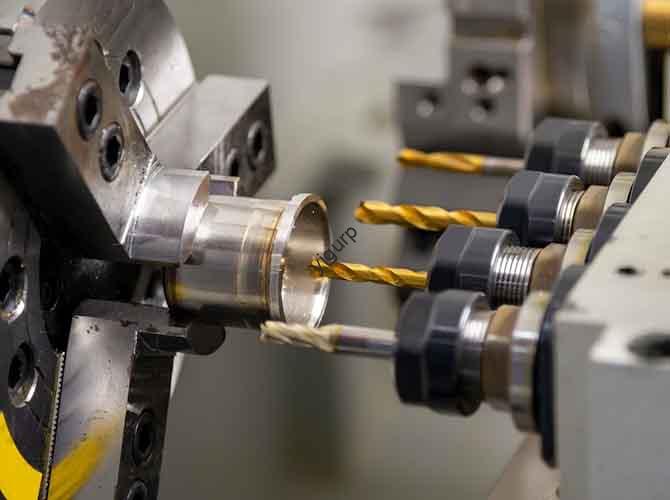
CNC large-scale machining involves fabricating oversized, pezzi pesanti (per esempio., ruote delle turbine eoliche, alberi di propulsione delle navi) utilizzando apparecchiature CNC ad alta rigidità, richiedendo un controllo rigoroso su ogni fase per evitare costosi difetti (per esempio., deformazione del pezzo, rottura dell'utensile) e garantire la sicurezza. A differenza della lavorazione CNC standard, la sua attenzione alle grandi dimensioni (Spesso >1 metro) e carichi pesanti (1–100 tonnellate) introduces unique risks, from equipment overload to precision drift. This article breaks down critical precautions across design, preparazione, execution, and post-processing stages, helping manufacturers mitigate risks and deliver consistent, high-quality large-scale parts.
1. Pre-Machining Precautions: Lay the Foundation for Success
Pre-machining preparation is make-or-break for CNC large-scale machining—small oversights here lead to irreversible errors later. Below is a 总分结构 of key precautions, organized by workflow:
1.1 Progetto & Programming Precautions
Large workpieces have complex geometries and tight tolerances (often ±0.05–0.1 mm), requiring rigorous programming checks:
| Precaution | Technical Details | Risk if Ignored |
| CAD Model Validation | – Use SolidWorks or AutoCAD to verify structural integrity (per esempio., load-bearing ribs for high-weight parts).- Check for design conflicts (per esempio., internal cavities that block tool access).- Add machining allowances (5–10 mm for roughing, 0.5–1 mm for finishing) to account for shrinkage/deformation. | Incomplete cavities or insufficient allowances force rework—costing $5,000+ for a 2-meter wind turbine flange (due to material waste and downtime). |
| CAM Toolpath Simulation | – Use Mastercam or UG/NX to simulate toolpaths in 3D, checking for: 1. Collisions (tool vs. workpiece, tool vs. fixture). 2. Overcuts (excessive material removal). 3. Empty strokes (optimize to reduce cycle time by 15–20%).- Test with a digital twin of the actual machine (matches spindle speed, axis travel). | A collision between a φ50 mm end mill and a 10-ton ship shaft can destroy the tool (\(2,000+) and damage the workpiece (\)50,000+), halting production for 3–5 days. |
1.2 Attrezzatura & Fixture Precautions
Large-scale machining relies on high-rigidity equipment and stable fixturing—critical for minimizing vibration and precision loss:
- Equipment Inspection:
- Check the heavy-duty bed per planarità (use a laser interferometer; tolerance ≤0.02 mm/m) e indossare (replace worn guide rails if backlash >0.005 mm).
- Test the high-power spindle (50–100 kW for large machines): Run at 500–1,000 RPM for 30 minuti, monitoring vibration (≤0.1 mm/s) e temperatura (≤60°C).
- Verify the automatic tool changer (ATC): Ensure tool change time <10 seconds and repeatability <±0,003 mm (prevents tool misalignment).
- Progettazione degli apparecchi & Installazione:
- Utilizzo custom heavy-duty fixtures (made of 45# steel or cast iron) con: – Multiple clamping points (4–8 for a 1.5-meter excavator arm) to distribute pressure evenly. – Anti-slip pads (rubber or copper) to prevent workpiece shifting during cutting.
- Align the fixture with the machine’s X/Y/Z axes (use a dial indicator; tolerance ±0.01 mm) and secure it with M20+ bolts (torque 500–800 N·m) to avoid movement under high cutting forces.
Risk Example: A loosely fixed fixture for a 5-ton crane base can shift by 0.2 mm during roughing—resulting in a 0.15 mm dimensional deviation that fails quality checks.
2. In-Machining Precautions: Maintain Control During Execution
In-machining is where large workpieces are shaped—real-time monitoring and parameter adjustments are critical to avoid defects. Below is a linear breakdown of key precautions:
2.1 Cutting Parameter Control
Large-scale machining uses high cutting forces (10–50kN) and slow speeds (50–200 mm/min for hard materials), requiring precise parameter setting:
| Materiale | Velocità del mandrino (giri al minuto) | Tasso di avanzamento (mm/min) | Depth of Cut (mm) | Key Precaution |
| Acciaio al carbonio (Q235) | 800–1,200 | 100–150 | 3–5 (roughing); 0.5–1 (finitura) | Use water-soluble coolant (flow rate 50–100 L/min) to reduce heat-induced deformation. |
| Acciaio inossidabile (304) | 600–800 | 80–120 | 2–4 (roughing); 0.3–0.8 (finitura) | Avoid dry cutting—use oil-based coolant to prevent built-up edges (BUE) on the tool. |
| Lega di alluminio (6061) | 1,500–2,000 | 200–300 | 4–6 (roughing); 0.8–1.2 (finitura) | Utilizzare acciaio ad alta velocità (HSS) tools with polished flutes to reduce chip adhesion. |
2.2 Real-Time Monitoring & Adjustment
- Vibration Monitoring: Use accelerometers mounted on the spindle and workpiece to track vibration levels. If vibration exceeds 0.15 mm/s: 1. Reduce feed rate by 10–20%. 2. Check for loose fixtures or dull tools.
- Load Monitoring: Monitor spindle load (via CNC system feedback). If load exceeds 80% of maximum capacity: 1. Pause machining to inspect for tool wear or workpiece misalignment. 2. Adjust depth of cut by 20–30% to reduce load.
- Controllo della temperatura: Keep workshop temperature at 20–25°C (±2°C) to avoid thermal expansion of the workpiece. For parts >2 meters long, thermal expansion of 0.1 mm can cause dimensional deviations.
2.3 Tool Management
Large-scale machining uses expensive, specialized tools—proper care extends their life and ensures precision:
- Tool Inspection: Check for wear (per esempio., flank wear >0.2 mm for carbide tools) before each use. Replace tools after 8–12 hours of cutting (varia in base al materiale).
- Tool Storage: Store tools in a climate-controlled cabinet (humidity 40–50%) per prevenire la ruggine. Use tool presetters to measure length/diameter (precisione ±0,001 mm) before installation.
3. Post-Machining Precautions: Ensure Final Quality & Safety
Post-machining steps finalize the workpiece—neglecting them undermines all prior efforts. Below is a list of critical precautions:
3.1 Sbavatura & Pulizia
- Sbavatura: Large workpieces have sharp edges (dal taglio) that pose safety risks and affect assembly. Utilizzo: – Vibration grinding (per superfici piane) or robotic deburring (for complex cavities) to remove burrs (≤0.05 mm height). – Manual touch-up with a file (for hard-to-reach areas) by trained operators (wear gloves to avoid cuts).
- Pulizia: Remove coolant, chips, and oil using: 1. High-pressure water (3–5 MPa) for external surfaces. 2. Pulizia ad ultrasuoni (40 kHz frequency) for internal channels (per esempio., oil passages in engine blocks). 3. Aria compressa (0.6 MPa) to dry the workpiece (previene la ruggine).
3.2 Ispezione di qualità
Large workpieces require comprehensive testing to meet standards—use the right tools for the job:
| Inspection Item | Tool/Method | Acceptance Criteria |
| Precisione dimensionale | Macchina di misura a coordinate (CMM) with ≥1.5-meter measuring range | Key dimensions (per esempio., flange diameter) within ±0.05 mm; position tolerance ≤0.1 mm. |
| Qualità della superficie | Surface Roughness Tester (Ra) | Ra ≤3.2 μm for structural parts; Ra ≤1.6 μm for mating surfaces (per esempio., shaft bearings). |
| Internal Defects | Ultrasonic Flaw Detector (UT) or X-ray | No internal cracks, porosità, or inclusions >2 mm di diametro (critical for load-bearing parts like crane bases). |
| Assembly Simulation | Test fit with mating components (per esempio., wind turbine wheel + lancia) | No forced assembly; clearance between parts 0.1–0.2 mm (ensures smooth operation). |
4. Safety Precautions: Protect Personnel & Attrezzatura
CNC large-scale machining involves heavy machinery and high voltages—safety is non-negotiable. Below is a list of non-negotiable safety rules:
- Formazione degli operatori: Only certified operators (con 2+ years of large-scale machining experience) are allowed to operate the equipment. Train them on: – Emergency stop procedures (location of E-stop buttons, response time <1 secondo). – Risk of workpiece tipping (never stand in the “fall zone” of a 10-ton part).
- Equipment Safety Checks: – Inspect electrical systems (cables, connettori) for damage before each shift—replace frayed cables to prevent electric shock. – Test safety guards (per esempio., spindle covers) to ensure they lock automatically if a collision is detected.
- Workpiece Handling: – Use overhead cranes (capacity 1.5x the workpiece weight) with certified slings (inspected monthly for wear). – Mark the workpiece’s center of gravity (COG) to avoid tipping during lifting—use a level to ensure it’s horizontal before moving.
La prospettiva della tecnologia Yigu
Alla tecnologia Yigu, we see CNC large-scale machining precautions as the backbone of reliable production. For energy clients, we validate wind turbine flange designs with 3D simulations and add 8 mm machining allowances to account for thermal deformation—reducing rework by 60%. For transportation clients, we use ultrasonic flaw detection on ship shafts and test-fit components before delivery, garantendo 100% assembly compliance. We also prioritize safety: our operators undergo quarterly training on emergency procedures, and we inspect cranes/slings weekly. Ultimately, precautions aren’t just rules—they’re investments that save time, ridurre i costi, and protect our clients’ reputations in high-stakes industries like energy and shipping.
Domande frequenti
- What is the most critical pre-machining precaution for CNC large-scale machining?
The most critical is CAM toolpath simulation with a digital twin. Large workpieces and tools are expensive, and collisions here cause catastrophic damage. Simulating with the actual machine’s parameters (velocità del mandrino, axis limits) catches 90% of potential collisions—saving tens of thousands in repair costs.
- How do you prevent workpiece deformation during CNC large-scale machining?
Three key steps: 1. Use custom heavy-duty fixtures with multiple clamping points to distribute pressure evenly. 2. Control workshop temperature (20–25°C ±2°C) to minimize thermal expansion. 3. Use coolant at high flow rates (50–100 L/min) to reduce heat-induced stress—critical for materials like stainless steel.
- What safety equipment is mandatory for CNC large-scale machining operators?
Operators must wear: 1. Occhiali di sicurezza (resistente agli urti) to protect from flying chips. 2. Steel-toe boots (toe cap resistance ≥200 kN) to prevent injury from falling parts. 3. Heat-resistant gloves (for handling warm workpieces) and hard hats (in the crane area). Inoltre, the machine must have emergency stop buttons and safety guards that can’t be bypassed.