
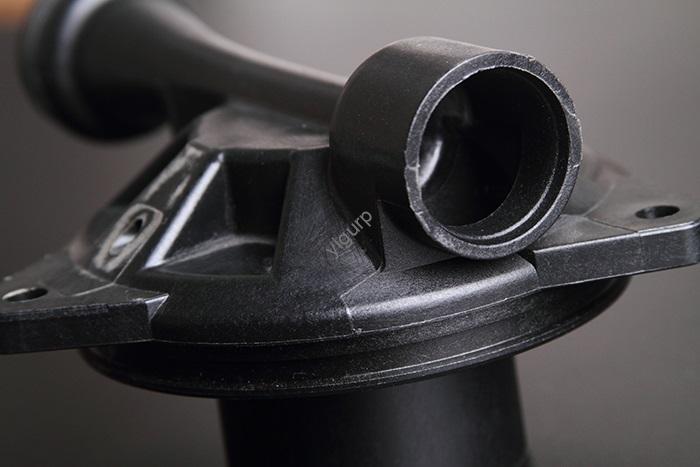
Quando lavori con i polimeri, pensa all'ABS, nylon, o PC: dovrai quasi sempre affrontare una grande domanda: Should I use Lavorazione CNC O 3Stampa D? Entrambi trasformano la plastica in parti funzionali, ma funzionano in modi totalmente diversi, e la scelta sbagliata può far perdere tempo, soldi, o rovinare la performance della tua parte. Questa guida analizza le differenze principali, walks you through how to choose, and uses real-world examples to make the decision easy.
Primo: The Core Difference—Subtractive vs. Produzione additiva
Before diving into choices, you need to understand how each process works. They’re opposites, and that’s why their strengths and weaknesses vary so much.
Lavorazione CNC: Produzione sottrattiva
CNC machining starts with a solid block of polymer (like a plastic cube or rod) and removes excess material using sharp, rotating tools. Imagine carving a statue from a block of stone—you cut away what you don’t need until the part matches your design.
Caratteristica chiave: It’s “subtractive” because you take material away. This means the final part’s strength comes from the original polymer’s solid structure (no layers to weaken it).
3D Stampa: Produzione additiva
3D printing builds parts strato dopo strato. It reads a digital design and deposits thin layers of polymer (either as a filament, come FDM, or powder, like SLS) until the part is complete. Think of stacking sheets of paper to make a 3D shape—each layer sticks to the one below.
Caratteristica chiave: It’s “additive” because you add material. Layers can create complex shapes, but they also mean the part might be weaker between layers (called anisotropy).
6 Critical Questions to Choose Between Polymer CNC and 3D Printing
The best option depends on your project’s needs. Answer these 6 domande, and you’ll have your answer in minutes.
1. How Strong Does Your Part Need to Be?
Strength is make-or-break for functional parts (like machine components or load-bearing brackets).
- CNC Machined Polymers: They’re isotropic—strong in all directions—because they’re cut from a solid block. No weak layers mean they hold up better under stress, Calore, o pressione.
- 3D Printed Polymers: They’re anisotropic—weaker along the layer lines. Per esempio, a 3D printed ABS bracket might break if pulled along the layers, even if it’s strong side-to-side.
Esempio del mondo reale: A factory needed polymer gears for a conveyor belt. They first tried 3D printed ABS gears—they broke after 2 weeks of use. Switching to CNC machined ABS gears made them last 6 mesi (3x più a lungo) because the solid structure handled the constant rotation.
Conclusione: Choose CNC if strength (especially for functional parts) is top priority. Pick 3D printing only if you can sacrifice some strength (per esempio., for decorative prototypes).
2. How Fast Do You Need the Part?
Lead time matters—especially if you’re prototyping or fixing a broken machine.
We tested lead times for a simple ABS part (a 10cm x 5cm bracket) con 3 common processes:
| Processo | Tempi di consegna medi (Working Days) |
| Stampa 3D FDM | 3–5 |
| Stampa 3D SLS | 4–6 |
| Lavorazione CNC (ABS) | 10–12 |
Why the Gap?: 3D printers start building immediately after you upload the design. CNC machining needs time to set up tools, program the machine, and cut the solid block—extra steps that add days.
Conclusione: Need it fast? Go with 3D printing (FDM is the quickest for simple parts). If time isn’t urgent, CNC is better for strength.
3. How Many Parts Do You Need? (Ripartizione dei costi)
Cost changes with volume—what’s cheap for 5 parts might be expensive for 500.
We used real pricing data (from Xometry and Zemi Technology) to compare costs per part for an ABS bracket:
| Number of Parts | Lavorazione CNC (ABS) | Stampa 3D FDM (ABS) | MJF 3D Printing (PA12) |
| 10 | $25 per parte | $18 per parte | $22 per parte |
| 100 | $15 per parte | $18 per parte | $16 per parte |
| 500 | $8 per parte | $18 per parte | $12 per parte |
Cosa significa:
- Piccoli lotti (<10 parti): 3Stampa D (FDM) is cheapest—no CNC setup costs to spread out.
- Lotti medi (100–300 parts): MJF 3D printing is a close second (it prints multiple parts at once), but CNC starts to catch up.
- Grandi lotti (>500 parts): CNC is the cheapest—setup costs are spread over hundreds of parts, and material waste is lower for simple designs.
Esempio del mondo reale: Serve una startup 20 prototype phone cases (ABS). FDM 3D printing cost \(360 totale (\)18 X 20). CNC would have cost \(500 (\)25 X 20)—a 28% savings with 3D printing. But when they scaled to 1,000 casi, CNC dropped to \(8 per parte (\)8,000 totale) contro. \(18,000 for FDM—saving \)10,000.
Conclusione: 3D printing for small batches; CNC for large batches; MJF for medium batches.
4. How Complex Is Your Design?
3D printing shines at shapes CNC can’t touch—CNC wins for simple, precise designs.
- 3D Printing Strengths: It handles organic shapes, strutture reticolari, or parts with hollow interiors (like a lightweight bracket with holes) facilmente. No tool needs to reach inside—layers build up around the shape. Per esempio, SLS 3D printing can make a polymer lattice that’s 50% lighter than a solid CNC part, with no extra work.
- CNC Limitations: CNC tools need to reach every surface of the part. If your design has a hole that’s hidden or a lattice with tiny gaps, the tool can’t get there—you’ll end up with a incomplete part.
Esempio: A medical device company wanted a polymer implant with a porous surface (to help bone grow into it). CNC machining couldn’t create the tiny pores—so they used SLS 3D printing to make the design work.
Conclusione: Complesso, organic, or porous designs? 3Stampa D. Semplice, solid designs? CNC.
5. What Tolerance and Precision Do You Need?
Tolleranza (how close the part is to your design) matters for parts that need to fit together (like gears or connectors).
| Metrico | Lavorazione CNC | Stampa 3D FDM | Stampa 3D SLS | MJF 3D Printing |
| Tolleranza | ±0.025–0.125 mm | ±0.3 mm | ±0.3 mm | ±0.3 mm |
| Minimum Feature Size | 0.01 mm (taglio) | 0.2 mm (strato) | 0.1 mm (strato) | 0.08 mm (strato) |
| Max Build Volume | 2000×800×1000 mm | 914×610×914 mm | 340×340×605 mm | 380×284×380 mm |
Why CNC Is Better: CNC cuts material with sharp tools, so it can hit tiny tolerances. 3D printing’s layers create small “steps” on the part’s surface—you might need sanding to get a smooth fit.
Esempio: An aerospace company needed polymer spacers that fit between metal parts. The spacers needed a tolerance of ±0.05 mm—3D printing (±0.3 mm) was too imprecise, so they used CNC machining to get the perfect fit.
Conclusione: Tolleranze strette (<±0,1 mm) or large parts? CNC. Looser tolerances? 3Stampa D.
6. What Polymer Material Do You Need?
Both work with common polymers (ABS, nylon, computer), but 3D printing has more specialty options.
- CNC-Compatible Polymers: Meglio per plastiche rigide come l'ABS, computer, nylon, or acetal. These are easy to cut and hold their shape well. You can’t use flexible polymers (come il TPU) or resins (like CLIP materials)—they’re too soft to machine without deformation.
- 3D Printing-Compatible Polymers: Works with rigid plastics E specialty options:
- TPU flessibile (for grips or shock absorbers).
- Resine (for clear, detailed parts like prototypes).
- High-temperature PA12 (for parts that need to handle heat).
Esempio: A toy company wanted a flexible polymer handle for a kids’ bike. CNC machining couldn’t cut TPU without it bending—so they used FDM 3D printing to make the flexible handle.
Conclusione: Rigid polymers? Either process. Flexible or resin-based polymers? Only 3D printing.
Quick Comparison Cheat Sheet
Short on time? Use this star rating (⭐=good, ⭐⭐=better, ⭐⭐⭐=best) to compare at a glance:
| Fattore | Lavorazione CNC di polimeri | 3D Stampa (FDM/SLS/MJF) |
| Forza | ⭐⭐⭐ | ⭐ |
| Tempi di consegna | ⭐ | ⭐⭐⭐ |
| Small-Batch Cost | ⭐ | ⭐⭐⭐ |
| Large-Batch Cost | ⭐⭐⭐ | ⭐ |
| Design Complexity | ⭐⭐ | ⭐⭐⭐ |
| Tolerance/Precision | ⭐⭐⭐ | ⭐ |
| Varietà di materiali | ⭐⭐ | ⭐⭐⭐ |
| Large Part Size | ⭐⭐⭐ | ⭐ |
Yigu Technology’s Perspective on Polymer CNC vs. 3D Stampa
Alla tecnologia Yigu, we don’t pick sides—we pick what’s best for your project. For clients needing strong, parti precise (like industrial components), we recommend CNC machining with ABS or PC. For startups prototyping complex designs or needing flexible TPU parts, 3Stampa D (FDM or SLS) is the way to go. We also help with medium batches: MJF 3D printing for multi-part efficiency, or CNC if strength is critical. Our team tests both processes with your polymer to ensure cost, velocità, and performance align—because the right choice isn’t about the technology, it’s about your goals.
FAQ About Polymer CNC vs. 3D Stampa
1. Can I use the same polymer (come l'ABS) for both CNC machining and 3D printing?
Yes—common polymers like ABS, nylon, and PC work with both processes. But the final part will differ: CNC ABS is stronger (solid block), while 3D printed ABS is weaker (stratificato). Always test the part’s performance if you switch processes.
2. Is 3D printing always cheaper for prototypes?
Almost always—for 1–10 parts, 3Stampa D (especially FDM) avoids CNC’s setup costs. But if your prototype needs high strength or tight tolerances (per esempio., a functional machine part), CNC might be worth the extra cost to avoid reworking later.
3. Can CNC machining make parts as light as 3D printed ones?
No—3D printing can create hollow or lattice structures that reduce weight without losing too much strength. CNC machining cuts from a solid block, so even if you drill holes, the part will be heavier than a 3D printed lattice version of the same design.