
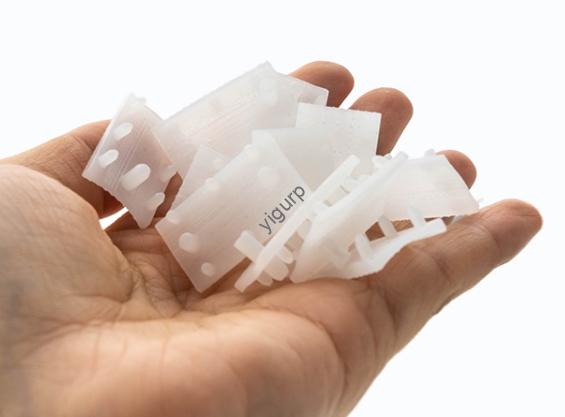
La lavorazione CNC dei polimeri è un processo di produzione ideale per la creazione di parti in plastica di alta qualità, dai prototipi funzionali ai cicli di produzione su larga scala. A differenza della stampa 3D, che costruisce le parti strato dopo strato, Polymer CNC machining uses subtractive technology: scolpisce forme precise da blocchi polimerici solidi, offrendo una resistenza meccanica superiore, tolleranze strette, e finiture superficiali lisce. This guide breaks down everything you need to know about Polymer CNC machining, including how it works, best materials to use, how it compares to 3D printing, post-processing options, and real-world use cases to help you decide if it’s right for your project.
Cos'è la lavorazione CNC dei polimeri? (Come funziona)
Polymer CNC machining is a computer-controlled subtractive process tailored for plastic materials. It follows the same core principles as metal CNC machining but with key adjustments to account for polymers’ unique properties (like lower rigidity and higher heat sensitivity). Here’s a step-by-step breakdown of how it works:
- Preparazione del progetto: Start with a 3D CAD model of your part. The model is converted to G-code—a language that tells the CNC machine how to move its tools.
- Impostazione materiale: A solid polymer block (per esempio., ABS, Acetale) is secured to the CNC machine’s worktable. A differenza del metallo, polymers need gentle clamping to avoid cracking or warping.
- Selezione dello strumento: Specialized cutting tools (often made of carbide or high-speed steel) are chosen for the polymer type. Per esempio, affilato, low-friction tools are used for soft plastics like PTFE to prevent melting.
- Processo di lavorazione: The CNC machine uses the G-code to guide the cutting tools. It removes excess polymer material in precise passes—first roughing cuts to shape the part, then finishing cuts for accuracy and smoothness.
- Raffreddamento & Chip Management: Since polymers melt at lower temperatures than metals, compressed air (non liquido refrigerante) is used to keep the tool and material cool. This also blows away plastic chips to avoid clogging.
- Controllo qualità: The finished part is removed, and critical dimensions are measured (using calipers or a coordinate measuring machine) to ensure it meets tolerances.
Key Advantages of Polymer CNC Machining
Polymer CNC machining stands out from other plastic manufacturing methods (like 3D printing or injection molding) for several reasons. These advantages make it ideal for projects that demand precision, forza, or large part sizes:
1. Superior Mechanical Strength
Since Polymer CNC machining cuts from solid polymer blocks, it doesn’t weaken the material’s molecular structure. Unlike 3D printed parts (which have weak layer lines), CNC-machined polymer parts are isotropic—strong in all directions. This is critical for load-bearing parts like brackets or gears.
Esempio: A robotics company needed durable arm brackets for a industrial robot. 3D printed ABS brackets broke after 100 cycles of use, but CNC-machined ABS brackets lasted 500+ cycles—5x longer—thanks to their solid structure.
2. Tight Dimensional Accuracy
Polymer CNC machining achieves tolerances as tight as ±0.025 mm—far better than most 3D printing technologies. This makes it perfect for parts that need to fit together precisely, like medical device components or electronics housings.
Data Point: A study comparing polymer manufacturing methods found that CNC-machined parts had 90% fewer dimensional errors than FDM 3D printed parts for complex features like holes and cantilevers.
3. Large Build Size Capabilities
3D printing is limited by build chamber size (massimo 600 mmx 900 mmx 900 mm for FDM). Al contrario, Polymer CNC machining can handle much larger parts—our partner network’s machines can process workpieces up to 1625.6 mmx 812 mmx 965.2 mm. This is a game-changer for large plastic parts like machine enclosures or furniture components.
Caso di studio: A furniture designer needed 10 large acrylic table tops (1200 mmx 800 mm). 3D printing would have required splitting the tops into smaller pieces and gluing them (risking weak points). Polymer CNC machining created each top as a single piece—fast, forte, and seamless.
4. Finitura superficiale liscia
Polymer CNC machined parts have a natural surface roughness of 3.2 micron—no layer lines like 3D printed parts. With fine machining, this can be reduced to 0.4 microns—smooth enough for cosmetic parts like consumer electronics casings.
Confronto: FDM 3D printed parts typically have a surface roughness of 12.5–25 microns—8x rougher than standard CNC-machined polymer parts—requiring extra sanding to look presentable.
Best Polymers for CNC Machining (With Use Cases)
Not all polymers are equally suited for CNC machining. The best choice depends on your part’s purpose, ambiente, e le esigenze prestazionali. Below are the most common polymers used in Polymer CNC machining, along with their key traits and applications:
| Polymer Type | Key Traits | Best Use Cases | Costo al kg (Dollaro statunitense) |
| ABS | Elevata resistenza agli urti, facile da lavorare, buona stabilità dimensionale | Prototipi, alloggiamenti per l'elettronica, parti interne automobilistiche | \(2–)4 |
| Acrilico (PMMA) | Trasparente, resistente ai graffi, rigido | Vetrine, lenti, segnaletica | \(3–)5 |
| Acetale (Delrin/POM) | Basso attrito, elevata resistenza all'usura, resistente agli agenti chimici | Ingranaggi, cuscinetti, valvole, strumenti medici | \(5–)8 |
| Nylon (Polycaprolactam) | Forte, flessibile, resistente al calore (fino a 120°C) | Mechanical parts, elementi di fissaggio, beni di consumo | \(4–)7 |
| SBIRCIARE | Resistenza al calore ultraelevata (fino a 250°C), biocompatibile | Componenti aerospaziali, impianti medici, high-temperature parts | \(80–)100 |
| PTFE (Teflon) | Non-stick, resistente agli agenti chimici, basso attrito | Sigilli, guarnizioni, attrezzature da laboratorio | \(20–)30 |
| computer (Policarbonato) | Resistente agli urti, trasparente, forte | Occhiali di sicurezza, bulletproof windows, involucri elettronici | \(4–)6 |
| UHMW PE | High abrasion resistance, basso attrito, durevole | Nastri trasportatori, wear strips, parti marine | \(8–)12 |
Esempio: A medical device manufacturer chose Acetal for surgical forceps because it’s chemical-resistant (stands up to sterilization) and low-friction (easy to use for surgeons). The CNC-machined forceps met strict biocompatibility standards and lasted 500+ cicli di sterilizzazione.
Polymer CNC Machining vs. 3D Stampa: Which to Choose?
Many projects can use either Polymer CNC machining or 3D printing—but the right choice depends on your part’s size, quantità, complessità, e bilancio. The table below compares the two processes across critical factors:
| Fattore | Lavorazione CNC di polimeri | 3D Stampa (FDM/SLS/MJF) |
| Build Size | Fino a 1625.6 mmx 812 mmx 965.2 mm | Max 600 mmx 900 mmx 900 mm (FDM) |
| Resistenza meccanica | Alto (isotropic, solid structure) | Medio (anisotropic, linee di strato) |
| Tolleranza | ±0,025 mm (stretto) | ±0,1 mm (looser; MJF/SLS better than FDM) |
| Finitura superficiale | 3.2–0.4 microns (liscio) | 12.5–25 microns (FDM); 6.3–12.5 microns (MJF/SLS) |
| Quantity Cost-Effectiveness | Meglio per 10+ parti (lower per-part cost) | Best for 1–10 parts (no setup fees) |
| Complessità | Good for simple-to-moderate designs (struggles with lattices) | Best for complex designs (reticoli, interni cavi) |
| Tempi di consegna (10 parti) | 3–5 giorni | 1–3 giorni (FDM); 4–6 giorni (MJF/SLS) |
Real-World Decision Example: Serve una startup 50 prototype drone frames. They considered both options:
- 3D Stampa (FDM): \(18 per frame, totale \)900, tempi di consegna 2 giorni. But frames had weak layer lines and needed sanding.
- Lavorazione CNC di polimeri: \(15 per frame, totale \)750, tempi di consegna 4 giorni. Frames were stronger, smoother, and required no post-processing.
The startup chose CNC machining—saving $150 and getting more durable prototypes that better mimicked production parts.
Post-Processing for Polymer CNC Machined Parts
While Polymer CNC machined parts have a smooth natural finish, post-processing can enhance their appearance, funzionalità, o durabilità. Below are the most common post-processing options:
1. Pearlescent Finishing
What it does: Removes loose plastic threads (called “burrs”) left after machining, creating an ultra-smooth surface.
Meglio per: Parts that need to be handled (per esempio., impugnature per utensili) or have tight fits (per esempio., ingranaggi).
Costo: \(2–)5 per parte.
Esempio: A tool manufacturer uses pearlescent finishing on CNC-machined Acetal tool handles—eliminating sharp burrs that could irritate users.
2. Dyeing
What it does: Changes the part’s color using solvent-based dyes. La maggior parte dei polimeri (come l'ABS, Nylon) take dye well, but options vary by material.
Meglio per: Cosmetic parts (per esempio., involucri di elettronica di consumo) or parts that need color coding (per esempio., strumenti medici).
Costo: \(3–)8 per parte (depends on color complexity).
Nota: Transparent polymers (like Acrylic) can be dyed to create tinted parts—popular for display cases or lenses.
3. Lacquering
What it does: Applies a glossy or matte paint layer that improves aesthetics and adds wear resistance.
Meglio per: Parts exposed to scratches (per esempio., custodie per telefoni) or outdoor elements (per esempio., garden tool parts).
Costo: \(5–)10 per parte.
Esempio: A consumer brand lacquers CNC-machined PC phone cases—adding a scratch-resistant coating that makes the cases last 2x longer.
4. Bonding (for Large Parts)
What it does: Joins multiple CNC-machined polymer parts using adhesives or ultrasonic welding. Used when a part is too large for a single polymer block.
Meglio per: Extra-large parts (per esempio., machine enclosures, mobilia).
Costo: \(10–)20 per bond (depends on part size).
Tip: Use polymer-compatible adhesives (per esempio., cyanoacrylate for ABS) to ensure strong bonds.
Yigu Technology’s Perspective on Polymer CNC Machining
Alla tecnologia Yigu, we specialize in Polymer CNC machining for projects that demand precision and strength. We help clients choose the right polymer—whether it’s ABS for prototypes, Acetal for gears, or PEEK for high-temperature parts—and optimize designs to avoid common issues (like thin walls that warp during machining). Our machines handle large parts up to 1625.6 mmx 812 mmx 965.2 mm, and we offer post-processing like pearlescent finishing and dyeing to meet cosmetic needs. For clients choosing between CNC and 3D printing, we provide side-by-side cost and performance analyses—ensuring they get the best process for their budget and goals. Polymer CNC machining isn’t just about making parts; it’s about delivering reliable, long-lasting solutions.
FAQ About Polymer CNC Machining
1. Can Polymer CNC machining handle flexible plastics like TPU?
Yes—but flexible polymers need special handling. We use slow cutting speeds and sharp, low-pressure tools to avoid stretching or deforming TPU. Tuttavia, for highly flexible parts (per esempio., ammortizzatori), 3D printing may be more cost-effective for small batches.
2. How much does Polymer CNC machining cost compared to 3D printing?
For 1–10 parts, 3D printing is cheaper (per esempio., \(18 per ABS part vs. \)25 for CNC). Per 10+ parti, CNC becomes more cost-effective: \(15 per ABS part for 50 unità (contro. \)18 for 3D printing)—saving $150 totale. Setup costs for CNC are spread over more parts, lowering per-unit prices.
3. What’s the maximum tolerance I can get with Polymer CNC machining?
Most projects use ±0.025 mm tolerance, which is standard for Polymer CNC machining. For ultra-precise parts (per esempio., impianti medici), we can achieve ±0.01 mm with specialized tools and fine machining passes. This is far tighter than 3D printing’s ±0.1 mm tolerance.