
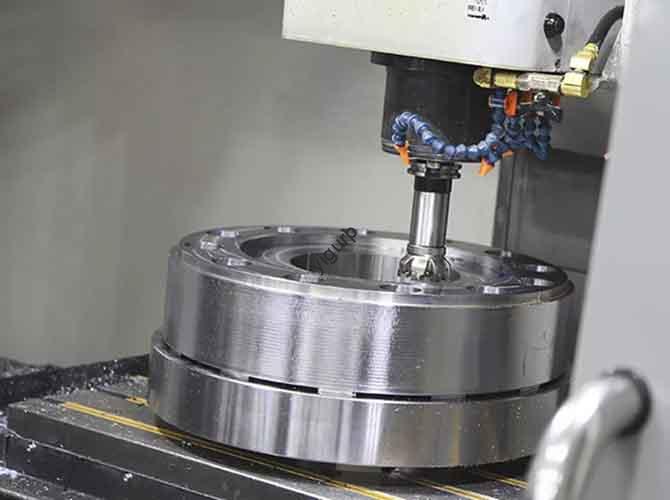
Ever picked up amachining drawing and felt overwhelmed by symbols, linee, e gergo? Non sei solo. Che tu sia un nuovo designer, un tecnico di officina, o un ispettore di qualità, padroneggiare i disegni meccanici è la chiave per trasformare le idee in parti precise. This guide breaks down everything from basic views to advanced tolerancing—with real-world examples to avoid costly mistakes.
1. What Is a Machining Drawing, e perché è importante?
UNmachining drawing (or engineering blueprint) is a visual language that communicates design intent, dimensions, and manufacturing requirements between engineers and production teams. Think of it as a “recipe” for making parts: miss a detail, and the final product might not fit or function.
In my 12 years of working with automotive components, I’ve seen this firsthand. A supplier once misread a thread callout on a brake caliper drawing—resulting in 500 non-functional parts and a $40,000 rework cost. That’s why every line, symbol, and note on a machining drawing carries weight.
2. Mastering Standard Views and Layout
Before diving into details, you need to understand how parts are presented. ILlayout of a machining drawing follows strict rules to ensure clarity.
Key Views Explained
| View Type | Scopo | Example Use Case |
|---|---|---|
| Orthographic Projection | 2D views (front, top, side) showing length, width, height | Simple parts like washers or brackets |
| Isometric View | 3D-like view for visualizing shape without distortion | Assemblies or complex housings |
| Section View | Reveals internal features (per esempio., buchi, cavities) by “taglio” the part | Engine blocks with hidden oil passages |
| Detail View | Magnifies small features (per esempio., discussioni) that are hard to see | Precision gears with fine teeth |
| Auxiliary View | Shows sloped surfaces that don’t align with standard views | Wedge-shaped machine parts |
Must-Have Layout Elements
Every professional drawing includes these sections:
- Title Block: Contains part name, part number, materiale, and designer info.
- Drawing Border: Defines the document’s edges (per standards like ASME Y14.5).
- Revision Block: Tracks changes (per esempio., “Rev A: Increased hole diameter to 10mm”).
- Scale: Indicates if the drawing is full-size (1:1) or scaled (per esempio., 1:2 for large parts).
- Sheet Size: Common sizes include A4 (210×297mm) and ANSI A (8.5×11 inches).
3. Dimensions and Tolerances: The Precision Backbone
Dimensions tell “how big” a part should be—tolerances tell “how much it can vary.” Getting this wrong leads to scrap or assembly failures.
Basic Dimension Types
- Linear Dimension: Measures length, width, or height (per esempio., “50mm”).
- Angular Dimension: Specifies angles (per esempio., “90° ±0.5°”).
- Diameter Symbol (⌀): Marks circular features (per esempio., “⌀15mm”).
- Radius Symbol (R): Labels curved edges (per esempio., “R5mm”).
Tolerancing Methods: Plus/Minus vs. GD&T
Most beginners start withPlus/Minus Tolerancing (per esempio., “25mm±0,1 mm”), which is simple but limited. Per parti complesse, Geometric Dimensioning and Tolerancing (GD&T) is essential—it controls shape, location, and orientation more precisely.
Here’s a real example from an aerospace project I worked on: We needed a shaft to fit into a bearing housing. Using plus/minus tolerancing led to 15% of parts jamming because it didn’t account for straightness. Switching to GD&T with aFeature Control Frame (controlling position and straightness relative to aDatum) reduced defects to 0.5%.
Critical GD&T Concepts
- Datum: A reference point/axis (per esempio., Datum A = part’s bottom surface).
- Basic Dimension: Theoretical exact size (boxed, per esempio., “50”)—tolerances come from GD&T symbols.
- Tolerance Stack-up: Calculating how individual tolerances add up (critical for assemblies). Tools like 3D CSWA can automate this, but manual checks catch errors early.
4. Geometric Characteristics and Symbols
GD&T uses 14 symbols to control geometric features. Below are the most common ones you’ll see:
| Characteristic | Symbol | What It Controls | Industry Example |
|---|---|---|---|
| Flatness | ⊥ | How flat a surface is | Engine cylinder heads (seal against gaskets) |
| Straightness | / | How straight a line/axis is | Drill bits (prevents wobbling) |
| Position | ⌖ | Location of features (per esempio., buchi) | Circuit board mounting holes |
| Runout | ⊕ | Vibration when rotating (per esempio., alberi) | Car wheel hubs (smooth driving) |
| Surface Finish Symbol | ▭ | Roughness of a surface (per esempio., “Ra 1.6μm”) | Pistons (reduces friction) |
Pro tip: Always pairSurface Finish Symbols with functional requirements. A gear tooth might need Ra 0.8μm for quiet operation, while a non-contact surface could use Ra 6.3μm to cut costs.
5. Annotations and Callouts: Avoid Misinterpretation
Annotations add critical manufacturing details that dimensions alone can’t convey. Here are the ones you’ll use daily:
- Leader Line: Connects notes to features (per esempio., “Trattamento termico: HRC 30-35”).
- Hole Callout: Combines size, depth, and type (per esempio., “⌀8mm THRU, Counterbore ⌀12mm × 3mm”).
- Thread Callout: Specifies thread type (per esempio., “M10 × 1.5 ISO Metric Coarse”).
- Common Features:
- Chamfer: Beveled edge (per esempio., “2×45°”)—prevents sharp edges.
- Fillet: Rounded edge (per esempio., “R3”)—reduces stress concentrations.
- Undercut: Groove for assembly (per esempio., “0.5mm × 1mm”)—common in bolts.
I once had a supplier misread aCounterbore callout as aCountersink on a flange—they used the wrong tool, E 200 parts had to be re-machined. Adding a simple note (“Use 12mm counterbore tool”) fixed the issue.
6. Drawing Standards and File Types
Machining drawings follow global standards to ensure consistency across borders. The two main systems are:
ASME vs. ISO: Differenze chiave
| Aspect | ASME Y14.5 (North America) | ISO GPS (Europe/Global) |
|---|---|---|
| Default Rule | Principle of Inclusiveness (MMC applies by default) | independent principle (Tolerances apply independently) |
| Contour Tolerance | Allows composite profile tolerances | No composite profile tolerances |
| Projection | Third-Angle Projection (views: front→top→right) | First-Angle Projection (views: front→bottom→left) |
Source: ASME Y14.5-2009 and ISO 1101:2012 standard .
Common File Types
| File Type | Use Case |
|---|---|
| DWG | Editable CAD files (AutoCAD, SolidWorks) |
| DXF | Interchangeable format (works across different CAD software) |
| Non-editable for sharing with suppliers/inspectors | |
| MBD | 3D model with embedded dimensions (replacing 2D blueprints—see below) |
7. The Future: Model-Based Definition (MBD)
For decades, 2D Blueprints were the norm—butModel-Based Definition (MBD) is changing the game. MBD embeds all dimensions, tolerances, and notes directly into a 3D CAD model, eliminating the need for separate drawings.
In a recent electric vehicle project, we switched from 2D to MBD for battery housing parts. Here’s what happened:
- Inspection time dropped by 40% (we used CT scans for Digital FAI instead of calipers) .
- Supplier errors fell by 25% (3D models are harder to misinterpret than 2D views).
- Design iterations speeded up—changes to the 3D model updated automatically, no more re-drawing blueprints.
The catch? MBD requires cross-team training (progettisti, macchinisti, inspectors) and compatible CAD tools. But for high-volume or complex parts, the ROI is undeniable.
La prospettiva della tecnologia Yigu
Machining drawings are the bridge between design and manufacturing, but their form is evolving. Alla tecnologia Yigu, we’ve observed that 60% of manufacturing errors stem from ambiguous 2D drawings—hence our focus on MBD integration. MBD isn’t just a “trend”; it’s a necessity for precision-critical industries like aerospace and EVs. We advise clients to start small: pilot MBD for one part family, train teams on GD&T fundamentals, and use digital inspection tools to validate results. The goal isn’t to abandon tradition, but to merge it with technology for faster, more accurate production.
Domande frequenti
Q1: What’s the difference between a detail view and an auxiliary view?
UNdetail view magnifies a small part of the drawing (per esempio., a thread). Anauxiliary view shows a sloped surface that can’t be fully seen in standard views (per esempio., a ramp on a bracket).
Q2: When should I use GD&T instead of plus/minus tolerancing?
Use GD&T for:
- Complex parts with multiple features (per esempio., engine blocks).
- Assemblies where position/orientation matter (per esempio., gearboxes).
- Reducing manufacturing costs (GD&T allows looser tolerances where they don’t affect function).
Q3: Is MBD replacing 2D blueprints entirely?
Not yet. Small shops or simple parts (per esempio., washers) still use 2D drawings because they’re cheaper and simpler. But MBD is becoming standard for automotive, aerospaziale, e dispositivi medici.
Q4: How do I avoid tolerance stack-up issues?
- Use GD&T with datums to control critical features.
- Calculate stack-up early (use tools like VisVSA or Excel spreadsheets).
- Test with prototypes—measure actual part variation before mass production.