
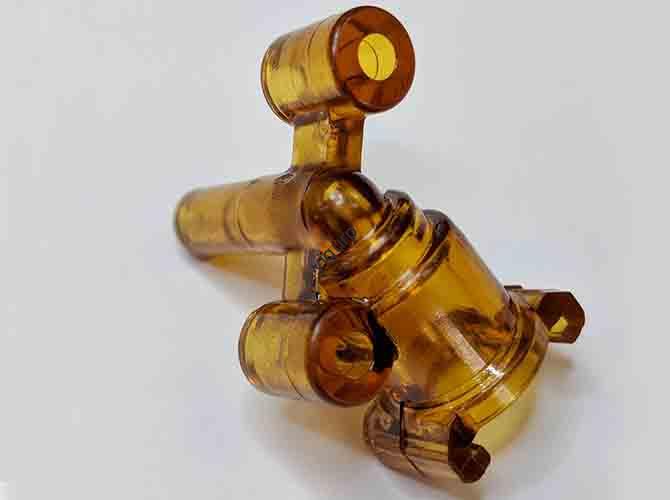
CNC (Controllo numerico computerizzato) E 3Stampa D are two foundational manufacturing technologies, ma differiscono drasticamente nel modo in cui creano le parti, una rimuovendo il materiale, l'altro aggiungendolo. Comprendere queste differenze è fondamentale per scegliere il metodo giusto per il tuo progetto, sia che tu stia realizzando prototipi, componenti prodotti in serie, o articoli personalizzati. Questo articolo analizza il core differences between CNC and 3D printing across 7 key areas, plus guidance on when to use each.
1. Core Difference 1: Forming Principle (Subtractive vs. Additive)
The biggest divide between CNC and 3D printing lies in their fundamental approach to making parts—a contrast that shapes every other aspect of their performance.
| Tecnologia | Forming Principle | Come funziona | Simple Analogy |
| CNC | Produzione sottrattiva | Starts with a solid block of raw material (per esempio., a metal billet, plastic sheet). High-speed tools (trapani, mulini, lathes) taglio, scolpire, or grind away excess material according to a digital program, leaving the desired part. | Carving a statue from a block of stone—you remove material to reveal the shape inside. |
| 3D Stampa | Produzione additiva | Builds parts layer by layer. A printer deposits material (per esempio., plastic filament, metal powder, resina) onto a platform, following a 3D model. Each thin layer bonds to the one below until the full part is complete. | Stacking LEGO bricks to build a house—you add material one layer at a time to create the shape. |
2. Side-by-Side Comparison: CNC vs. 3D Printing Across 6 Key Areas
To quickly assess which technology fits your needs, use this comprehensive table comparing their performance in materials, costo, velocità, e altro ancora.
| Comparison Category | CNC | 3D Stampa | Chiave da asporto |
| Materials Used | – Primarily rigid materials: metal alloys (alluminio, acciaio), legna, plastica (ABS, acrilico), stone.- Limited flexibility for soft/elastic materials. | – Wide range: plastica (PLA, PETG, TPU), metalli (titanium, stainless steel powder), ceramica, wax, resina, even food/biological materials.- Excels at flexible (TPU) and specialized (photosensitive resin) materiali. | 3D printing offers more material versatility; CNC is better for traditional rigid materials like metal. |
| Operating Software | – Complex programming software (per esempio., UG, MASTERCAM, CIMATRON).- Requires skilled operators to set tool paths, adjust cutting speeds, and optimize for material. | – Simple slicing software (per esempio., Cura, PrusaSlicer).- Automatically converts 3D models to layer-by-layer instructions; supports generate automatically; minimal training needed for basic use. | 3D printing is more accessible for beginners; CNC needs professional expertise. |
| Post-elaborazione | – Extensive options: grinding (for smooth surfaces), oil spraying (for protection), deburring (removing sharp edges), dyeing (per colore).- May require multiple steps to refine the part. | – Simple and limited: sanding (to smooth layer lines), polishing (for resin parts), basic coloring.- Many resin or high-quality filament parts need little to no post-processing. | CNC parts need more post-processing but offer more finish customization; 3D printing saves time on finishing. |
| Application Fields | – Industrial manufacturing: jewelry (precision metal casting molds), hardware tools, componenti automobilistici (engine parts), aerospaziale (large metal structures).- Best for high-strength, mass-produced parts. | – Prototyping (veloce, low-cost models), medico (custom implants, modelli dentali), aerospaziale (lightweight complex parts), arte (custom sculptures), food/bioprinting.- Excels at personalized or complex designs. | CNC dominates mass industrial production; 3D printing leads in customization and niche fields like bioprinting. |
| Production Cost | – High upfront costs: CNC machines range from \(10,000–)1,000,000+.- Requires skilled labor (higher labor costs).- Cost-effective for large-batch production (cost per part drops with volume). | – Low entry costs: Consumer 3D printers start at \(200–)2,000; industrial models go up to $500,000.- Minimal labor (automated process).- Cost-effective for small batches (1–100 parts) o articoli personalizzati (no mold fees). | 3D printing wins for low-volume/custom projects; CNC is cheaper for mass production. |
| Production Speed | – Fast for large-batch or simple parts: A CNC machine can mill 100 identical metal brackets in hours.- Speed depends on part complexity (simple shapes = faster; complex shapes = slower). | – Slow for most parts: A small plastic prototype (per esempio., a phone case) takes 2–8 hours; large/complex parts (per esempio., a 30cm resin statue) can take 24+ hours.- High-speed 3D printers (per esempio., FDM with accelerated extrusion) reduce time but are still slower than CNC for simple parts. | CNC is faster for mass production; 3D printing is slower but avoids setup delays for small batches. |
3. When to Choose CNC vs. 3D Stampa? (Step-by-Step Decision Guide)
Use this linear, question-driven process to match the technology to your project’s goals:
Fare un passo 1: Ask About Batch Size
- Large batches (100+ parts): Choose CNC—its high upfront costs are offset by low per-part costs. Per esempio, a CNC machine can produce 500 aluminum hinges faster and cheaper than a 3D printer.
- Small batches (1–50 parts) or custom one-offs: Choose 3Stampa D—no mold or tooling setup means you save time and money. Per esempio, a custom medical brace for a single patient is faster to 3D print than to CNC.
Fare un passo 2: Ask About Part Complexity & Materiale
- Complex, intricate designs (per esempio., lattice structures, hollow parts): Choose 3Stampa D—it can create shapes that are impossible to CNC (per esempio., a resin dental model with tiny internal channels).
- Rigid, high-strength materials (per esempio., acciaio, alluminio): Choose CNC—it handles dense metals better than most 3D printers (industrial metal 3D printers exist but are far more expensive).
Fare un passo 3: Ask About Speed Needs
- Need parts fast (per esempio., emergency production of a machine component): Choose CNC for simple parts (per esempio., a metal bracket in 1–2 hours). For complex small parts (per esempio., a resin prototype), 3D printing may be faster (no tool setup).
4. Yigu Technology’s Perspective on CNC vs. 3D Stampa
Alla tecnologia Yigu, we see CNC and 3D printing as complementary—not competing—tools. Many clients mistakenly think they have to choose one, but the best results often come from combining them: Use 3D printing to quickly prototype a complex part (per esempio., a custom gear), then use CNC to mass-produce the final metal version for durability. We also advise clients to avoid overcomplicating choices: For low-volume functional parts (per esempio., 10 plastic housings), 3D printing cuts costs by 40–60% vs. CNC. For high-volume industrial parts (per esempio., 1,000 aluminum brackets), CNC is 2–3x faster and cheaper per unit. The key is to align the technology with your batch size, materiale, and complexity needs—not to pick a “winner.”
Domande frequenti: Common Questions About CNC and 3D Printing
- Q: Can 3D printing replace CNC for metal parts?
UN: Not yet. Industrial metal 3D printers (per esempio., SLM) can make metal parts, but they’re far more expensive than CNC machines and slower for large batches. CNC is still the go-to for mass-produced metal parts (per esempio., automotive engine components) due to its speed and cost-effectiveness.
- Q: Which technology is better for prototyping?
UN: It depends on the prototype’s goal. For fast, low-cost plastic prototypes (per esempio., testing a new phone case design), 3Stampa D is better (2–8 hours, \(5–)50 per parte). For prototypes that need to mimic final metal parts (per esempio., testing a gear’s strength), CNC is better (it uses the same material as the final product).
- Q: Is CNC more accurate than 3D printing?
UN: Generally, SÌ. High-end CNC machines have an accuracy of ±0.001mm (1 micrometer), while most consumer 3D printers have an accuracy of ±0.1mm. Tuttavia, industrial 3D printers (per esempio., resin SLA printers) can match CNC accuracy for small, parti dettagliate (per esempio., jewelry molds)—but at a higher cost.