
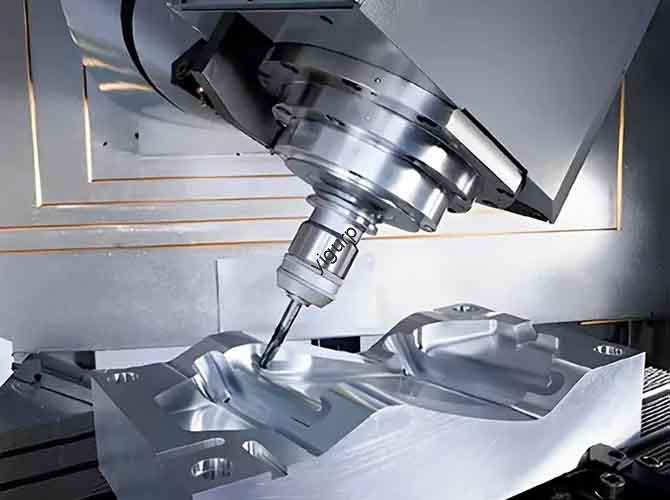
When developing prototypes—whether for product testing, validazione del progetto, or small-batch trials—choosing between 3Stampa D E Lavorazione CNC directly impacts prototype quality, costo, e tempi di consegna. Questo articolo analizza le differenze fondamentali nei principi di produzione, materiali, precisione, e applicazioni, aiutandoti a selezionare il metodo giusto per le tue esigenze di prototipo.
1. Confronto a colpo d'occhio: 3D Stampa vs. CNC Prototypes
To quickly grasp the biggest contrasts, start with this comprehensive table. It highlights 8 key dimensions that define how each method performs in prototype production.
| Comparison Dimension | 3D Printing Prototypes | CNC Prototypes |
| Manufacturing Principle | Produzione additiva: Builds parts by stacking materials layer by layer (per esempio., FDM, SLA) | Subtractive manufacturing: Shapes parts by cutting excess material from a solid blank (per esempio., fresatura, girando) |
| Material Types | Plastica (ABS, PLA, nylon), metalli (acciaio inossidabile, titanium alloy), resina, gesso, ceramica | Solid blocks/plates: Plastica (ABS, computer, PMMA), metalli (alluminio, rame, acciaio) |
| Structural Complexity | Excellent for complex designs (internal cavities, hollow structures, irregular shapes) | Challenged by complex internal features (tool access limitations) |
| Surface Quality | Layered texture (default); improved via post-processing (sanding, polishing); SLA offers smooth surfaces | High finish (default); fine machining achieves low roughness; may have tool marks (fixed via post-processing) |
| Processing Precision | Di livello industriale: ±0.1mm; consumer-grade: inferiore; affected by temperature/materials | High to ultra-high: ±0.01mm (high-precision machines); coerente (depends on machine/tool/program) |
| Production Speed | Slow (layer-by-layer stacking); slower for large/high-precision parts; high-speed models improve efficiency | Fast for simple parts/large batches; slower for complex parts (tool changes/parameter adjustments) |
| Cost Investment | Low entry cost (desktop printers); high cost for professional-grade machines; material cost varies by type | High upfront cost (machines, software, utensili); lower per-part cost for large-scale production |
| Typical Applications | Low-volume, personalized prototypes (medical prosthetics, aerospace complex parts, conceptual models) | High-precision, mass-produced prototypes (ricambi auto, dispositivi medici, mold components) |
2. Deep Dive Into Core Differences
Below is an in-depth analysis of the most critical differences, using a “principle + example” structure to connect technical traits to real-world prototype use cases.
2.1 Manufacturing Principle: Adding Layers vs. Cutting Away Material
The fundamental divide lies in how each method creates prototypes:
- 3D Stampa: It’s like building a house with bricks—layer-by-layer accumulation. Per esempio, using FDM (Modellazione della deposizione fusa) to make a plastic prototype: the printer heats PLA filament, extrudes it through a nozzle, and deposits it on the platform one layer at a time (each layer ~0.1mm thick) until the part is complete. With SLA (Stereolitografia), an ultraviolet laser scans liquid photosensitive resin, curing it layer by layer into a solid prototype (ideal for detailed figurines or dental models).
- Lavorazione CNC: It’s like carving a statue from a block of stone—removing excess material. For a metal prototype (per esempio., an aluminum bracket), the CNC machine uses a rotating milling tool to cut away unwanted metal from a solid aluminum block. The tool follows a pre-programmed path (G-code) to shape the bracket’s holes, edges, and surfaces—no layers, just precise removal.
Why It Matters: 3D printing’s additive approach avoids tool access issues, making it perfect for prototypes with hidden features (per esempio., a hollow drone frame with internal wiring channels). CNC’s subtractive method excels at solid, high-strength prototypes (per esempio., a metal engine component).
2.2 Structural Complexity: Freedom to Design vs. Tool Limitations
Can the method handle your prototype’s most complex features?
- 3D Stampa: It thrives on complexity. You can print prototypes with internal cavities, lattice structures, O irregular shapes without extra effort. Per esempio, a medical device prototype with a curved, hollow interior (to fit human anatomy) can be printed in one piece—no assembly needed. Traditional machining would struggle here, as tools can’t reach internal spaces.
- Lavorazione CNC: It’s limited by tool access. For a prototype with a deep internal hole or a curved undercut, the CNC tool may not fit into tight spaces, requiring multiple setups or even making the design unmachinable. Per esempio, a prototype with a 50mm-deep cavity and a narrow opening would need a long, thin tool (prone to vibration) or split molds—adding time and cost.
Why It Matters: If your prototype has unique, complex geometry (per esempio., aerospace engine parts with intricate cooling channels), 3D printing is the only feasible choice.
2.3 Precisione & Surface Quality: Consistency vs. Finish
How accurate and smooth does your prototype need to be?
- 3D Stampa: Precision varies by equipment. Industrial-grade 3D printers (per esempio., SLA) achieve ±0.1mm accuracy—good for conceptual models or non-critical parts. Tuttavia, the layered process leaves a visible texture (like a stack of paper). You can fix this with post-processing: sanding the surface with fine-grit paper or applying a coating to achieve a smooth finish (per esempio., a 3D-printed phone case prototype).
- Lavorazione CNC: It delivers unmatched precision. High-end CNC machines hit ±0.01mm accuracy—critical for prototypes that need to fit with other parts (per esempio., a plastic gear prototype that must mesh with a metal shaft). The surface finish is also superior: fine machining leaves a smooth, shiny surface (Ra 0.8μm or lower) with minimal tool marks. Per esempio, a CNC-machined PMMA (acrilico) prototipo (per esempio., a display case) can be used directly without post-processing.
Why It Matters: For prototypes that require functional testing (per esempio., a medical device that must fit a patient’s body exactly), CNC’s precision is non-negotiable.
2.4 Costo & Velocità: Entry Cost vs. Scale Efficiency
How do cost and speed change with your prototype volume?
- 3D Stampa: It’s cost-effective for small batches. A desktop 3D printer (\(200–)2,000) can make 1–10 prototypes cheaply—great for startups testing a single design. But speed is a downside: a 10cm-tall prototype may take 4–8 hours to print. Professional-grade 3D printers ($10,000+) are faster but raise upfront costs.
- Lavorazione CNC: It’s efficient for large batches. While a CNC machine costs \(50,000–)500,000 (plus software/tools), it can make 100+ prototypes quickly. Per esempio, 50 aluminum bracket prototypes take 4 hours with CNC—vs. 2 days with 3D printing. The per-part cost drops as volume increases, making it ideal for pre-production runs.
Why It Matters: If you need 1–5 prototypes fast and on a budget, 3D printing wins. Per 50+ prototipi di alta precisione, CNC is more cost-efficient.
3. Yigu Technology’s View on 3D Printing vs. CNC Prototypes
Alla tecnologia Yigu, we see 3D printing and CNC as complementary, not competitive. For complex, low-volume prototypes (per esempio., custom medical implants), 3D printing saves time and enables innovative designs. For high-precision, mass-produced prototypes (per esempio., auto parts for pre-production testing), CNC ensures consistency and strength. We often recommend combining both: use 3D printing for rapid design iterations and CNC for final functional prototypes. As technology advances, we’re integrating AI into both methods—optimizing 3D print layer patterns and CNC tool paths—to cut costs and boost efficiency for our clients.
4. Domande frequenti: Common Questions About 3D Printing vs. CNC Prototypes
Q1: Can 3D printing make metal prototypes as strong as CNC-machined ones?
It depends on the material. 3D-printed metal prototypes (per esempio., titanium alloy via SLM) have good strength but may have tiny pores (from layer bonding) that reduce durability. CNC-machined metal prototypes (cut from solid blocks) have uniform density and higher strength—better for load-bearing parts (per esempio., engine components).
Q2: Is CNC machining always more expensive than 3D printing for prototypes?
NO. For 1–10 prototypes, 3D printing is cheaper (no CNC setup/programming costs). Per 50+ prototipi, CNC’s faster speed and lower per-part cost make it cheaper. Per esempio, 100 plastic prototypes cost \(500 with CNC—vs. \)1,000 with 3D printing.
Q3: Can 3D printing prototypes be used for functional testing (per esempio., stress tests)?
SÌ, but choose the right material. Industrial-grade 3D-printed parts (per esempio., nylon via SLS or metal via SLM) can withstand stress, impatto, and temperature changes—suitable for testing. Consumer-grade PLA prototypes are brittle, so they’re only good for visual/conceptual tests. CNC prototypes (solid plastic/metal) are more reliable for rigorous functional testing.