
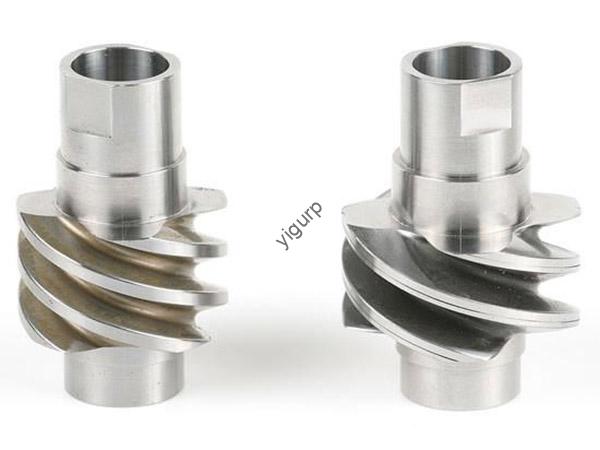
If you’re working on high-stress projects—like heavy machinery or automotive transmissions—EN24 structural steel is a name you need to know. Questo acciaio legato si distingue per la sua eccezionale resistenza e tenacità, ma come si comporta negli scenari del mondo reale? Questa guida analizza tutto, dalla sua composizione chimica al suo costo, so you can decide if it’s right for your next project.
1. Material Properties of EN24 Structural Steel
EN24’s performance starts with its carefully balanced properties. Let’s dive into the details that make it a top choice for high-demand applications.
1.1 Composizione chimica
IL chemical composition of EN24 is what gives it its strength. Below is a standard range (per EN 10083-3):
| Elemento | Gamma di contenuti (%) | Key Function |
| Carbonio (C) | 0.36 – 0.44 | Boosts hardness and tensile strength |
| Manganese (Mn) | 0.60 – 0.90 | Improves ductility and weldability |
| Silicio (E) | 0.10 – 0.40 | Enhances heat resistance during fabrication |
| Zolfo (S) | ≤ 0.050 | Ridotto al minimo per evitare fragilità |
| Fosforo (P) | ≤ 0.050 | Controllato per evitare fessurazioni |
| Cromo (Cr) | 0.90 – 1.20 | Increases wear resistance and toughness |
| Nichel (In) | 1.30 – 1.70 | Boosts impact resistance, especially at low temperatures |
| Molibdeno (Mo) | 0.15 – 0.25 | Improves hardenability and fatigue resistance |
| Other alloying elements | Trace amounts (per esempio., rame) | No major impact on core properties |
1.2 Proprietà fisiche
EN24’s physical properties make it suitable for extreme conditions:
- Densità: 7.85 g/cm³ (same as most structural steels)
- Punto di fusione: 1420 – 1460°C
- Conduttività termica: 44 Con/(m·K) at 20°C (lower than carbon steel, so it heats slowly)
- Specific heat capacity: 465 J/(kg·K)
- Coefficient of thermal expansion: 13.0 × 10⁻⁶/°C (20 – 100°C, stable for precision parts)
1.3 Proprietà meccaniche
These are the traits that matter most for high-stress applications:
- Resistenza alla trazione: 800 – 1000 MPa (after quenching and tempering)
- Yield strength: ≥ 600 MPa
- Allungamento: ≥ 12% (enough flexibility for forming without breaking)
- Durezza: 240 – 300 HB (Brinell scale, can be increased with heat treatment)
- Resistenza agli urti: ≥ 50 J at -40°C (excellent for cold environments)
- Fatigue resistance: ~400 MPa (handles repeated loads, like engine shafts)
- Hardening and tempering effects: Tempra (raffreddamento rapido) seguito dal rinvenimento (heating to 500 – 600°C) increases strength while keeping toughness—critical for gears and axles.
1.4 Altre proprietà
- Resistenza alla corrosione: Moderare (needs coatings like chrome plating or oiling for outdoor use)
- Weldability: Giusto (requires preheating to 200 – 300°C to prevent cracks; post-weld heat treatment is recommended)
- Lavorabilità: Bene (best when annealed to reduce hardness)
- Magnetic properties: Ferromagnetico (works with magnetic inspection tools)
- Duttilità: Moderare (can be bent but not as easily as low-carbon steel)
- Toughness: Alto (resists breaking under sudden impacts, like a car hitting a pothole)
2. Applications of EN24 Structural Steel
EN24’s strength and toughness make it ideal for parts that face heavy loads or shocks. Ecco i suoi usi più comuni:
- Mechanical engineering:
- Ingranaggi: Used in industrial gearboxes (per esempio., for conveyor systems) because of its wear resistance. A German manufacturer uses EN24 for its 10-ton gearboxes, which last 50% longer than those made with carbon steel.
- Alberi: Powers pumps and turbines—EN24’s fatigue resistance prevents cracking from constant rotation.
- Axles: Supports heavy machinery (per esempio., forklifts) thanks to its high yield strength.
- Industria automobilistica:
- Transmission components: Gear sets and drive shafts in trucks and SUVs. Un americano. truck brand uses EN24 for its transmission shafts, which handle 300+ horsepower without failing.
- Suspension parts: Shock absorber mounts—EN24’s impact resistance stands up to rough roads.
- Macchinari industriali:
- Cuscinetti: Used in large electric motors (per esempio., for factories) because of its hardness.
- Rollers: For steel mills—EN24 resists wear from hot metal sheets.
- Costruzione:
- Componenti strutturali: Heavy-duty beams in industrial buildings (per esempio., warehouses with overhead cranes).
- Beams and columns: In bridges that carry heavy trucks—EN24’s tensile strength supports 10+ ton loads.
- Costruzione navale:
- Componenti dello scafo: For small cargo ships—EN24’s toughness resists waves and collisions.
- Railway industry:
- Ruote: For freight trains—EN24’s wear resistance reduces maintenance costs.
- Axles: Supports train cars (per esempio., coal carriers) thanks to its high strength.
3. Manufacturing Techniques for EN24 Structural Steel
Turning EN24 into usable parts requires precise processes. Here’s how it’s made:
3.1 Rolling Processes
- Hot rolling: The main method. Steel is heated to 1150 – 1250°C and pressed into shapes (bar, piatti, forgings). Hot-rolled EN24 has a rough surface but high strength.
- Cold rolling: Rarely used for EN24 (since it’s often heat-treated later), but done for thin sheets that need a smooth finish.
3.2 Trattamento termico
Heat treatment is critical for EN24’s performance:
- Ricottura: Heated to 820 – 850°C, held, poi raffreddato lentamente. Reduces hardness for easier machining.
- Normalizing: Heated to 850 – 900°C, cooled in air. Improves uniformity in large parts.
- Quenching and tempering: The most important step. Steel is heated to 830 – 860°C (quenched in oil), then tempered at 500 – 600°C. This creates a balance of strength and toughness.
3.3 Fabrication Methods
- Taglio: Usi taglio al plasma (for thick plates) O oxy-fuel cutting (for bars). EN24’s high carbon content means slower cutting than low-carbon steel.
- Welding techniques: Arc welding (most common) E saldatura laser (for precision parts). Preheating is a must—skip it, and you’ll get cracks.
- Bending and forming: Done when the steel is annealed (softened). EN24 can be bent into simple shapes (per esempio., parentesi) but not complex curves.
3.4 Controllo qualità
- Metodi di ispezione:
- Ultrasonic testing: Checks for internal defects (per esempio., buchi) in forgings.
- Magnetic particle inspection: Finds surface cracks (per esempio., in gears).
- Certification standards: Must meet ISO 683-3 (alloy steels for quenching and tempering) e EN 10204 (material certification) to ensure quality.
4. Casi di studio: EN24 in Action
4.1 Industria meccanica: A Wind Turbine Shaft
A Danish wind energy company used EN24 for its 2.5 MW turbine shafts. The shafts face constant rotation (1500 giri al minuto) and wind loads. Dopo 5 anni, tests showed no signs of fatigue—EN24’s fatigue resistance kept the shafts running. Without EN24, the company would have had to replace shafts every 2 anni.
4.2 Automobilistico: A Truck Transmission
A Japanese truck manufacturer switched to EN24 for its transmission gear sets. Previously, they used carbon steel, which failed after 100,000 miglia. EN24 gears now last 200,000+ miglia, riducendo i costi di manutenzione 40%. La chiave? EN24’s wear resistance and toughness.
5. Comparative Analysis: EN24 vs. Other Materials
How does EN24 stack up to other options? Let’s compare:
5.1 contro. Other Types of Steel
| Feature | EN24 Acciaio strutturale | Acciaio al carbonio (A36) | Acciaio legato (EN19) |
| Resistenza alla trazione | 800 – 1000 MPa | 400 – 550 MPa | 620 – 780 MPa |
| Resistenza agli urti (at -40°C) | ≥ 50 J | ≤ 20 J | ≥ 40 J |
| Costo (per ton) | \(1,200 – \)1,500 | \(600 – \)800 | \(800 – \)1,000 |
5.2 contro. Non-Metallic Materials
- Calcestruzzo: EN24 is 10x stronger in tension and 3x lighter. But concrete is cheaper for foundations. Per esempio, a bridge uses concrete for its base and EN24 for its load-bearing beams.
- Materiali compositi (per esempio., fibra di carbonio): Composites are lighter but 2x more expensive. EN24 is better for parts that need high strength at a lower cost (per esempio., riduttori).
5.3 contro. Other Metallic Materials
- Leghe di alluminio: Aluminum is lighter but has lower tensile strength (200 – 300 MPa). EN24 is better for heavy loads (per esempio., truck axles).
- Acciaio inossidabile: Stainless steel resists corrosion but costs 3x more. EN24 is a better choice for indoor parts (per esempio., riduttori) or parts that can be coated.
5.4 Costo & Environmental Impact
- Cost analysis: EN24’s material cost is higher than carbon steel, but its longer lifespan (50%+ in molti casi) makes it cheaper over time. Fabrication cost is also higher (due to preheating for welding), but this is offset by fewer replacements.
- Environmental impact: EN24 is 100% riciclabile (salva 75% energy vs. making new steel). Its production uses more energy than carbon steel but less than stainless steel.
6. Yigu Technology’s View on EN24 Structural Steel
Alla tecnologia Yigu, we recommend EN24 for high-stress applications where durability is key. Suo excellent tensile strength E resistenza alla fatica make it perfect for mechanical parts like gears and shafts. We often pair EN24 with our anti-wear coatings to extend its lifespan by 30%+. While EN24’s fabrication cost is higher, its long-term reliability saves clients money. For projects that can’t afford failure—like industrial gearboxes or truck transmissions—EN24 is the smart choice.
FAQ About EN24 Structural Steel
- Can EN24 be welded without preheating?
No—preheating to 200 – 300°C is required. EN24’s high carbon and alloy content makes it prone to cracking if welded cold. Post-weld heat treatment (per esempio., ricottura) is also recommended to reduce stress.
- Is EN24 suitable for outdoor use?
It depends. EN24’s resistenza alla corrosione is moderate—uncoated, it will rust in wet or salty environments. Per uso esterno, add a coating (per esempio., chrome plating or epoxy paint) to protect it.
- How does EN24 compare to EN19?
EN24 is stronger (resistenza alla trazione: 800 – 1000 MPa vs. EN19’s 620 – 780 MPa) and has better impact resistance. But EN19 is cheaper and easier to weld. Choose EN24 for high-stress parts (per esempio., alberi delle turbine) and EN19 for lighter loads (per esempio., small beams).