
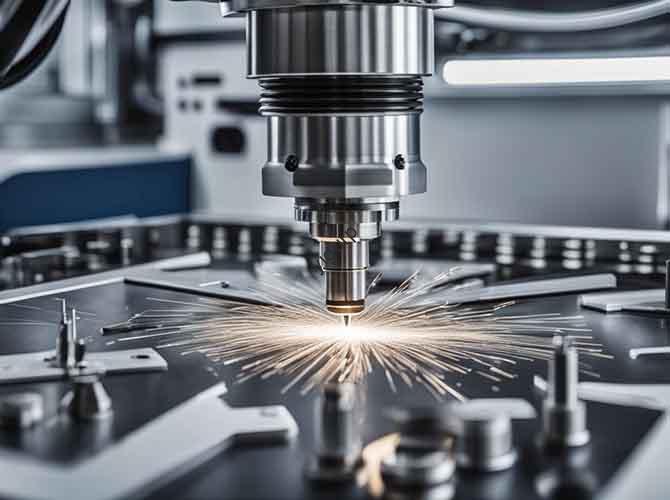
Se ti sei mai chiesto come i produttori creano soluzioni complesse, precise parts from super-hard materials like tungsten carbide or hardened steel—materials that resist traditional cutting tools—you’re likely thinking ofLavorazione ad elettroerosione (Elettroerosione). Che tu sia uno studente che apprende le basi della produzione, un macchinista che cerca di espandere le tue capacità, o un ingegnere che progetta componenti personalizzati, this guide breaks down EDM into simple, actionable insights. We’ll cover everything from how it works to real-world applications, plus pro tips to avoid common mistakes.
1. What Is EDM? The Basics of Non-Contact Machining
Al suo centro, Lavorazione ad elettroerosione (Elettroerosione) is a non-traditional machining process that shapes materials by creating controlled electrical sparks between an electrode and a workpiece. Unlike drilling or milling (which use physical force), EDM relies onthermal erosion—the heat from sparks melts and vaporizes tiny bits of the workpiece, leaving behind a precise shape.
Key Principles That Make EDM Work
EDM only works if three conditions are met:
- A small spark gap (usually 0.01–0.3 mm) between the electrode and workpiece. This gap prevents short circuits and ensures sparks form consistently.
- UN dielectric fluid (like deionized water or mineral oil) fills the spark gap. It cools the workpiece, flushes away melted material, and insulates the gap to control sparking.
- UN pulse generator delivers short, high-voltage electrical pulses. These pulses create the sparks that remove material.
Esempio del mondo reale: Mold Making for Plastic Toys
I once worked with a mold shop that needed to create a mold for a toy with tiny, curved details (pensare: a dinosaur’s scales). Traditional milling tools kept breaking when trying to cut the hardened steel mold. They switched to EDM, using a graphite electrode shaped like the toy. The EDM process etched the details into the steel without touching it—resulting in a mold that produced 10,000+ toys with perfect consistency.
2. Types of EDM Processes: Which One Fits Your Project?
Not all EDM is the same. Each type is designed for specific tasks, from cutting thin parts to drilling tiny holes. Below’s a breakdown of the most common processes, with use cases to help you choose.
| EDM Type | Alternative Names | Come funziona | Ideale per |
|---|---|---|---|
| Sinker EDM | Ram EDM, Die Sinking | A solid electrode (per esempio., graphite) is lowered into the workpiece. Sparks erode the workpiece to match the electrode’s shape. | Creating 3D shapes (per esempio., cavità dello stampo, gear teeth). |
| Wire EDM | Wire-Cut EDM | A thin, charged wire (usually brass) moves along a path, cutting the workpiece like a “spark saw.” | Cutting flat, forme complesse (per esempio., componenti aerospaziali, metal stencils). |
| Hole Drilling EDM | Fast Hole EDM | A hollow electrode flushes dielectric fluid through itself to drill deep, narrow holes. | Drilling cooling holes in turbine blades (up to 100x deeper than the hole diameter). |
| Micro EDM | – | Uses ultra-small electrodes (as thin as 0.01 mm) for precision micro-machining. | Dispositivi medici (per esempio., tiny needles) o elettronica (per esempio., microchips). |
Pro Tip: Don’t Overcomplicate It
If you need to cut a flat part with intricate edges (like a custom metal sign), Wire EDM is your best bet. For 3D shapes (like a mold for a coffee cup), go with Sinker EDM. I’ve seen shops waste time (e soldi) using the wrong type—for example, trying to drill a 0.5 mm hole with Wire EDM instead of Hole Drilling EDM, which took 5x longer.
3. Key EDM Components & Consumables: What You Need to Get Started
To run an EDM machine, you need more than just the machine itself. Below are the critical components and consumables, plus insights into choosing quality parts.
Essential Components
- Power Supply: Controls the pulse frequency, voltaggio, and current. A high-quality supply (like those with digital controls) ensures consistent sparking—critical for surface finish.
- Servo Control System: Maintains the perfect spark gap. If the gap is too small, the electrode and workpiece short-circuit; too large, and sparks stop.
- Dielectric System: Includes a reservoir, pump, and filter. It circulates the dielectric fluid and removes debris. A clogged filter can ruin parts—so clean it weekly!
Must-Have Consumables
- Electrodes: Choose based on your process. Graphite is cheap and works for Sinker EDM; copper is more durable but pricier. For Micro EDM, use tungsten electrodes (they resist wear).
- Wire (for Wire EDM): Brass wire is the most common—it’s affordable and works for most metals. For stainless steel or titanium, use zinc-coated brass (it cuts faster).
- Filters & Flushing Nozzles: Filters prevent debris from re-entering the spark gap. Flushing nozzles direct fluid to the gap—adjusting their angle can reduce cutting time by 20% (per a study by the Society of Manufacturing Engineers).
4. EDM Process Parameters: How to Adjust for Perfect Results
The biggest mistake new machinists make is ignoring EDM parameters. Small tweaks can mean the difference between a rough, flawed part and a precision component. Below are the most important parameters to master, plus how to adjust them.
Critical Parameters & Their Effects
| Parameter | What It Does | How to Adjust for Better Results |
|---|---|---|
| Pulse On Time (Ton) | The length of each electrical pulse. Longer Ton = more heat = faster material removal. | For rough cuts: Increase Ton (per esempio., 100 µs) to save time. For smooth finishes: Decrease Ton (per esempio., 20 µs). |
| Pulse Off Time (Toff) | The time between pulses. Longer Toff = more cooling = less electrode wear. | If the electrode is wearing too fast: Increase Toff. If the process is too slow: Decrease Toff (but don’t go below 10 µs—risk of overheating). |
| Current (Amperage) | The strength of the electrical pulse. Higher current = more material removed. | For hard materials (tungsten carbide): Use higher current (per esempio., 50 UN). For thin parts: Use lower current (per esempio., 5 UN) to avoid warping. |
| Flushing Pressure | The force of the dielectric fluid. Higher pressure = better debris removal. | If you see “burn marks” on the workpiece: Increase pressure (per esempio., 50 psi). For delicate parts: Decrease pressure (per esempio., 10 psi). |
Caso di studio: Fixing a Rough Surface Finish
A client once brought me a stainless steel part with a rough surface (Ra = 8 µm)—way too high for their medical device. We checked their parameters: Ton was 80 µs, current was 40 UN. We adjusted Ton to 30 µs and current to 20 UN, and the finish improved to Ra = 1.6 µm—within their specs. La chiave? Balancing speed (material removal) with quality (finitura superficiale).
5. EDM Applications & Materiali: What Can (and Can’t) You Machine?
EDM shines when other processes fail—especially with hard, brittle, or heat-sensitive materials. Below are its most common uses and the materials it works best with.
Top EDM Applications
- Muffa & Die Making: As mentioned earlier, EDM creates precise cavities in hardened steel molds (used for plastic, metallo, or rubber parts).
- Aerospace Components: EDM cuts complex shapes in titanium and Inconel (superalloys used in jet engines) without causing stress cracks.
- Dispositivi medici: Micro EDM makes tiny, sharp parts like surgical needles and orthopedic implants—where precision is a matter of life and death.
- Burr-Free Machining: EDM leaves no burrs (sharp edges), which is critical for electronics (per esempio., circuit boards) where burrs can cause short circuits.
Best Materials for EDM
EDM works withany electrically conductive material. The most common include:
- Hardened steel (fino a 65 HRC)
- Tungsten carbide
- Titanium and its alloys
- Copper and brass
- Acciaio inossidabile
What EDM Can’t Do
EDM won’t work with non-conductive materials like plastic, bicchiere, o legno. If you need to machine these, consider laser cutting or waterjet cutting instead.
Yigu Technology’s Perspective on EDM
Alla tecnologia Yigu, we see EDM as a cornerstone of modern precision manufacturing. As industries like aerospace and medical devices demand smaller, more complex parts, EDM’s ability to handle hard materials and micro-details becomes even more critical. We’ve noticed a trend: more clients are combining EDM with 3D printing (per esempio., 3D-printed graphite electrodes) to speed up prototyping. This hybrid approach cuts lead times by 30–40% compared to traditional EDM. We also advise clients to invest in training—even the best EDM machine will underperform if operators don’t understand parameter tuning. For small shops, starting with a used Wire EDM (well-maintained) is a cost-effective way to test if EDM fits their needs.
Domande frequenti: Answers to Common EDM Questions
1. Is EDM expensive?
EDM machines cost more upfront than traditional mills (starting at $50,000 contro. $10,000), but they save money long-term for hard-to-machine parts. Per esempio, EDM reduces tool wear (no physical cutting) and eliminates the need for multiple setups.
2. How accurate is EDM?
Modern EDM machines can achieve tolerances as tight as ±0.001 mm—more than enough for most aerospace and medical applications. The accuracy depends on the machine’s servo system and electrode quality.
3. Can EDM cut thick materials?
SÌ! Wire EDM can cut parts up to 300 mm di spessore, while Sinker EDM can handle even thicker workpieces (per esempio., 500 mm) with the right electrode.
4. How long does EDM take?
EDM is slower than traditional machining (per esempio., UN 100 mm cut might take 10 minutes vs. 2 minutes with a mill), but it’s faster for complex or hard materials. Per esempio, drilling a 1 mm hole in tungsten carbide takes 2 minutes with EDM—vs. 30 minutes with a drill (and the drill will break).
5. Is EDM safe?
SÌ, if you follow safety rules. Always wear gloves and eye protection (dielectric fluid can splash), and ensure the machine is grounded (to avoid electric shocks). Never touch the electrode or workpiece while the machine is running.