
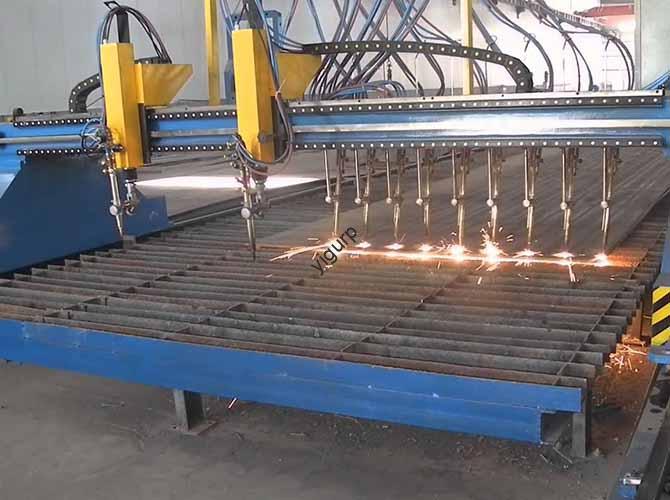
1. CNC Basics and Core Technology
To choose the right CNC solution and get the most out of it, è fondamentale comprenderne i principi fondamentali e i componenti chiave. Molte aziende spesso incorrono in trappole quando introducono sistemi CNC, spesso a causa della mancanza di comprensione della tecnologia sottostante – such as confusingmulti-axis linkage control technology and ordinary CNC systems, resulting in a mismatch between equipment and production needs.
1. Core components and working principles
The CNC system mainly includes the controller, servo drive unit, actuator (motor, spindle) and input and output equipment. The workflow is clear: the program is written throughthe CNC programming basics (the commonG code and M code are explained in detail), the controller parses the instructions, e ilservo drive and motor technology drive the machine tool to complete the processing. Here is a key indicator to pay attention to: CNC accuracy and repeated positioning errors, high-end equipment can be controlled within ±0.001mm, which directly determines the machining quality of precision parts.
2. Key technology analysis
- Open CNC architecture: Compared with closed systems, it supports third-party software integration, such as an auto parts factory connecting MES systems with CNC equipment through open architecture, increasing production efficiency by 30%;
- CNC interpolation algorithm: This is the core to ensure the smoothness of the machining trajectory, common linear interpolation and arc interpolation have met most of the needs, and complex surface processing requires high-order interpolation algorithms;
- Multi-axis linkage control technology: 3-axis linkage is suitable for simple parts, and 5-axis linkage can process complex surfaces (such as aerospace components), but equipment costs will increase by 50%-80%, which needs to be trade-off based on capacity requirements.
2. CNC machining technology and application
The value of CNC solutions is ultimately reflected in the machining effect, which corresponds to different materials and industries with great differences in processes. The following is a highly practical process selection guide, with real case references:
| Processing scenario | Recommended process | Key notes | Case effect |
| Metal precision parts (e.g. ingranaggi) | Precision parts CNC fabrication + in-line inspection | Thermal error compensation technology is used to control the temperature effect | Scrap rate at a machine shop dropped from 5% A 1.2% |
| Mold processing (complex cavities) | High-speed cutting process + 5-axis machining solution | Optimizetoolpath optimization algorithms to reduce empty strokes | 40% reduction in machining cycles |
| Materiali compositi (fibra di carbonio) | Composite CNC machining-specific strategies | Reduce the cutting speed and use a diamond tool | Avoid material delamination with a 98% tasso di passaggio |
| Difficult-to-machine materials (leghe di titanio) | Low speed high feed + cooling optimization | Vibration suppression technology is used to reduce tool wear | 2x longer tool life |
It is worth mentioning that theCNC machining of aerospace components, such parts have extremely high requirements for precision and stability, usually need to be equipped with five-axis linkage system +online testing and quality control attrezzatura, through this combination, a aerospace company successfully realized the batch precision machining of engine blades, meeting the tolerance requirements of ±0.005mm.
3. CNC industry solutions
General-purpose CNC solutions are often “unacclimatized,” and industry-specific solutions can significantly increase capacity. Here are the customization ideas for key industries:
1. High value-added industry solutions
- Aerospace CNC special solution: focusing on the processing of large structural parts, equipped with gantry CNC machine tool + multi-spindle linkage, supporting titanium alloy, superalloy and other difficult-to-machine materials, after the introduction of an aviation manufacturing plant, the processing efficiency of large fuselage parts increased by 50%;
- Precision machining of medical devices: emphasizing miniaturization and high cleanliness, utilizzando micro CNC machining technology of precision instruments, with ultra-precise spindles (rotation speed ≥ 20000rpm) to meet the biocompatibility requirements of implantable parts;
- Automotive manufacturing CNC production line: Pursuing automation and batch consistency, Attraverso the integration of CNC in the automated production line, the whole process from blank to finished product is unmanned, and the cycle time of a car company’s production line is compressed from 60 secondi / piece to 45 secondi / piece.
2. Exclusive solutions for small and medium-sized enterprises
Il nucleo diSME CNC solutions È “conveniente”: priority is given to second-hand high-end equipment (30%-40% more cost-effective than new machines), combined withexisting CNC upgrade solutions (such as installing servo motors, upgrading controllers), and combininglean production in CNC applications, which can improve efficiency under the premise of controllable costs. Through equipment upgrades + lean management, a hardware factory has increased its annual output value by 2 million yuan and has a return on investment of 150%.
4. CNC solution selection and implementation
Selection errors are the biggest risk for businesses to introduce CNC systems, and here is a full-process guide that has been proven in practice:
1. Core principles of selection
- Matching capacity: Flexible CNC system for small batches and multiple varieties, priority special production lines for large-scale production;
- Machine tools are matched with CNC systems: Per esempio, high-speed machine tools need to be equipped with high-response servo systems, otherwise performance will be wasted;
- Cost-benefit analysis: Refer to the cost-benefit analysis model to calculate equipment depreciation, operation and maintenance costs, and capacity improvement benefits, usually high-quality equipment can recover in 2-3 anni.
2. Implement key steps
- Demand research: clarify processing materials, requisiti di precisione, and production capacity targets;
- Scheme design: Scegliere a turnkey CNC solution (including equipment, installation, and commissioning) to reduce the difficulty of implementation;
- Personnel training: Through the training and technical support services provided by suppliers, ensure that operation and maintenance personnel master core skills;
- Operation and maintenance planning: Formulate a CNC system maintenance strategy, regularly calibrate accuracy, check servo systems, and extend equipment life (high-end CNC equipment can have a normal service life of up to 10-15 anni).
3. Avoidance of common pit points
- Only look at the price, not the compatibility: a CNC system purchased at a low price by an electronics factory cannot be connected with the existing ERP, and an additional 200,000 yuan is invested in transformation;
- Neglecting after-sales support: Enterprises in remote areas need to give priority to suppliers with local service outlets to avoid equipment failure and production line downtime;
- Excessive pursuit of high-end configuration: A small workshop purchased a five-axis CNC machine tool and actually processed simple parts, con meno di 30% equipment utilization.
5. CNC efficiency and quality optimization
With the introduction of CNC solutions, optimization never ends. The following is an immediate optimization strategy, supported by specific data:
1. Efficiency Improvement Tips
- Tool management and optimization: Using the tool life monitoring system, a mold factory reduced downtime by 25% by reasonably planning the tool replacement cycle;
- Machining parameter optimization strategy: Adjust the cutting speed and feed according to the material characteristics, such as increasing the cutting speed from 1000m/min to 2000m/min when processing aluminum alloy, and increase the efficiency by 60%;
- Production data collection and analysis: Collect equipment operation data through IoT devices to identify bottleneck processes, and a mechanical processing plant optimizes production schedules accordingly, increasing overall efficiency by 35%.
2. Quality control methods
- Thermal error compensation technology: can reduce the error caused by temperature change by 30%-50%, especially suitable for high-precision processing;
- Mass production consistency control: Controllo statistico del processo (SPC) is used to monitor the processing size in real time and control fluctuations within the allowable range.
- Surface quality optimization: Through vibration suppression tecnologia + coolant optimization, the surface roughness of parts in an auto parts factory was reduced from Ra1.6μm to Ra0.8μm.
6. Yigu Technology’s views
The core value of CNC solutions lies in “precise matching of requirements + continuous optimization and iteration”. The current industry trend is intelligence and customization, and enterprises should not blindly follow the trend of high-end equipment, but should choose solutions based on their own production capacity and industry characteristics. Small and medium-sized enterprises can lower the threshold through the “basic equipment + local upgrade” modello, while large enterprises need to deploy automation integration and data management to gain an advantage in high-end manufacturing competition. At the same time, technical training and operation and maintenance system construction are the key to long-term benefits, and ignoring these two points, no matter how advanced the equipment is, it is difficult to exert its value.
7. FAQ FAQ
- Q: SMEs with limited budgets prioritize upgrading their CNC systems or replacing machines?
UN: Preferential CNCupgrade solutions for existing equipment, such as installing high-precision servo motors and upgrading controllers, cost only 1/3-1/2 of the new machine, and can quickly improve accuracy and efficiency.
- Q: What are the core differences between 5-axis CNC machining and 3-axis machining?
Answer: The five axes can control the movement of five coordinate axes at the same time, and can process complex surfaces (such as impellers, cavità dello stampo), with higher accuracy but higher cost; The triaxis is suitable for simple flat and cylindrical parts, and is more cost-effective.
- Q: How can I judge the stability of a CNC system?
UN: Focus on the maturity ofservo drive and motor technology, the industry reputation of the supplier, and whether there are long-term use cases from similar companies (it is recommended to visit at least 3 utenti).
- Q: What should I do if the tool wears out too quickly in CNC machining?
Answer: It can be optimized from three aspects: selecting tools that are suitable for materials (such as cemented carbide tools for machining titanium alloys), optimizing cutting parameters (reducing cutting speed and increasing feed), and usingvibration suppression and surface quality control technology.