
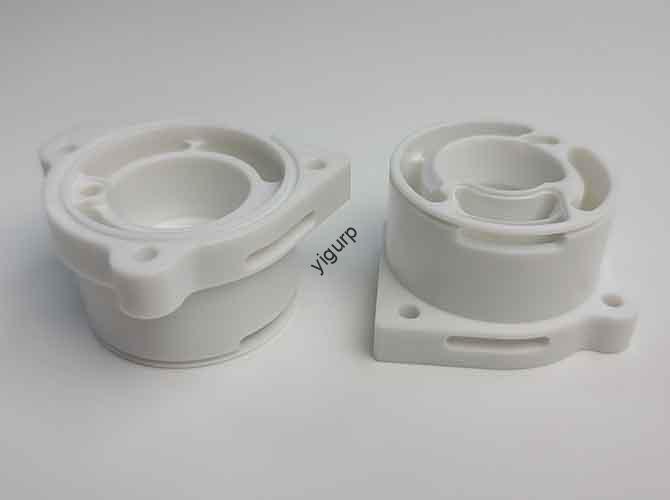
Silicone mold processing is a precision manufacturing technique that transforms liquid silicone rubber (LSR) ou du caoutchouc de silicone condensé en élastique, moules riches en détails. En infusant du silicone non durci sur les surfaces des prototypes, il reproduit des structures complexes, des microtextures de 0,05 mm aux grands composants architecturaux. Ses principaux atouts (faible coût, cycle court, haute personnalisation) faites-en un incontournable pour un échantillonnage rapide, production en petites séries, and personalized crafts. But how does the process work, what materials are best, and how to avoid common pitfalls?
1. Key Materials for Silicone Mold Processing: Match to Use Cases
The performance of a silicone mold depends entirely on material selection. Below is a breakdown of silicone types, their characteristics, and ideal applications—aligned with core material traits from industry standards:
| Silicone Type | Key Characteristics | Compliance Standards | Applications typiques |
| Medical-Grade Silicone | Withstands high-temperature steam sterilization (121°C+); biocompatible (no skin irritation) | FDA 21 CFR §177.2600; OIN 10993 | Medical orthosis production (par ex., custom braces), food-contact molds (chocolat, bonbons) |
| Industrial-Grade Silicone | Adjustable hardness (Shore A 5–60°); balances tear strength (>3kN/m) and resilience | GB/T 5574 (industrial rubber standards) | Resin handicraft molding, architectural decoration component duplication, industrial part prototyping |
| Specialty Conductive Silicone | Contains conductive fillers (par ex., noir de carbone); maintains flexibility | CEI 60093 (electrical conductivity) | Electronic device packaging (par ex., sensor gaskets, anti-static mold inserts) |
| Condensed Silicone Rubber | Faible coût; cures via moisture absorption (releases ethanol); easy to mix | Industrial-grade only (no food/medical use) | Low-criticality crafts (par ex., simple plaster molds), temporary seals |
2. Step-by-Step Workflow of Silicone Mold Processing
Silicone mold processing follows a standardized 4-stage cycle—each step critical to capturing details and ensuring mold durability. The process is linear, with clear quality checkpoints:
Stage 1: Prototype Pre-Treatment (Lay the Foundation)
- Cleaning: Wipe the prototype (3D print, physical object, or master model) with isopropyl alcohol to remove oil, dust, or fingerprints. Even tiny debris causes mold defects (par ex., marques).
- Fixing: Secure the prototype to a flat base (par ex., acrylic plate) using double-sided tape. Ensure it’s centered—this prevents uneven silicone distribution.
- Release Agent Application: Spray a thin layer of PVA water-soluble release agent or silicone-specific release spray. This reduces adhesion, making demolding easier (critical for fragile prototypes like resin models).
Stage 2: Silicone Blending (Mix for Uniformity)
- Component Ratio: Mix silicone main agent and curing agent in a precise ratio (common ratios: 10:1 for industrial-grade, 1:1 for LSR). Use an electronic scale (±0.1g accuracy) to avoid curing failures.
- Additifs (Si nécessaire):
- For color-coded molds: Add non-toxic pigments (1–2% of total weight) to the main agent before mixing with curing agent.
- For heat-resistant molds: Incorporate thermal powder (par ex., alumine) to boost temperature tolerance (jusqu'à 200°C).
- Defoaming: Stir the mixture slowly (30–50 RPM) for 2–3 minutes, then place in a vacuum chamber (-0.1MPa) for 15–20 minutes. This removes air bubbles—without it, the mold will have holes that ruin details.
Stage 3: Gate Molding (Capture Details)
- Containment Setup: Build a frame (wood or acrylic) around the prototype. The frame should be 5–10cm taller than the prototype’s highest point to prevent silicone overflow.
- Technique de coulée: Slowly pour the blended silicone over the prototype’s edges (not directly on top) at a rate of 1–2cm/min. This lets silicone flow into micro-details (par ex., 0.05mm texture lines) without trapping air.
- Leveling: Tap the frame gently 2–3 times to release surface bubbles. For deep cavities, use a small brush to guide silicone into gaps—avoiding air pockets.
Stage 4: Guérison & Démoulage (Finalize the Mold)
- Curing Conditions:
- Room-temperature curing: Let stand for 24–48 hours (ideal for condensed silicone; humidity 40–60% works best).
- Accelerated curing: Heat in an oven at 60–80°C for 2–4 hours (speeds up LSR curing; reduces cycle time for small-batch production).
- Démoulage: Une fois guéri (test by touching the silicone—should be firm, not sticky), peel the mold from the prototype’s edges. Use a plastic spatula to lift stuck areas—never pull hard (this stretches the mold).
- Post-Trim: Cut off excess silicone (éclair) with sharp scissors. Sand the mold’s inner edges with 400-grit sandpaper for a smooth finish (improves the quality of cast parts).
3. Comparaison: Silicone Molds vs. Traditional Molds
Silicone molds outperform traditional options (acier, résine époxy) in key areas—especially for small-scale or custom projects. The table below highlights the differences:
| Feature | Silicone Molds | Steel Molds | Epoxy Resin Molds |
| Equipment Investment | Faible (no large machines needed; works with basic tools) | Haut (requires CNC machining centers; $50k+ setup) | Moyen (needs mold frames and mixing equipment) |
| Detail Replication | Excellent (captures 0.05mm microstructures; ideal for textures) | Bien (limited to 0.1mm details; best for smooth parts) | Équitable (prone to bubble traps; loses detail in deep cavities) |
| Service Life | Modéré (30–50 cycles for industrial-grade; 10–20 for craft-grade) | Long (100k+ cycles; pour la production de masse) | Court (5–10 cycles; brittle and prone to cracking) |
| Compatibilité des matériaux | Wide (supports polyurethane, gypse, cement, résine, and low-temperature metals) | Limité (best for plastic injection molding) | Narrow (only works with low-viscosity resins) |
| Temps de cycle | Rapide (24–48 hours per mold) | Lent (2–4 weeks for machining) | Moyen (3–5 days for curing) |
4. Défis communs & Solutions in Silicone Mold Processing
Even experienced operators face issues—most stem from poor process control. Below is a cause-and-effect guide to troubleshooting:
| Défi | Root Cause | Practical Solution |
| Mold Dimensional Deviations | Ambient temperature/humidity fluctuations; uneven curing shrinkage | – Cure in a temperature-controlled room (20–25°C, 40–60% humidity).- Use low-shrinkage silicone (<0.5% taux de retrait; par ex., LSR).- Add a 1–2% dimensional allowance to the prototype. |
| Bubbles in the Mold | Fast pouring; inadequate vacuum defoaming; stirring too vigorously | – Pour silicone at 1cm/min; avoid splashing.- Extend vacuum time to 25 minutes; repeat if bubbles remain.- Stir at 30 RPM (use a slow-speed mixer if available). |
| Difficult Demolding | Insufficient release agent; prototype surface roughness | – Apply a second thin layer of release agent (focus on textured areas).- Sand rough prototype surfaces with 600-grit sandpaper before pre-treatment. |
| Mold Tearing During Use | Low tear strength silicone; thin mold walls (<5mm) | – Switch to industrial-grade silicone with tear strength >4kN/m.- Make mold walls 8–10mm thick for high-cycle use (par ex., 50+ casts). |
5. Best Practices for Silicone Mold Maintenance
Proper care extends a silicone mold’s service life from 10 cycles to 50+. Follow these tips:
- Clean Immediately Post-Use: Wipe the mold with warm water and neutral detergent (par ex., dish soap) after each casting. Avoid harsh chemicals (acetone dissolves silicone).
- Dry Thoroughly: Pat the mold with a lint-free cloth, then air-dry in a cool, shaded area. Moisture trapped in cavities causes mold growth.
- Store Correctly:
- Lay flat (never fold) to prevent permanent creases.
- For long-term storage (1+ mois), dust the mold’s inner surface with talcum powder to prevent sticking.
- Repair Minor Damage: Fix small tears with a drop of silicone main agent + curing agent (10:1 ratio). Cure for 24 hours before reuse.
6. Yigu Technology’s Perspective on Silicone Mold Processing
Chez Yigu Technologie, we see silicone mold processing as a catalyst for rapid innovation—especially for small businesses and creators. For architectural firms, our industrial-grade silicone (Shore A 20–30°) has replicated 1:10 scale building facades with 0.05mm texture accuracy, cutting prototyping time by 60% contre. epoxy molds. For medical device makers, our medical-grade LSR molds meet FDA standards, enabling custom orthosis production with 24-hour turnaround.
We’re optimizing two key areas: 1) Developing eco-friendly condensed silicone (reducing VOCs by 30%) for sustainable crafting; 2) Integrating 3D scanning to automate prototype pre-treatment (assurer 100% silicone coverage). Our goal is to make high-precision silicone mold processing accessible—no large equipment required.
FAQ
- Can I reuse a silicone mold made via this process, and how many times?
Yes—reusability depends on the silicone type: Industrial-grade molds last 30–50 cycles; de qualité médicale (LSR) molds last 50+ cycles; craft-grade condensed silicone lasts 10–20 cycles. Proper cleaning (warm water + detergent) and storage (flat, sec) extend life.
- What’s the best way to avoid curing shrinkage in silicone molds?
Use low-shrinkage silicone (par ex., LSR with <0.5% rétrécissement) and control curing conditions: Cure at 20–25°C (avoid extreme temperatures) and 40–60% humidity. For large molds, add a 1–2% dimensional allowance to the prototype (par ex., a 10cm prototype becomes 10.1cm to offset shrinkage).
- Can silicone mold processing be used for high-temperature casting materials (par ex., low-melting metals)?
Yes—but choose the right silicone: Use industrial-grade silicone with thermal powder additives (heat resistance up to 200°C) for low-melting metals (par ex., pewter, melting point 170°C). Avoid medical-grade or condensed silicone—they deform above 120°C. Always test a small mold sample first to confirm heat tolerance.