
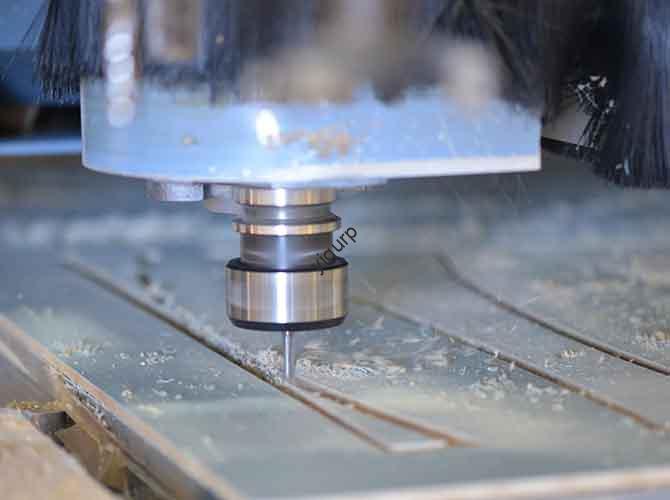
Rugosité de la surface, measured by the Râ (Écart moyen arithmétique) valeur, is a critical indicator of Usinage CNC quality—it directly impacts part functionality, résistance à l'usure, et en forme. Que vous fabriquiez des biens de consommation, composants industriels, ou implants médicaux, connaître la gamme Ra réalisable de traitement CNC et comment la contrôler est essentielle. Cet article décompose RA values that CNC processing can reach across common methods, explains key influencing factors, and shares practical selection strategies.
1. RA Value Ranges by Common CNC Machining Methods
Different CNC machining techniques—from rough turning to ultra-precision grinding—deliver vastly different Ra values. Below is a detailed table of achievable ranges, tailored to help you match methods to your roughness needs.
| CNC Machining Method | Sub-Method | Achievable RA Value Range (µm) | Typical Application Scenarios |
| Tournage CNC | Rough Turning | 20 – 10 | Initial shaping of metal blanks; parts with no surface finish requirements (par ex., temporary structural supports) |
| Semi-Finishing/Finishing Turning | 1.6 – 0.8 | General-purpose parts (par ex., low-speed shafts, non-critical housings) | |
| Mirror Turning (Diamond Tools for Non-Ferrous Metals) | 0.04 – 0.01 | Haute brillance, pièces de précision (par ex., aluminum decorative components, optical instrument parts) | |
| Fraisage CNC | Rough Milling | 6.3 – 2.5 | Grandes pièces de structure (par ex., bâtis de machines, bracket blanks) |
| Finish Milling | 1.6 – 0.63 | Fitted parts (par ex., sliding guides, carters d'engrenages) | |
| Super Fine Milling (High-Speed, Small Feed) | 0.4 | Composants mécaniques de précision (par ex., high-speed bearing seats) | |
| Alésage CNC | Ordinary Boring | 2.5 – 0.63 | Hole machining for general parts (par ex., hydraulic cylinder bores) |
| Fine Boring | 0.32 – 0.08 | High-precision holes (par ex., engine cylinder bores, precision valve holes) | |
| Affûtage | Meulage de précision | 0.16 – 0.04 | Pièces à forte usure (par ex., courses de roulements, embouts d'outils) |
| Ultra-Precision Grinding | < 0.01 | Ultra-high-precision components (par ex., medical implant surfaces, semiconductor parts) |
2. Practical RA Value Selection: Balancing Function, Coût, and Scenarios
Not all parts need ultra-low Ra values—over-processing wastes time and money. Below is a guide to standard RA options and their cost implications, aligned with real-world use cases.
2.1 Standard RA Grades for CNC Processing
| RA Value (µm) | Grade Type | Key Application Scenarios | Cost Impact (contre. Râ 3.2 µm) |
| 3.2 | Economy Grade | General consumer parts (par ex., plastic toy components, simple brackets); light-load, low-speed moving parts. Surface has slight knife marks but no functional impact. | Base cost (0% increase) |
| 1.6 | Functional Grade | Tightly fitting or stressed parts (par ex., sliding guides, low-speed rotary shafts); requires high-speed cutting and fine feed. | ~3% cost increase |
| 0.8 | High-Grade | Roulements, high-stress concentration areas (par ex., gear teeth roots); improves wear resistance and fatigue life. | ~5% cost increase |
| 0.4 | Ultra-Fine Grade | High-precision bearings, implants médicaux (par ex., artificial joints); demands strict surface smoothness to avoid tissue irritation or friction damage. | 11–15% cost increase |
| < 0.01 | Ultra-Precision Grade | Semiconductor parts, composants optiques; only achievable via ultra-precision grinding. | 50–100% cost increase |
2.2 Exemple: How to Choose RA for an Automotive Shaft
- If the shaft is a non-critical auxiliary component (par ex., a cover support shaft): Choisir Râ 3.2 µm (économie, no unnecessary cost).
- If the shaft is a rotating part with a sliding fit (par ex., a transmission auxiliary shaft): Choisir Râ 1.6 µm (balances function and cost).
- If the shaft is a high-speed bearing journal (par ex., an engine crankshaft): Choisir Râ 0.8 µm (ensures wear resistance and long life).
3. 3 Key Factors That Affect CNC Processing Surface Roughness
To achieve your target RA value consistently, you need to control these three critical variables:
3.1 Sélection d'outils & Paramètres de coupe
- Tool Edge Accuracy: Dull or low-precision tools leave deeper tool marks, increasing Ra values. Use sharp, high-hardness tools (par ex., carbide tools for steel, diamond tools for non-ferrous metals).
- Cutting Speed: Higher speed (within material limits) reduces friction between tool and workpiece, creating a smoother surface. Par exemple, increasing turning speed from 100 m/min to 300 m/min can lower Ra from 1.6 μm à 0.8 µm.
- Vitesse d'alimentation: Smaller feed rates (par ex., 0.1 mm/rev vs. 0.3 mm/rev) reduce the distance between tool paths, minimizing surface irregularities.
3.2 Workpiece Material Properties
- Métaux non ferreux (par ex., alliages d'aluminium, cuivre): Soft and easy to machine, making it simple to achieve low Ra values (par ex., Râ 0.04 μm via mirror turning).
- Métaux ferreux (par ex., acier au carbone, acier inoxydable): Harder and more prone to tool wear, requiring stricter process control (par ex., higher tool hardness, optimized cooling) to reach Ra < 0.8 µm.
3.3 Techniques de post-traitement
Post-processing can further improve surface roughness, but note its impact on dimensional tolerances:
- Polissage: Reduces Ra by 50–70% (par ex., depuis 1.6 μm à 0.4 µm) but may slightly reduce part size.
- Ponçage: Suitable for removing minor tool marks (par ex., lowering Ra from 3.2 μm à 1.6 µm) but is labor-intensive.
- Galvanoplastie: Creates a smooth coating (par ex., chromage) to lower Ra, but adds cost and requires strict environmental controls.
4. Yigu Technology’s Perspective on CNC Processing Surface Roughness
Chez Yigu Technologie, we often see clients overspecify RA values—for example, choosing Ra 0.4 μm for a non-critical bracket that only needs Ra 3.2 µm, increasing costs by 15% unnecessarily. Nos conseils: Start with the functional requirement, not the lowest possible Ra. For most industrial parts, Ra 1.6–0.8 μm balances performance and cost. We also help clients optimize processes: For a recent automotive client, adjusting their milling feed rate from 0.2 mm/rev to 0.1 mm/rev (while keeping speed constant) lowered Ra from 1.6 μm à 0.8 μm without extra cost. For ultra-precision needs (par ex., implants médicaux), we combine fine boring with polishing to hit Ra 0.4 μm consistently, ensuring both quality and cost efficiency.
FAQ: Common Questions About CNC Processing Surface Roughness RA
- Q: Can CNC turning achieve Ra < 0.01 μm like ultra-precision grinding?
UN: Non. Even with diamond tools, mirror turning (the most precise CNC turning method) only reaches Ra 0.01–0.04 μm. Râ < 0.01 μm requires ultra-precision grinding, which uses abrasive particles to remove material at the micron level.
- Q: Will increasing cutting speed always lower the RA value?
UN: Non. Beyond a certain limit, excessively high speed causes tool overheating and wear, which increases Ra. Par exemple, turning aluminum at > 500 m/min may melt the material surface, creating irregularities. Always follow material-specific speed guidelines.
- Q: How do I verify if a CNC shop can actually achieve the RA value I need?
UN: Ask for a sample part machined with the same material and process as your project. Use a surface roughness tester (par ex., a portable Ra meter) to measure the sample’s Ra value—don’t rely solely on the shop’s claims. Pour les pièces critiques (par ex., implants médicaux), request a third-party inspection report.