
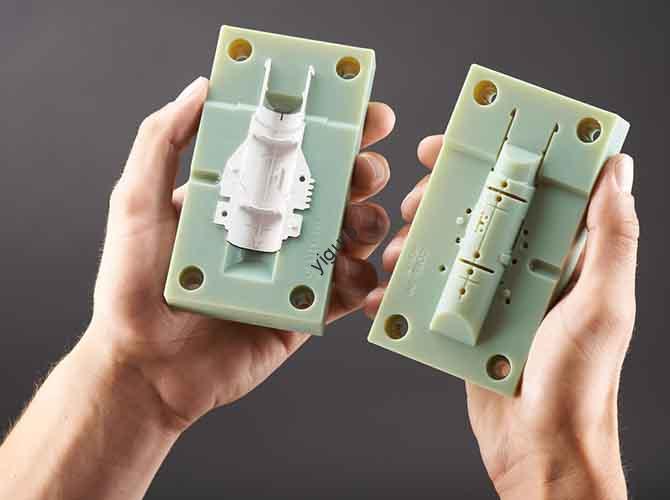
Prototype injection molding is a specialized manufacturing process that converts 3D-printed prototypes into small-batch injection-molded parts (généralement 10 à 500 unités) pour valider la faisabilité de la conception, performances matérielles, et flux de production de masse. Contrairement au moulage par injection traditionnel (axé sur la production de gros volumes), il donne la priorité à la flexibilité, rentabilité, et une itération rapide, ce qui la rend essentielle pour des secteurs tels que les biens de consommation, automobile, et électronique. Cet article détaille son flux de travail principal, material/tool choices, troubleshooting tips, and real-world applications to help teams bridge the gap between prototypes and mass production.
1. What Are the Core Objectives of Prototype Injection Molding?
Every step in the process serves specific goals that directly reduce risks in mass production.
| Objective | Description | Real-World Example |
| Design Validation | Confirm if the prototype’s structure (par ex., parois minces, contre-dépouilles) is compatible with injection molding and if parts assemble without interference. | Testing if a 3D-printed horse-shaped ornament prototype (with a 1.5mm thin wall and 2° draft angle) can be injected without warping or incomplete filling. |
| Material Performance Testing | Verify if the chosen injection molding material (par ex., ABS, PC) matches the prototype’s intended function (force, flexibilité, apparence). | Checking if ABS plastic (used for the horse ornament) retains its impact resistance (no cracking when dropped from 1m) after injection molding. |
| Optimisation des paramètres de processus | Identify optimal injection molding settings (température, pression, temps) to avoid defects (éclair, rétrécissement) in mass production. | Adjusting the horse ornament’s injection pressure from 80MPa to 100MPa to eliminate “lack of material” in the ornament’s legs. |
| Coût & Cycle Time Estimation | Gather data (mold costs, part production time) to forecast mass production budgets and timelines. | Using prototype data to estimate that mass-producing 10,000 horse ornaments will cost \(2/unité (contre. \)15/unité pour prototypes). |
2. What Is the Step-by-Step Prototype Injection Molding Workflow?
The process follows a linear, repeatable sequence—each stage builds on the previous one to ensure quality and consistency.
2.1 Étape 1: Préparation préliminaire (Lay the Foundation)
This stage defines requirements and optimizes the prototype to avoid injection molding defects.
2.1.1 Prototype Optimization for Injection Molding
3D-printed prototypes often need design tweaks to fit injection molding constraints:
| Optimisation | Reason | Specification Example |
| Add Draft Angles | Prevents parts from sticking to the mold during demolding. | 1°–3° draft angle on all vertical surfaces (par ex., the horse ornament’s body sides). |
| Adjust Wall Thickness | Avoids uneven cooling (causing shrinkage) ou remplissage incomplet. | Épaisseur minimale de paroi: 1mm (ABS/PC); maximum variation: ≤50% (par ex., 1.5mm wall → no sudden jumps to 3mm). |
| Optimize Parting Surfaces | Ensures clean mold separation without damaging part appearance or strength. | Place parting surfaces along non-visible edges (par ex., the horse ornament’s belly, not its face). |
| Design Gate Positions | Reduces weld marks (weak points) and ensures uniform melt flow. | Use side gates for large parts (horse ornament’s base) or point gates for small, detailed features (horse’s ears). |
2.1.2 Material Selection Guide
Choose materials based on the prototype’s function, apparence, and compatibility with injection molding:
| Matériel | Propriétés clés | Applications idéales |
| ABS | Haute résistance, good toughness, facile à colorier. | Pièces structurelles (horse ornament bodies, electronic device shells). |
| PC (Polycarbonate) | Transparent, résistant aux chocs, résistant à la chaleur (jusqu'à 120°C). | Pièces de précision (clear light covers, composants automobiles). |
| Pennsylvanie (Nylon) | Résistant à l'abrasion, résistant aux produits chimiques, flexible. | Pièces fonctionnelles (engrenages, charnières, toy joints). |
| PMMA (Acrylique) | High transparency (92% transmission de la lumière), finition brillante. | Pièces décoratives (clear ornament details, vitrines). |
Critical Note: Ensure the material’s shrinkage rate matches the 3D-printed prototype (par ex., ABS has a 0.5%–0.8% shrinkage rate—reserve this in mold design to avoid dimensional 偏差).
2.1.3 Conception de moules & Sélection
Molds for prototype injection molding prioritize cost and speed over high-volume durability:
| Mold Type | Idéal pour | Fourchette de coût | Délai de mise en œuvre |
| Soft Molds (Silicone/Aluminum) | Petits lots (10–100 unités), formes complexes (contre-dépouilles). | \(1,000–)5,000 | 3–7 jours |
| Semi-Hard Molds (P20 Steel) | Lots moyens (100–500 unités), haute précision (±0,05 mm). | \(5,000–)15,000 | 7–14 jours |
| Hard Molds (H13 Steel) | Large prototype batches (500+ unités) or pre-mass production tests. | \(15,000–)50,000 | 14–21 jours |
Mold Key Features:
- Circuit de refroidissement: Add water channels to reduce cycle time (par ex., 15-second cooling for the horse ornament vs. 30 seconds without cooling).
- Mécanisme d'éjection: Use ejector pins (pour les pièces simples) or push plates (for complex shapes like the horse’s curved body) to ensure smooth demolding.
2.2 Étape 2: Mold Processing & Tryout Preparation
Turn the mold design into a physical tool and prepare for injection testing.
2.2.1 Mold Manufacturing Methods
Choose a processing method based on mold material, complexité, et besoins de précision:
| Method | Idéal pour | Précision | Exemple |
| Usinage CNC | Aluminum/steel molds with simple-to-medium complexity (par ex., horse ornament bodies). | ±0,01mm | Cutting a P20 steel mold for the horse ornament using a 5-axis CNC machine. |
| Usinage par électroérosion (GED) | Molds with complex surfaces or hard materials (par ex., Acier H13). | ±0,005mm | Creating the horse ornament’s detailed facial features (eyes, mane) in a carbide mold. |
| 3D-Printed Molds | Low-batch, pièces complexes (par ex., horse ornaments with internal cavities). | ±0,1mm | 3D printing a silicone mold for 10–20 horse ornament prototypes (rapide, faible coût). |
2.2.2 Tryout Preparation
- Mold Assembly: Secure mold components (cavité, cœur, cooling system) and check for alignment (no gaps between parting surfaces).
- Configuration de la machine: Install the mold on an injection molding machine (5–50 tons, suitable for small batches); calibrate clamping force (10%–20% higher than injection pressure to prevent flash).
- Préchauffage: Heat the mold to the material’s recommended temperature (par ex., ABS: 60°C–80°C; PC: 80°C–100°C) to reduce shrinkage.
2.3 Étape 3: Moulage par injection (Core Production Stage)
Optimize parameters and execute injection to produce defect-free parts.
2.3.1 Critical Parameter Settings
Parameter values vary by material—use the table below as a starting point and adjust based on trial results:
| Paramètre | ABS (Horse Ornament Example) | PC (Precision Parts) | Pennsylvanie (Pièces fonctionnelles) |
| Température du baril | 200°C–240°C (zone d'alimentation: 200°C; ajutage: 240°C) | 260°C–300°C | 230°C–270°C |
| Température du moule | 60°C–80°C | 80°C–100°C | 40°C–60°C |
| Pression d'injection | 80–120MPa | 100–150MPa | 70–110MPa |
| Holding Pressure | 50%–80% de la pression d’injection (par ex., 60MPa for 100MPa injection) | 60%–90% de la pression d’injection | 40%–70% de la pression d’injection |
| Temps d'injection | 2–5 seconds (depends on part size: 3 seconds for a 50g horse ornament) | 3–8 seconds | 2–6 seconds |
| Temps de refroidissement | 10–20 secondes (15 seconds for the horse ornament) | 15–30 secondes | 8–15 secondes |
2.3.2 Mold Testing & Dépannage
Start with low-speed, low-pressure trials to identify and fix defects:
| Common Defect | Root Cause | Solution |
| Lack of Material | Insufficient injection volume/pressure; narrow gates. | Increase injection pressure by 10%–20%; widen gates from 1mm to 1.5mm. |
| Flash (Excess Plastic) | Mold parting surface not tight; clamping force too low. | Nettoyer les surfaces du moule; increase clamping force by 10%–15%. |
| Shrinkage/Bubbles | Inadequate holding time; mold temperature too low. | Extend holding time by 2–3 seconds; raise mold temperature by 10°C–20°C. |
| Weld Marks | Multiple melt flows merging; gate position poorly placed. | Add a secondary gate; increase barrel temperature by 10°C–15% to improve melt flow. |
2.3.3 Production en petits lots
Once parameters are stable (no defects in 5–10 consecutive parts), start small-batch production:
- For multi-cavity molds (par ex., 2 cavities for horse ornaments), ensure uniform filling across all cavities.
- Record production time per part (par ex., 30 seconds/unit for the horse ornament) to estimate mass production cycle times.
2.4 Étape 4: Post-traitement & Contrôle qualité
Refine parts to meet design standards and validate performance.
2.4.1 Étapes de post-traitement
| Étape | But | Exemple (Horse Ornament) |
| Gate Trimming | Remove excess plastic from gate positions; sand edges to avoid sharpness. | Cut off the gate (on the horse’s base) with a utility knife; sand with 400-grit sandpaper. |
| Cleaning | Remove oil, débris, or mold release agent. | Wipe parts with isopropyl alcohol; use ultrasonic cleaning (40°C, 10 minutes) for detailed features (horse’s mane). |
| Secondary Processing | Enhance appearance or functionality. | – Pulvérisation: Apply matte black paint to the horse’s body.- Gravure Laser: Add a brand logo to the horse’s base.- Assemblée: Attach movable legs (injected separately) with metal pins. |
2.4.2 Quality Inspection Checklist
| Inspection Type | Method | Acceptance Standard |
| Précision dimensionnelle | Use digital calipers/3D scanners to measure key dimensions. | Deviation ≤±0.1mm (par ex., horse ornament height: 100mm ±0.1mm). |
| Apparence | Inspection visuelle (naked eye + 10x magnifying glass). | No defects: éclair, rayures, discoloration, or bubbles. |
| Performances mécaniques | Impact test (drop from 1m); tensile test (pour la force). | ABS parts: No cracking after impact; tensile strength ≥40MPa. |
| Assembly Fit | Test if parts assemble with other components (par ex., movable legs). | Legs snap into body without forcing; rotate 360° smoothly. |
3. What Are the Key Precautions to Avoid Failures?
3.1 Matériel & Mold Compatibility
- Match Material to Mold: Soft molds (silicone/aluminum) work best with low-temperature materials (ABS, Pennsylvanie); hard molds (Acier H13) are required for high-temperature materials (PC, PPS). Using PC with a silicone mold will melt the mold.
- Account for Shrinkage: Add shrinkage allowances to the mold design (par ex., 0.5% for ABS—design the horse ornament mold at 100.5mm to get a 100mm final part).
3.2 Cost Control
- Choose the Right Mold: For batches ≤100 units, use soft molds (\(1,000–)5,000) to save 70% contre. hard molds. For batches ≥500 units, hard molds become cost-effective (coût unitaire inférieur).
- Minimize Iterations: Test 3D-printed prototypes thoroughly (par ex., check wall thickness, draft angles) before mold making—each mold rework costs \(500–)2,000 and adds 3–5 days to lead time.
3.3 Timeline Management
- Plan for Trials: Allocate 2–3 days for mold testing and troubleshooting (even with well-optimized prototypes).
- Coordinate with Suppliers: Share prototype designs with mold makers 1–2 weeks in advance to avoid delays in mold processing.
4. What Is a Real-World Example: Horse-Shaped Ornament Prototype Injection Molding?
Let’s apply the workflow to a common consumer product: a 100mm-tall horse-shaped ornament.
- Préparation préliminaire:
- Prototype Optimization: Add 2° draft angles to the horse’s body; adjust wall thickness from 1mm to 1.5mm (ABS-compatible).
- Sélection des matériaux: Choose ABS (résistant aux chocs, facile à peindre).
- Conception de moules: Use a single-cavity aluminum mold ($2,000) with a side gate (on the horse’s base) and cooling channels in the legs.
- Mold Processing & Tryout:
- CNC machine the aluminum mold (3 jours); assemble and install on a 10-ton injection molding machine.
- Preheat the mold to 70°C (ABS recommended temperature).
- Moulage par injection:
- Parameters: Barrel temperature 220°C, injection pressure 100MPa, holding pressure 70MPa, injection time 3 secondes, temps de refroidissement 15 secondes.
- Dépannage: Initial trials show “lack of material” in the horse’s ears—increase injection pressure to 110MPa and widen the gate to 1.5mm.
- Post-traitement & Inspection:
- Trim gates, sand edges, and spray matte black paint.
- Inspect: Précision dimensionnelle (100mm ±0.1mm), aucun défaut, and legs assemble smoothly.
- Résultat: 50 defect-free horse ornaments produced in 2 days—ready for market testing.
Yigu Technology’s Perspective
Chez Yigu Technologie, we see prototype injection molding as a “risk reducer” for product teams. Too many clients skip this step and jump to mass production—only to discover their horse ornament’s thin walls warp or their mold gates leave ugly marks, costing \(10k–\)50k in reworks. Our approach: We help clients optimize prototypes for injection molding (par ex., adjusting draft angles) and choose cost-effective molds (aluminum for small batches). Par exemple, we helped a client cut horse ornament prototype costs by 40% by using a shared aluminum mold (instead of a custom steel mold) and optimized injection parameters to eliminate shrinkage. Prototype injection molding isn’t an extra expense—it’s the fastest way to ensure mass production runs smoothly, on time, and on budget.
FAQ
- Can prototype injection molding use the same molds as mass production?
Rarely—prototype molds (aluminum/silicone) are designed for small batches (10–500 unités) and have shorter lifespans (1,000–10,000 shots). Mass production uses steel molds (100,000+ shots) pour la durabilité. Cependant, prototype mold designs can be modified for mass production (par ex., adding cavities to a single-cavity prototype mold).
- How much does prototype injection molding cost for a small batch (50 unités) of horse-shaped ornaments?
Total cost: \(3,500–)5,000. Breakdown: Moule (\(2,000–)3,000), matériel (ABS: \(50–)100), travail (\(500–)1,000), et post-traitement (\(500–)800). This is 70% cheaper than producing 50 units via 3D printing (\(15/unit vs. \)50/unité).
- **