
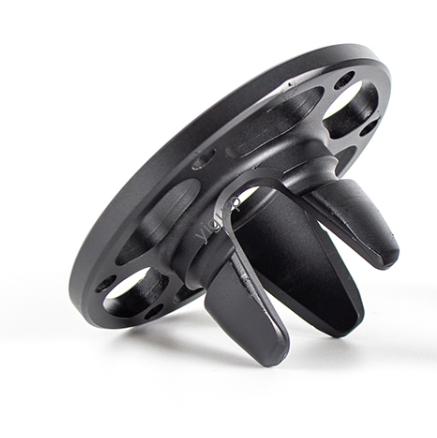
Si vous êtes dans le développement de produits, you’ve likely wondered about the key distinctions between pièces prototypes et injection molding products. Ces deux étapes jouent des rôles essentiels mais très différents dans la transformation d'un concept de produit en un article prêt à être commercialisé.. Pour vous aider à prendre des décisions claires pour votre projet, we’ll break down their differences from production processes to cost, with easy-to-understand data and examples.
1. Production Process: From One-Off Creation to Mass Production
The biggest gap between prototype parts and injection molding lies in how they’re made—one focuses on flexibility for design testing, while the other prioritizes consistency for large-scale output.
| Aspect | Pièces prototypes | Injection Molding Products |
| Core Purpose | Verify design feasibility and display concepts | Mass-produce uniform final products |
| Production Methods | Handcrafting, Usinage CNC, 3Impression D | Injecting molten plastic into molds (cooling to shape) |
| Taille du lot | 1–50 pieces (petit lot, one-off common) | 1,000+ pièces (large-batch standard) |
| Délai de mise en œuvre | 3–7 jours (fast for design iterations) | 2–4 semaines (longer setup; faster per-piece output) |
| Cohérence | Modéré (varies by maker/machine) | Haut (99% uniformity across batches) |
Par exemple, if you’re designing a new phone case, you’d first make 2–3 CNC-machined prototype parts to check if the button slots align. Once the design is fixed, you’d use injection molding to make 10,000 identical cases for sale.
2. Sélection des matériaux: Flexibility vs. Process Suitability
Prototype parts use a wide range of materials to test different functions, while injection molding sticks to plastics that work with its high-heat, high-pressure process.
Prototype Part Materials (Diverse for Testing)
- Plastiques: ABS (for strength testing), PVC (for flexibility checks)
- Métaux: Aluminium (léger, facile à usiner), acier inoxydable (for durability tests)
- Matériaux spécialisés: Silicone (for grip or seal tests), clay/sludge (for early shape mockups)
- Why this variety? If you’re making a prototype of a child’s toy, you might test both soft silicone (for safety) and hard plastic (for sturdiness) to pick the best option.
Injection Molding Materials (Focused on Process Compatibility)
Nearly 95% of injection molding products use thermoplastics—materials that melt easily and hold shape when cooled. The most common options include:
- PMMA (Acrylique): Clair, résistant aux rayures (used for phone screens, vitrines)
- PC (Polycarbonate): Résistant aux chocs (used for laptop shells, safety goggles)
- PP (Polypropylène): Flexible and chemical-resistant (used for water bottles, contenants alimentaires)
- Pennsylvanie (Nylon): Strong and heat-resistant (used for gears, pièces automobiles)
- Why these plastics? They can withstand the injection molding process (temperatures 180–300°C) and produce consistent, high-quality parts at scale.
3. Usage: Design Validation vs. Final Commercial Products
Prototype parts and injection molding products serve entirely different stages of the product lifecycle—you’ll never use a prototype as a final saleable item, and you’ll never use injection molding to test a new design.
How Prototype Parts Are Used (Early Development)
- Design Verification: Check if the product’s size, forme, and features work (par ex., does a prototype water bottle fit in a car cup holder?).
- Function Testing: Test durability, convivialité, or safety (par ex., dropping a prototype phone case to see if it protects a phone).
- Stakeholder Approval: Show prototypes to clients or investors to get feedback before investing in mass production.
- Key stat: 80% of product teams make 2–3 prototype iterations to fix design flaws.
How Injection Molding Products Are Used (Final Stage)
- Biens de consommation: Sold directly to customers (par ex., plastic utensils, petites voitures).
- Pièces industrielles: Used in larger products (par ex., plastic gears for washing machines, connectors for electronics).
- Bulk Supplies: Provided to other businesses (par ex., plastic containers for food manufacturers).
- Key stat: Injection molding produces over 30% of all plastic products worldwide—from tiny medical parts to large appliance components.
4. Cost and Efficiency: Short-Term Investment vs. Long-Term Savings
Costs vary drastically because prototype parts are for small batches, while injection molding leverages economies of scale.
Cost Breakdown (par 100 Pieces)
| Cost Type | Pièces prototypes (CNC-Machined) | Injection Molding Products |
| Initial Setup Cost | \(50–)200 (no mold needed) | \(1,000–)5,000 (création de moule) |
| Per-Piece Cost | \(20–)50 | \(0.50–)3.00 |
| Total Cost for 100pcs | \(2,050–)5,200 | \(1,050–)5,300 |
Efficiency Tradeoffs
- Pièces prototypes: Fast to start (no mold design), but slow and expensive for large batches. If you need 10 pièces, prototypes cost \(200–)500 total—far cheaper than making a mold.
- Moulage par injection: Slow to start (molds take 2–4 weeks to make), but ultra-efficient for large runs. Pour 10,000 pièces, injection molding costs \(5,000–)30,000 total—compared to \(200,000–)500,000 pour les prototypes.
Yigu Technology’s Perspective
Chez Yigu Technologie, we see pièces prototypes et moulage par injection as two sides of the same product development coin. Prototypes let our clients “fail fast, fix fast”—we often use 3D printing and CNC machining to deliver prototypes in 3–5 days, helping them refine designs without wasting time on molds. Once designs are locked, our injection molding team ensures consistent, high-quality mass production—we’ve optimized processes to cut mold setup time by 20% and per-piece costs by 15% for clients in electronics and consumer goods. Ensemble, these stages turn great ideas into profitable products.
FAQ (Frequently Asked Questions)
- Can I use prototype parts for small-scale sales?
No—prototypes are made for testing, not long-term use. They may not meet safety standards (par ex., toxic materials) or have consistent quality, so they’re not suitable for commercial sale.
- When should I switch from prototypes to injection molding?
Switch once your design is 100% finalized (no more changes needed) and you need 500+ pièces. If you need fewer than 500 pièces, prototypes are more cost-effective.
- What’s the most common mistake in choosing between the two?
Many teams jump to injection molding too early—before fixing design flaws. This wastes money on mold changes (each mold tweak costs \(500–)2,000). Always test with prototypes first!