
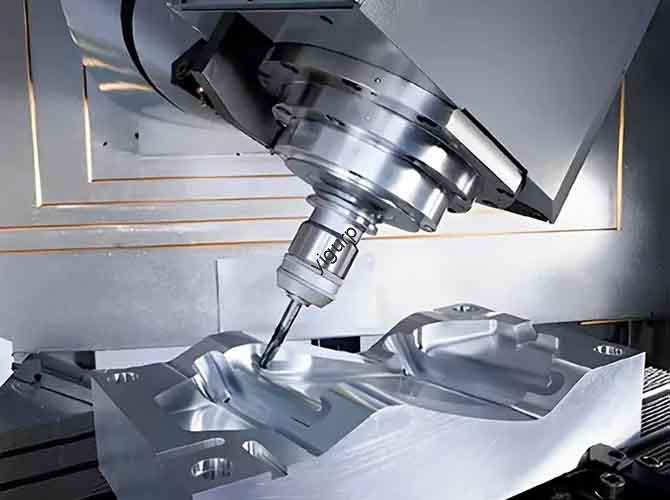
Le développement d'un prototype de cuiseur à riz nécessite un processus de modélisation d'usinage CNC précis pour valider la faisabilité de la conception., tester la stabilité structurelle, et garantir l'alignement avec les besoins des utilisateurs - étapes critiques avant la production de masse. Contrairement aux autres appareils de cuisine, les cuiseurs à riz ont des exigences structurelles uniques (par ex., doublures résistantes à la chaleur, couvercles scellés) qui façonnent chaque étape du processus de modélisation. Ce guide détaille le flux de travail complet, from 3D modeling to post-processing, avec des paramètres clés, material choices, and practical tips to ensure prototype success.
1. Préparation préliminaire: Lay the Foundation for Modeling
The success of CNC machining starts with thorough preparation, including 3D model design, sélection des matériaux, and tool/fixture readiness. This stage ensures the subsequent machining process is efficient and accurate.
(1) 3Modélisation D: The Core of Prototype Design
Use professional CAD software to create a detailed 3D model that covers all key structures of the rice cooker. The model must balance design aesthetics, functional needs, and machining feasibility.
| Structure Category | Key Design Details | Precision Requirements | But |
| External Structure | Shell (cylindrical or square shape), control panel (button positions, display window), handle (ergonomic curve) | Shell diameter error ±0.2mm; button hole position tolerance ±0.1mm | Ensure assembly accuracy; meet user operation habits |
| Internal Structure | Liner (deep cavity, 3–5mm thickness), heating plate mounting groove, sensor fixing holes | Liner roundness error ≤0.1mm; mounting groove depth tolerance ±0.05mm | Fit internal components (par ex., heating plate, sensor); ensure heat conduction efficiency |
| Process Features | Draft slope (3°~5° on shell/lid), rounding corners (R1.5mm on handle edges), parting lines | Draft slope avoids machining interference; rounding prevents user scratches | Simplify CNC machining; improve user safety |
Model Optimization Tips:
- Layered Processing: Split complex structures (par ex., lid with inner sealing ring groove) into separate components (outer lid + inner sealing layer) to reduce tool interference during machining.
- Detail Marking: Clearly label key dimensions (par ex., liner thickness, button hole diameter) in the model to avoid machining deviations.
- Interference Check: Use software (par ex., SolidWorks) to simulate part assembly and ensure no overlapping or collision between components (par ex., lid and shell when closed).
(2) Sélection des matériaux: Match Performance to Component Roles
Different parts of the rice cooker require materials with specific properties (par ex., résistance à la chaleur, rigidité). Below is a detailed comparison of suitable materials:
| Type de matériau | Applicable Parts | Propriétés clés | Machinability Advantages |
| Plastique ABS | Shell, control panel housing, button bases | Léger (density 1.05g/cm³), facile à colorier, faible coût | Low tool wear; can be machined at high speed (10,000–15,000 rpm) |
| Alliage d'aluminium (6061) | Liner, heating plate brackets, handle cores | Haute résistance (tensile strength 276MPa), good heat conductivity, résistant à la corrosion | Smooth surface after machining; suitable for deep cavity processing (liner) |
| Acrylique (PMMA) | Display window, transparent lid parts | High light transmittance (≥92%), clear appearance, bonne résistance aux chocs | Precision cutting achievable; polished surface mimics glass |
| Nylon (Pennsylvanie) | Internal structural supports (par ex., supports de capteur) | Résistance à la chaleur (continuous use temp 80–120°C), résistant à l'usure | Faible coefficient de frottement; no deformation during machining |
Blank Preparation:
- Cut blanks according to the maximum size of each part: Par exemple, an ABS shell with a diameter of 200mm and height of 150mm requires a 220mm×220mm×160mm ABS block to reserve machining allowance (5–10mm on each side).
- For aluminum alloy liners, use extruded aluminum blocks to ensure uniform material density and reduce machining defects.
(3) Tool & Fixture Preparation: Ensure Machining Stability
The right tools and fixtures prevent part shifting and ensure machining accuracy.
| Tool Type | Application Scenarios | Tool Size Recommendation |
| Flat-Bottom End Mill | Rough machining of shell contours, liner outer walls | Φ8–Φ12mm (ABS); Φ6–Φ10mm (alliage d'aluminium) |
| Ball-Head End Mill | Finishing of curved surfaces (handle, lid edges), deep cavity inner walls | Φ3–Φ6mm (ABS/acrylic); Φ2–Φ5mm (alliage d'aluminium) |
| Twist Drill | Drilling of button holes, sensor mounting holes | Φ2–Φ8mm (match hole size requirements) |
| Tap | Processing of threaded holes (par ex., handle fixing holes) | M3–M6 (according to assembly needs) |
Fixture Selection:
- Vacuum Suction Cups: Pour pièces plates (par ex., acrylic display windows, aluminum alloy plates) to avoid clamping marks.
- Precision Vises: For irregular parts (par ex., ABS shell blanks) with adjustable jaws to ensure firm fixing.
- Custom Jigs: For deep cavity parts (par ex., aluminum alloy liners) to support the cavity wall and prevent deformation during machining.
2. Exécution d'usinage CNC: From Blank to Prototype Shape
This stage converts blanks into prototype parts through rough machining, finition, and special structure processing—each step requires strict parameter control.
(1) Program Writing & Debugging: Avoid Machining Errors
- G-Code Generation: Import the 3D model into CAM software (par ex., Mastercam, PowerMill). Set machining parameters based on material and tool type:
- For ABS shell rough machining: Cutting speed 12,000 tr/min, vitesse d'avance 1,500 mm/min, cutting depth 1–2mm.
- For aluminum alloy liner finishing: Cutting speed 18,000 tr/min, vitesse d'avance 800 mm/min, cutting depth 0.1–0.3mm.
- Empty Run Test: Conduct an empty run on the CNC machine to check tool path 合理性 (par ex., no collision with fixtures, sufficient space for tool movement). Adjust the program if issues are found.
(2) Usinage grossier: Remove Excess Material Efficiently
The goal of rough machining is to quickly shape the blank into a rough outline close to the final part, leaving a small finishing allowance.
| Matériel | Machining Focus | Key Operations |
| Plastique ABS | Shell contour, control panel slot | Use Φ10mm flat-bottom mill to cut the outer contour first; then machine the control panel slot (depth 5mm) |
| Alliage d'aluminium | Liner deep cavity, bracket outline | Use Φ8mm flat-bottom mill for layered cutting of the liner cavity (depth 100mm, 2mm per layer); leave 0.3mm allowance |
| Acrylique | Display window outer shape | Use Φ6mm flat-bottom mill to cut the rectangular outline (size 80mm×50mm); leave 0.2mm allowance |
(3) Finition: Achieve Precision & Smooth Surface
Finishing focuses on improving dimensional accuracy and surface quality, ensuring the part meets design requirements.
Key Operations & Parameters:
- Curved Surface Finishing: For handle curved surfaces, use a Φ4mm ball-head mill with a step distance of 0.1mm to eliminate tool marks; achieve surface roughness Ra ≤1.6μm.
- Deep Cavity Finishing: For aluminum alloy liner inner walls, use an extended Φ3mm ball-head mill (length 120mm) to reach the cavity bottom; adjust spindle speed to 20,000 rpm to avoid vibration.
- Hole Machining: Drill button holes (Φ5mm) with a twist drill, then use a reamer (Φ5mm) to improve hole roundness (error ≤0.02mm).
Special Structure Handling:
- Thin-Walled Parts (par ex., ABS shell side walls, 2mm épaisseur): Use high-speed cutting (15,000 tr/min) and reduce cutting depth to 0.5mm; add temporary support ribs during machining to prevent deformation.
- Trous filetés: Drill bottom holes first (par ex., Φ3.3mm for M4 threads), then tap with a high-speed steel tap (vitesse 500 tr/min) to avoid thread stripping.
(4) Machining Quality Inspection
After finishing, inspect each part to catch defects early:
- Dimensional Check: Use a digital caliper or coordinate measuring machine (MMT) to verify key dimensions—e.g., liner diameter (200mm ±0.1mm), button hole spacing (30mm ±0.05mm).
- Surface Check: Visually inspect for tool marks, bavures, or melting (common in ABS); use a roughness tester to confirm Ra value (≤1.6μm for appearance parts).
3. Post-traitement: Enhance Appearance & Fonctionnalité
Post-processing improves the prototype’s aesthetics and performance, making it closer to the mass-produced product.
(1) Traitement de surface: Tailor to Material & Part Role
| Matériel | Part Type | Surface Treatment Steps | Expected Outcome |
| Plastique ABS | Shell, control panel | 1. Sand with 400#→800#→1000# sandpaper (remove tool marks); 2. Spray primer (30µm d'épaisseur); 3. Spray matte paint (color matching to design, 50µm d'épaisseur); 4. Oven cure at 60°C for 2 heures | Paint adhesion ≥4B (pas de pelage); uniform color, no bubbles |
| Alliage d'aluminium | Liner, handle | 1. Degrease with isopropyl alcohol; 2. Anodize (form 8–10μm thick silver-gray oxide film); 3. Sandblast (for liner inner wall, improve heat absorption) | Résistant à la corrosion; liner inner wall roughness Ra 3.2μm (good for heat conduction) |
| Acrylique | Display window | 1. Polish with 600#→1200#→2000# abrasive paste; 2. Clean with lens cleaner | Light transmittance ≥90%; no visible scratches |
(2) Assemblée & Functional Debugging
- Assemblée: Assemble processed parts (shell, liner, lid, boutons, display window) using screws or snaps—ensure no interference between components (par ex., lid opens/closes smoothly, buttons press without jamming).
- Functional Test:
- Structural Stability: Apply a 3kg load to the lid (simulate accidental pressure) pour 10 minutes; check for deformation (no more than 0.2mm).
- Fit Check: Verify the liner fits tightly in the shell (gap ≤0.5mm) to ensure heat is not lost.
- Button Function: Test button stroke (2mm ±0.2mm) and feedback force (5–7N) to ensure comfortable operation.
4. Contrôle de qualité & Optimisation: Ensure Prototype Reliability
Strict quality control ensures the prototype meets design standards, while optimization reduces costs and improves efficiency.
(1) Key Quality Control Points
| Control Item | Standard | Inspection Method |
| Précision dimensionnelle | Key dimensions error ≤±0.1mm | CMM or digital caliper |
| Qualité des surfaces | No tool marks, bavures, or paint defects | Inspection visuelle + roughness tester |
| Assembly Matching | No interference; uniform gaps (≤0.5mm) | Feeler gauge + assembly simulation |
| Material Performance | ABS parts: résistance à la chaleur (no deformation at 80°C for 1 heure); aluminum alloy parts: no rust after 48-hour salt spray test | High-temperature oven + salt spray test |
(2) Optimization Strategies
- Material Saving: Pour les grandes pièces (par ex., ABS shell), design hollow structures (with 3mm thick walls) to reduce blank size and material waste by 20–30%.
- Optimisation des processus: Combine rough and semi-finishing for simple parts (par ex., button bases) to reduce tool change time by 15–20%.
- Batch Machining: Pour 10+ prototypes, use multi-cavity fixtures to machine multiple parts at once—improve efficiency by 40–50%.
Yigu Technology’s Perspective on Rice Cooker Prototype CNC Machining Modeling
Chez Yigu Technologie, we believe design-machining integration is the core of efficient rice cooker prototype modeling. Many clients face issues like liner deformation or poor shell surface quality due to disconnected design and machining. Our team optimizes models for manufacturability: Par exemple, adding 0.5mm machining allowance to liner walls and designing draft slopes for shell parts to avoid tool jamming. We also select materials strategically—using ABS for shells (rentable, easy to finish) and aluminum alloy 6061 for liners (excellent heat conduction, durable). For post-processing, we use automated sanding equipment to ensure uniform surface quality, reducing manual errors by 30%. Our goal is to deliver prototypes that accurately reflect mass-production effects, helping clients shorten product development cycles by 20–25%.
FAQ
- Why is aluminum alloy 6061 chosen for rice cooker liners instead of other materials?
Alliage d'aluminium 6061 has a balance of high strength, good heat conductivity (167W/m·K), and corrosion resistance—critical for liners that need to withstand high temperatures (jusqu'à 100°C) and repeated use. It also machines smoothly, allowing for precise deep cavity processing to fit heating plates, which other materials like stainless steel (heavier, lower heat conductivity) ou en plastique (poor heat resistance) ne peut pas correspondre.
- How to prevent deformation of thin-walled ABS shell parts during CNC machining?
We use three key methods: 1) High-speed cutting (15,000–18,000 rpm) to reduce cutting force and heat generation; 2) Reduce cutting depth to 0.5mm per pass and increase feed rate to 1,200 mm/min to minimize material stress; 3) Add temporary support ribs (2mm d'épaisseur) in the model, which are machined off after the main structure is stable.
- What is the total time required for the CNC machining modeling process of a single rice cooker prototype?
Total time is ~3–5 days: 1 day for 3D modeling and material preparation, 1–2 days for CNC machining (rugueux + finition), 0.5–1 day for post-processing (painting/anodizing), and 0.5–1 day for assembly and functional testing. Batch production (5+ prototypes) can be shortened to 2–3 days by parallel processing (par ex., machining multiple parts at once).