
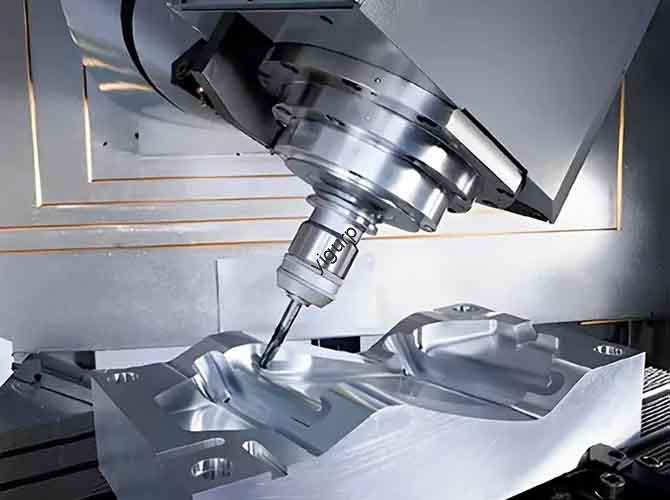
Si vous avez déjà eu du mal à usiner des matériaux durs comme le titane ou à créer des cavités 3D complexes, tu n'es pas seul. Traditional machining often hits limits with precision and material hardness—but Usinage par électroérosion (GED) change le jeu. Ce processus sans contact utilise des étincelles électriques pour éroder le matériau, et ses différents types sont adaptés aux besoins de fabrication spécifiques. Let’s break down the 5 key types of EDM, with real-world examples and critical details to help you choose the right one.
What Is Electric Discharge Machining (GED)?
Before diving into types, let’s cover the basics. EDM works by creating repeated electrical sparks between an electrode and a conductive workpiece, both submerged in a dielectric fluid. The sparks generate heat (up to 10,000°C) that melts and vaporizes tiny bits of material, while the dielectric cools the area and flushes away debris . It’s ideal for tight tolerances (often ≤±2 µm) and hard materials—no mechanical force means zero workpiece distortion .
1. EDM à plomb (Bélier EDM): For Complex 3D Cavities
What it is: Also called Die Sinking ou Cavity EDM, this type uses a custom-shaped electrode (généralement Graphite Electrode ou Copper Electrode) that acts as a “negative” of the desired shape. The electrode is lowered into the workpiece, eroding material to form cavities . It uses EDM Oil as dielectric, which aids in Mirror Finishing pour surfaces lisses.
Real-world case: A mold maker for automotive interiors needed a 3D cavity with intricate undercuts for a dashboard component. Using a Vertical EDM machine and graphite electrode, they achieved a Ra 0.2 µm surface finish—eliminating post-machining polishing and cutting lead time by 25% .
Idéal pour: Mold/die manufacturing, composants aérospatiaux, and any part requiring Complex Cavities.
2. Électroérosion à fil: For Precise 2D & Tapered Cuts
What it is: Known as Wire Cut EDM ou Traveling Wire EDM, this process uses a thin, moving wire (typiquement Brass Wire ou Molybdenum Wire) as the electrode. Guided by Wire Guides, the wire cuts along a CNC-programmed path. Deionized Water serves as dielectric, et Skim Cuts refine the finish . It excels at Taper Cutting (angles up to 30°) et Through-hole Cutting.
Key data: The global EDM wire market is projected to grow from \(2.47 milliards en 2024 à \)3.33 billion by 2029 (CAGR 6.7%), driven by demand for automotive and medical parts .
Real-world case: A medical device manufacturer needed 0.5mm-thick titanium surgical blades with sharp edges. En utilisant EDM à fil CNC, they achieved ±1 µm tolerance—critical for ensuring consistent cutting performance in surgeries .
Idéal pour: Punches/dies, pièces de précision, and large/thick workpieces.
3. Hole Drilling EDM (Fast Hole EDM): For Small, Deep Holes
What it is: Also called Small Hole EDM, this type uses a Hollow Electrode to drill tiny holes (aussi petit que 0,1 mm) in hard materials. Haut Flushing Pressure pushes dielectric through the electrode to remove debris quickly—hence “Fast Hole Drilling” .
Real-world case: An aerospace supplier needed 100+ Coolant Holes in a turbine blade (Inconel 718, a superalloy). Using Hole Drilling EDM, they drilled 2mm-deep holes in 12 seconds each—far faster than laser drilling, with no thermal damage to the blade .
Idéal pour: Aubes de turbines, Starter Holes for Wire EDM, and parts requiring holes in Hard Materials.
4. Micro EDM (μEDM): For Miniature Components
What it is: Specialized for Micro-Machining, this type creates features like Micro-Holes (down to 0.08mm) et Micro-Gears using tiny Micro-Electrodes et RC Circuit technology for precise spark control . It delivers Haute précision (±0.1 µm) critical for small parts.
Real-world case: A company making pacemakers needed 0.1mm Micro-Holes in a titanium housing for wire leads. Using μEDM, they produced 500+ units without a single defect—meeting strict medical device standards .
Idéal pour: Dispositifs médicaux, wearable technology, and micro-optics.
5. EDM Milling: For Flexible 3D Shaping
What it is: Combining elements of sinker EDM and milling, this type (also Die-Sinking EDM Milling) uses simple Cylindrical Electrodes instead of custom shapes. The electrode moves along a Tool Path, en utilisant Layer-by-Layer Machining to build complex shapes. Electrode Wear Compensation ensures accuracy .
Real-world case: A robotics firm needed a complex 3D gear housing. En utilisant CNC EDM Milling, they avoided expensive custom electrodes—saving $3,000 per part—and adjusted the tool path mid-process to fix a design error, reducing scrap by 40% .
Idéal pour: Prototypage, complex 3D shapes, et production en faible volume.
EDM Type Comparison: Which Should You Choose?
| Feature | EDM à plomb | Électroérosion à fil | Hole Drilling EDM | Micro EDM | EDM Milling |
| Electrode | Custom-shaped (graphite/cuivre) | Thin wire (brass/molybdenum) | Hollow tube | Micro-rod (≤0.1mm) | Cylindrique (simple) |
| Tolérance | ±2–5 µm | ±0.5–2 µm | ±1–3 µm | ±0.1–1 µm | ±1–4 µm |
| Dielectric | EDM Oil | Deionized Water | Deionized Water/EDM Oil | Deionized Water | EDM Oil |
| Key Strength | 3D cavities | 2D precision/tapers | Small/deep holes | Miniature features | Flexible 3D shaping |
| Typical Application | Cavités de moisissures | Surgical blades | Turbine coolant holes | Pacemaker parts | Robot housings |
2025 EDM Trends: What Manufacturers Need to Know
The EDM industry is evolving fast—here are two key trends:
- IA & Automation: Machines now use AI to adjust parameters in real time (reducing manual work by 40%) and predict maintenance, boosting uptime by 30% .
- Durabilité: Eco-friendly dielectric fluids and energy-efficient machines are becoming standard, helping manufacturers cut carbon footprints and costs .
Yigu Technology’s Perspective
Electric Discharge Machining is no longer just a “precision tool”—it’s a driver of innovation across industries. Chez Yigu Technologie, we’ve seen how pairing the right EDM type with smart technology transforms production: Micro EDM, Par exemple, has enabled our medical clients to shrink device sizes by 50% without losing functionality. The key is matching the process to the part: Sinker EDM for cavities, Wire EDM for precision cuts, and EDM Milling for flexibility. As AI integrates deeper, we’ll see even faster, more reliable EDM—making it accessible for small-batch and custom manufacturing too.
FAQ
1. Can EDM machine non-conductive materials?
No—EDM requires the workpiece to be conductive (par ex., acier, titane, cuivre). For non-conductive materials (like ceramics), consider laser machining.
2. Which EDM type is cheapest?
EDM Milling is often more cost-effective for low-volume runs because it uses simple, reusable electrodes (no custom tooling like Sinker EDM).
3. How does electrode material affect performance?
Graphite electrodes are cheaper and handle high temperatures well (great for large cavities), while copper electrodes offer better precision (ideal for small, pièces détaillées) .
4. What’s the smallest feature EDM can create?
Micro EDM can produce Micro-Holes as small as 0.08mm and Micro-Gears with tooth pitches under 0.1mm .