
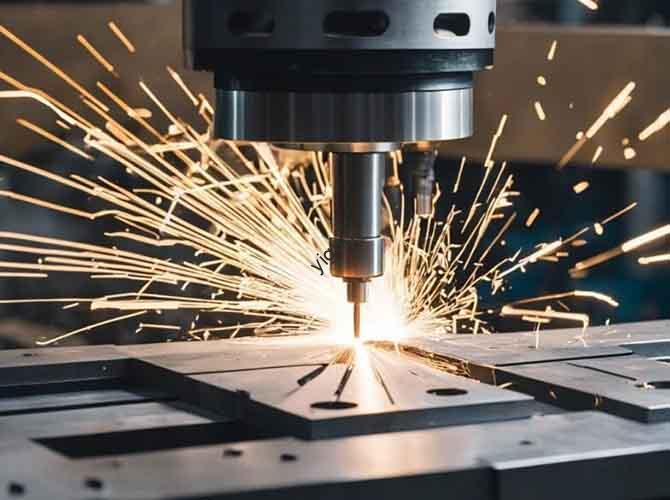
Si vous avez déjà eu du mal à choisir le bon acier pour un projet, j'ai vu un outil s'user trop vite, ou s'est battu pour obtenir une finition lisse, tu n'es pas seul. Le fraisage de l'acier est un équilibre de connaissances sur les matériaux, sélection d'outils, et une stratégie intelligente, mais cela ne doit pas nécessairement être écrasant. This guide takes you from basics to pro tips, with real-world examples to solve your biggest pain points.
1. Choosing the Right Steel: Machinability Breakdown
The first rule of successful steel milling? Start with the right material. Not all steels behave the same, and picking the wrong one can ruin tool life or finish quality. Let’s break down the most common types and how to work with them.
Key Steel Types & Machinability Ratings
Machinability Rating compares a material’s ease of machining to Acier au carbone (set at 100). Here’s how popular steels stack up:
| Steel Type | Indice d'usinabilité | Dureté (CRH) | Idéal pour | Pro Tips |
| Acier doux | 80-100 | 12-18 | Pièces structurelles, parenthèses | Use higher speeds; low power needs |
| Acier au carbone | 100 (benchmark) | 15-25 | Engrenages, arbres | Balanced speed/feed; minimal coolant needed |
| Acier allié | 60-80 | 20-35 | Composants automobiles, outils | Use coated tools; adjust for alloy content |
| Acier inoxydable | 50-70 | 18-28 | Food equipment, pièces médicales | Vitesses lentes; heavy feeds to avoid work hardening |
| Acier à outils | 30-50 | 30-60 | Meurt, outils de coupe | Pre-hardened grades reduce post-machining heat treatment |
Real-World Example: Stainless Steel Headaches Solved
A food equipment manufacturer I worked with kept failing at milling Austenitic Stainless Steel (304 grade). Their tools galled, chips were stringy, and parts had burn marks. The issue? They used the same parameters as for carbon steel.
Nous sommes passés à:
- UN positive rake carbide end mill avec un chip breaker design
- Cutting speed reduced from 300 SFM to 150 SFM
- Increased feed per tooth from 0.002 IPT to 0.005 IPT
- Through-spindle coolant (emulsion) à 50 psi
Résultat: Tool life doubled, and burn marks disappeared. The fix worked because austenitic stainless has low thermal conductivity—slow speeds prevent overheating, and chip breakers handle its ductile nature .
2. Outils de fraisage & Insertions: Pick What Works for Your Steel
The right tool turns a frustrating job into a smooth one. Let’s cut through the jargon to find your best match.
Tool Material Basics
- High-Speed Steel (HSS): Great for Acier doux or low-volume jobs. Affordable but wears fast at high speeds.
- Carbide End Mills: The workhorse for most steels. Idéal pour Acier allié et Acier inoxydable—handles heat and wear better than HSS.
- Cermet Inserts: Perfect for finishing Acier à outils or hard materials (jusqu'à 45 CRH). More brittle than carbide, so use light cuts.
Revêtement & Géométrie: Small Details, Big Impact
Coatings extend tool life by reducing friction and heat:
- Étain (Titanium Nitride): Good for Acier au carbone—low cost, basic wear resistance.
- TiCN (Titanium Carbonitride): Better for Acier allié—harder than TiN.
- AlTiN (Aluminum Titanium Nitride): Top choice for Acier inoxydable and high-temp jobs—resists oxidation up to 1,100°F.
For geometry, variable helix end mills fight chatter (vibration) dans Slot Milling, alors que wiper inserts boost surface finish in Fraisage du visage.
3. Milling Operations & Strategies: From Roughing to Finishing
Your strategy depends on whether you’re removing bulk material (roughing) or refining the surface (finition). Let’s compare the most useful techniques.
Common Operations: When to Use Each
| Operation | But | Idéal pour | Key Tip |
| Fraisage du visage | Create flat surfaces | Large workpieces (par ex., blocs moteurs) | Utiliser wiper inserts for Ra < 1.6 μm finish |
| Shoulder Milling | Cut square edges/stepped surfaces | Supports, cadres | Keep radial depth of cut ≤ 50% of tool diameter |
| Trochoidal Milling | Fast material removal with low force | Acier inoxydable or tough alloys | Reduces tool wear by spreading load |
| High-Efficiency Milling (HEM) | Maximize speed without overloading | Grand volume Acier allié parties | Uses constant chip load—cuts cycle time by 30%+ |
Étude de cas: HEM Cuts Costs for Oil & Gas Parts
An oil & gas manufacturer wanted to speed up milling acier à faible teneur en carbone composants. They switched from conventional roughing to HEM with a 5-flute carbide end mill (AlTiN coating).
Résultats :
- Cutting speed (SFM) jumped from 280 à 450
- Cycle time dropped from 2.55 minutes pour 1.8 mins per part
- Annual savings: $870 + 1.5 hours of machine time
The secret? HEM uses adaptive toolpaths that keep the tool engaged consistently, reducing heat and wear.
4. Paramètres d'usinage: Get Speeds & Feeds Right
Even the best tool fails with bad parameters. Let’s demystify the numbers that matter.
Core Parameters Explained
- Cutting Speed (SFM): How fast the tool moves across the steel (surface feet per minute).
- Feed per Tooth (IPT): How much material the tool removes per tooth (inches per tooth).
- Axial/Radial Depth of Cut: How deep/wide the tool cuts into the steel.
Quick-Reference Parameter Chart
| Steel Type | Cutting Speed (SFM) | Feed per Tooth (IPT) | Axial Depth of Cut |
| Acier doux | 300-500 | 0.003-0.005 | Up to tool diameter |
| Acier au carbone | 250-400 | 0.002-0.004 | 2× tool diameter |
| Acier inoxydable | 100-200 | 0.004-0.006 | 0.5× tool diameter |
| Acier à outils | 150-250 | 0.001-0.003 | 0.25× tool diameter |
Power & Installation: Don’t Overlook the Basics
- Horsepower Requirements: Usinage acier dur (40+ CRH) besoins 50% more power than Acier doux . Use the formula:
PC (kW) = (ap × f × vc × kc) ÷ (60 × 10³ × η)
Exemple: Milling mild steel at 120 m/min needs 4.65 kW .
- Rigid Setup: Loose clamps cause chatter. Use fixtures or vises with 3x the workpiece weight for stability.
5. Fixing Surface Finish Issues: Troubleshoot Like a Pro
A rough finish or dimensional error usually traces to one of these problems. Here’s how to fix them.
Problèmes courants & Solutions
| Problème | Cause | Solution |
| Built-Up Edge (BUE) | Low cutting speed; poor coolant | Increase SFM; switch to emulsion coolant |
| Chatter/Vibration | Unbalanced tool; wrong spindle speed | Utiliser variable helix tool; adjust speed to 1,000-4,000 RPM |
| Tool Wear (Flank/Crater) | High heat; wrong coating | Switch to AlTiN coating; add through-spindle coolant |
| Burr Formation | Dull tool; low feed rate | Replace tool; increase IPT by 0.001 |
Pro Tip: Prevent Work Hardening
Acier inoxydable et Acier à outils harden when cut too lightly. Always use a depth of cut ≥ 0.015” to avoid “riding” the tool on the workpiece surface .
Yigu Technology’s Perspective
Steel milling success lies in “material-tool-parameter synergy.” Too many shops focus on tools alone, but even premium carbide fails if paired with wrong speeds or a weak setup. We’ve seen manufacturers cut tool costs by 40% just by matching coated inserts to steel type (par ex., AlTiN for stainless) and optimizing HEM toolpaths. As automation grows, integrating real-time coolant and vibration sensors will make these optimizations even easier—turning guesswork into precision.
FAQ: Your Steel Milling Questions Answered
- What’s the best coolant for stainless steel milling?
Emulsion (5-10% huile) works best—it cools and lubricates to prevent BUE. Avoid neat oil, which doesn’t dissipate heat well .
- Climb Milling vs. Conventional Milling: Which is better?
Utiliser Climb Milling pour Acier inoxydable (reduces work hardening) et Conventional Milling for brittle Acier à outils (avoids tool chipping).
- How often should I replace carbide inserts?
Replace when flank wear reaches 0.015” or surface finish degrades—usually after 10-15 parts for Acier allié.
- Can HSS tools mill tool steel?
Oui, but only for low-volume jobs. Carbide or cermet inserts last 5-10x longer.