
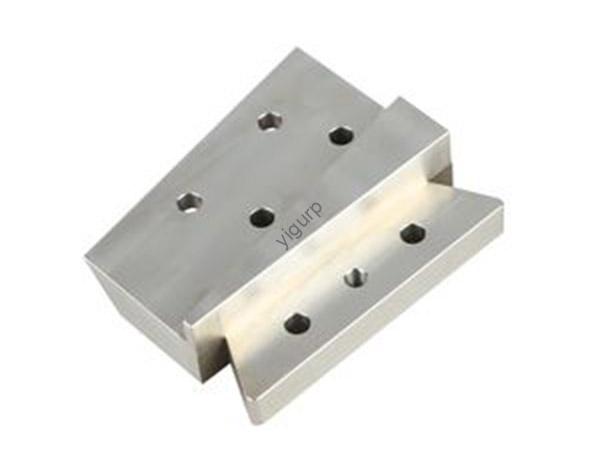
Si vous êtes en génie mécanique, automobile, ou fabrication, L'acier de construction S45C est un matériau de base. En tant qu'acier à teneur moyenne en carbone, ça équilibre la force, usinabilité, et l'abordabilité, mais comment cela fonctionne-t-il pour votre projet? Ce guide détaille ses principales caractéristiques, applications du monde réel, étapes de fabrication, et comment il se compare à d'autres matériaux, pour que vous puissiez prendre des décisions intelligentes.
1. Material Properties of S45C Steel
S45C’s popularity comes from its well-rounded properties. Explorons soncomposition chimique, propriétés physiques, propriétés mécaniques, et d'autres caractéristiques critiques.
1.1 Composition chimique
S45C is defined by its medium carbon content (per JIS G4051 standards). Below is the typical element range:
| Élément | Symbole | Contenu maximum/typique (%) | Fonction clé |
|---|---|---|---|
| Carbone (C) | C | 0.42–0.48 | Main driver of strength and hardness |
| Manganèse (Mn) | Mn | 0.60–0,90 | Improves tensile strength and workability |
| Silicium (Et) | Et | 0.15–0,35 | Améliore la résistance à la chaleur pendant le traitement |
| Soufre (S) | S | ≤0.030 | Minimisé pour éviter la fragilité |
| Phosphore (P.) | P. | ≤0.030 | Limité pour éviter les fissures à froid |
| Chrome (Cr) | Cr | ≤0.20 | Trace amount for minor corrosion resistance |
| Nickel (Dans) | Dans | ≤0.20 | Trace amount for slight toughness boost |
| Molybdène (Mo) | Mo | ≤0.05 | Oligoélément, minimal impact on properties |
| Vanadium (V) | V | ≤0.05 | Oligoélément, no major performance effect |
1.2 Propriétés physiques
These traits affect how S45C behaves in different environments:
- Densité: 7.85 g/cm³ (norme pour les aciers au carbone, easy to calculate part weight)
- Point de fusion: 1495–1530°C (compatible with common heat treatment processes)
- Conductivité thermique: 49 Avec(m·K) à 20°C (good for heat dissipation in machinery)
- Capacité thermique spécifique: 470 J/(kg·K) (gère les changements de température sans dommage)
- Coefficient de dilatation thermique: 13.8 µm/(m·K) (faible expansion, réduisant la déformation dans des températures extrêmes)
1.3 Propriétés mécaniques
S45C’s mechanical strength makes it ideal for load-bearing and wear-resistant parts. Key values (annealed state unless noted):
- Résistance à la traction: 570–700 MPa (handles pulling forces in shafts or gears)
- Limite d'élasticité: ≥335 MPa (resists permanent deformation under pressure)
- Élongation: ≥15% (flexible enough for shaping into simple components)
- Dureté: 160–200 Brinell (recuit); jusqu'à 55 CRH (after quenching/tempering)
- Résistance aux chocs: ≥30 J at 20°C (moderate toughness—best for non-cold environments)
1.4 Autres propriétés
- Résistance à la corrosion: Faible (prone to rust; needs painting, galvanisation, or oiling for protection)
- Soudabilité: Modéré (requires preheating to 150–250°C to avoid cracking; post-weld annealing recommended)
- Usinabilité: Bien (facilement percé, tourné, or milled with standard tools—best in annealed state)
- Propriétés magnétiques: Ferromagnétique (répond aux aimants, utile pour le tri industriel)
- Ductilité: Modéré (can be bent or forged into shapes but less flexible than low-carbon steels)
2. Applications of S45C Structural Steel
S45C’s balance of strength and machinability makes it versatile across industries. Voici des exemples concrets:
2.1 Génie mécanique
- Arbres: Industrial motor shafts use S45C—its tensile strength (570–700 MPa) handles high-speed rotation, and post-heat treatment boosts wear resistance.
- Engrenages: Small to medium-sized gears (par ex., dans les systèmes de convoyeurs) use S45C—its hardness (after tempering) résiste à l'usure des dents.
- Roulements: Bearing races for low-load machinery use S45C—its machinability ensures precise dimensions.
2.2 Automobile
- Composants de transmission: Manual transmission gears in compact cars (par ex., Honda Civic) use S45C—its strength endures constant gear meshing.
- Pièces de moteur: Camshafts for small engines (par ex., tondeuses à gazon) use S45C—heat treatment improves surface hardness for wear resistance.
- Pièces de suspension: Shock absorber rods use S45C—its yield strength prevents bending under road impacts.
2.3 Autres applications
- Équipement minier: Small drill bits for light mining use S45C—heat treatment boosts hardness for rock drilling.
- Machines agricoles: Tractor axle pins use S45C—its strength handles heavy loads from plowing.
- Systèmes de tuyauterie: Low-pressure industrial pipes (par ex., for water transport) use S45C—its machinability allows easy threading.
2.4 Construction (Limited Use)
S45C is rarely used for large construction projects (due to low corrosion resistance), but it works for small components like:
- Handrail brackets in indoor industrial buildings
- Small support pins for conveyor systems in factories
3. Manufacturing Techniques for S45C Steel
Producing high-quality S45C requires careful control of carbon content and processing. Voici le processus étape par étape:
3.1 Production primaire
- Four à arc électrique (AEP): Méthode la plus courante : la ferraille est fondue à 1 600 °C., then carbon and manganese are added to reach the 0.42–0.48% C range.
- Four à oxygène de base (BOF): Utilisé pour les gros lots : le minerai de fer est converti en acier, then carbon is adjusted to meet S45C standards.
- Coulée continue: L'acier en fusion est coulé dans des moules pour former des dalles, fleurit, ou billettes (raw material for secondary processing).
3.2 Traitement secondaire
- Laminage à chaud: Slabs are heated to 1100–1200°C and rolled into bars, tiges, or plates—this improves strength and workability.
- Laminage à froid: Pour pièces de précision (par ex., arbres minces), cold rolling increases surface smoothness and hardness.
- Traitement thermique: Critical for S45C performance:
- Recuit: Heating to 820–860°C, cooling slowly—softens steel for machinability.
- Quenching/tempering: Heating to 820–860°C, quenching in water/oil, then tempering at 500–600°C—boosts hardness and toughness.
- Traitement de surface: Galvanisation (pour les parties extérieures), peinture (for indoor parts), ou huilage (for moving parts like gears) pour éviter la rouille.
3.3 Contrôle de qualité
To meet JIS G4051 standards, every batch of S45C is tested:
- Analyse chimique: Spectrometers check carbon and alloy content to ensure compliance.
- Essais mécaniques: Les tests de traction mesurent la résistance; hardness tests verify Brinell/HRC values.
- Contrôles non destructifs (CND): Les tests par ultrasons détectent les fissures internes; magnetic particle testing checks surface flaws.
- Contrôle dimensionnel: Calipers and lasers ensure bars/plates match size specifications.
4. How S45C Compares to Other Materials
Choosing S45C depends on cost, force, et les besoins du projet. Voici comment cela se compare:
4.1 Comparaison avec d'autres aciers
| Matériel | Teneur en carbone (%) | Résistance à la traction (MPa) | Résistance à la corrosion | Coût par rapport. S45C | Idéal pour |
|---|---|---|---|---|---|
| S45C Steel | 0.42–0.48 | 570–700 | Faible | Base (100%) | Engrenages, arbres, petites pièces mécaniques |
| Acier à faible teneur en carbone (S10C) | 0.08–0,12 | 320–450 | Faible | 80% | Welded parts (par ex., parenthèses) |
| Acier à haute résistance (S690QL) | 0.18 | 770–940 | Modéré | 220% | Structures lourdes (par ex., poutres de pont) |
| Acier inoxydable (304) | 0.08 | 515 | Excellent | 350% | Environnements corrosifs (par ex., chemical parts) |
4.2 Comparaison avec les métaux non ferreux
- Aluminium (6061-T6): L'aluminium est plus léger (densité 2.7 g/cm³ contre. 7.85 g/cm³) mais plus faible (résistance à la traction 310 MPa contre. 570–700 MPa)—use S45C for high-strength mechanical parts.
- Cuivre: Le cuivre est plus conducteur mais plus doux (résistance à la traction 220 MPa) and pricier—S45C is better for load-bearing use, not electrical components.
4.3 Comparaison avec les matériaux composites
- Polymères renforcés de fibres (PRF): Le FRP est plus léger et résistant à la corrosion mais a une résistance à la traction inférieure (300 MPa contre. 570–700 MPa)—S45C is more reliable for wear-resistant parts like gears.
- Composites en fibre de carbone: Carbon fiber is stronger (résistance à la traction 3000 MPa) but costs 8x more—use it for aerospace; S45C is the economical choice for industrial machinery.
5. Yigu Technology’s View on S45C Structural Steel
Chez Yigu Technologie, S45C is our go-to for medium-strength mechanical parts. Its balance of machinability, force, and cost makes it perfect for gears, arbres, et composants automobiles. We recommend annealing it for easy processing and quenching/tempering for wear resistance. For corrosion protection, we pair it with our zinc-plating service, extending part life by 20–25%. While it’s not ideal for cold or corrosive environments, it’s unmatched for affordable, reliable industrial parts.
FAQ About S45C Structural Steel
- Can S45C be used in cold climates?
Non, not recommended. Its impact toughness drops in low temps (≥30 J at 20°C, lower at -10°C+), so it may crack under stress. Use cold-resistant steels like S355JR for cold environments. - Do I need to preheat S45C before welding?
Oui. Preheat to 150–250°C to prevent hydrogen cracking. Après soudage, anneal at 600–650°C to reduce internal stress—this ensures the weld joint stays strong. - How does S45C differ from S45C-Mn?
S45C-Mn has higher manganese (1.00–1.30% vs. 0.60–0.90% for S45C), boosting tensile strength (620–750 MPa vs. 570–700 MPa). Use S45C-Mn for parts needing extra strength; S45C for standard applications.